When people hear the phrase pre-Hispanic cuisine, they often picture something distant. They think of museum pieces, ancient markets, or dishes recreated for cultural events. It can sound like a subject for historians, archaeologists, or chefs trying to revive the past.
But that is not really the point historian José Luis Curiel Monteagudo is making.
His argument is simpler and more interesting. Pre-Hispanic food culture in Mexico did not disappear. It never really left. It is still part of daily life, still sitting on kitchen counters, still sold in markets, and still eaten on the street every morning. You can see it in tortillas, tamales, atole, nopales, and salsas ground in stone. You can see it in the way corn is prepared, the tools people still use, and the foods that remain so common that many people barely stop to think about them.
That is what makes the subject worth a closer look. This is not only a story about the past. It is a story about what millions of people in Mexico still eat, cook, buy, and recognize every day.
The big idea is not that Mexican food never changed
Curiel’s point is not that Mexican cooking stayed frozen in time. No serious historian would argue that. Mexican food changed significantly after the Spanish conquest and continued to evolve. New animals, new grains, new cooking habits, global trade, industrial food production, supermarkets, and modern urban life all reshaped the national diet.
But underneath those changes, a very old base remained.
That base is made up of ingredients, techniques, and food habits that predate the conquest by centuries. Corn is at the center of it, along with beans and chiles. So are foods like tamales, atole, and nopales. So are tools like the metate and molcajete. So is nixtamalization, the alkaline cooking process that turns dried maize into nixtamal and then masa. These are not fringe survivals. They are part of how the country still feeds itself.
That is why Curiel’s argument matters. He is asking readers to stop thinking of pre-Hispanic cuisine as something rare or ceremonial. In many cases, it is the food right in front of them.
The easiest place to see it is the tortilla
If you want the clearest proof that old foodways are still alive in Mexico, start with the tortilla.
It is hard to think of any other food that connects the country’s deep past to daily life more clearly than this one. Tortillas are everywhere. They are eaten at breakfast, lunch, and dinner. They are used at formal meals and simple home meals. They show up in restaurants, lunch counters, street stands, markets, and family kitchens. For millions of people, they are not a side item. They are the center of the meal.
That matters because the tortilla is not just a flat piece of corn dough. It is the end result of a much older system. Behind it is maize cultivation, the handling of dried kernels, nixtamalization, grinding, shaping, and cooking on a hot surface. Even when parts of that process are now industrialized, the basic chain still traces back to an old Mesoamerican food system.
The numbers also show how central tortillas remain. Studies and consumer data in Mexico have found that annual per-person tortilla consumption remains very high, and that the vast majority of Mexican households still spend part of their food budget on corn tortillas. In other words, this is not a symbolic food. It is still a mass daily staple.
That is what makes the tortilla such an important part of this conversation. It is not a relic. It is living evidence.
What survives is not only the food, but the know-how behind it
One of the best ways to understand the survival of pre-Hispanic food culture is to stop looking only at dishes and start looking at technique.
A lot of older food knowledge survives because it still works.
Take nixtamalization. It may sound technical, but most readers have already benefited from it, even if they have never heard the word before. This is the process of cooking and soaking maize in an alkaline solution, usually with lime, before grinding it into masa. It improves the texture of the dough, changes flavor, helps with digestion, and increases the availability of certain nutrients.
That is a remarkable example of old practical knowledge surviving into the present. It shows that pre-Hispanic food culture was not simply a matter of ingredients. It was also a matter of food science, even if nobody would have called it that at the time.
So when someone eats tortillas, tamales, sopes, or other masa-based foods today, they are often eating the result of a process developed long before modern Mexico existed as a nation.
That is one reason the conversation matters. The continuity is not only visual. It is built into the way staple foods are still made possible.
Ancient does not mean primitive
This is where the subject often gets misunderstood.
People sometimes hear words like pre-Hispanic and assume they refer to something basic, undeveloped, or crude. But many of these techniques were highly effective and incredibly durable. They lasted because they solved real problems and fit daily life.
Nixtamalization is one example. Stone grinding is another. Cooking on the comal is another. These methods survived for so long because they produced results people valued. They gave the right texture, the right taste, and the right kind of food for daily use.
Even when modern life changes the process, it does not always erase the older logic behind it. A family may buy masa instead of grinding corn at home. A tortillería may use machinery instead of hand grinding. Packaged tortillas may replace handmade ones for convenience. But the maize-and-lime system behind the staple often remains.
That is important because survival does not always mean doing everything the same way people did centuries ago. Sometimes it means the old structure remains, even when the labor, setting, or speed has changed.
The old tools never fully went away
Curiel also points to something that many people in Mexico already know without thinking too much about it: the old tools are still around.
The metate and the molcajete are some of the clearest examples.
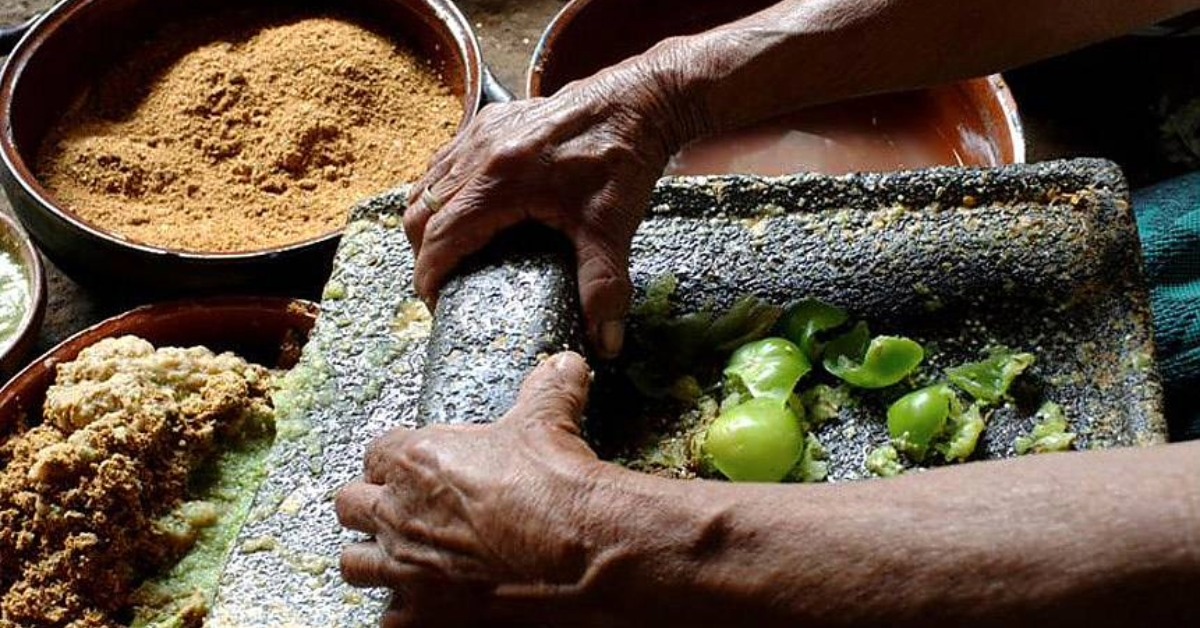
A metate is the stone surface used for grinding grain by hand. A molcajete is the stone mortar used to grind chiles, herbs, and other ingredients into salsas and pastes. These are not just decorative symbols of “traditional Mexico.” In many households, they are still used, and in many others, they remain familiar objects, whether passed down, bought at market, or kept for specific types of cooking.
That matters because tools carry food culture with them. A salsa made in a blender is not exactly the same as one made in a molcajete. The texture changes. The flavor can change. The rhythm of preparation changes, too. The same goes for grinding, mashing, and cooking methods that shape the final dish.
In that sense, the survival of pre-Hispanic cuisine is not only visible in ingredients. It is also visible in kitchen hardware. Stone, clay, fire, and handwork still have a place in Mexican cooking, even in a country where industrial food is common and time is short.
Tamales and atole show how old food habits stay practical
Another reason Curiel’s argument feels convincing is that the foods he points to are so ordinary.
Tamales and atole are not rare cultural performances. They are practical foods. They travel well. They fit mornings. They fit busy schedules. They fit home cooking and street vending. They are filling, familiar, and easy to recognize.
That helps explain why they endured.
Tamales are portable and flexible. They can be simple or elaborate, festive or everyday. They can be eaten on the move or shared at gatherings. Atole works in a similar way. It is warm, filling, and tied to routines that still make sense, especially in the morning.
Anyone who has spent time around markets, bus stops, neighborhood corners, or transit hubs in Mexico has seen how these foods remain woven into daily life. They are not sold as historical artifacts. They are sold because people still want them.
That may be one of the strongest points in the whole discussion. Old foodways often survive not because people sit around consciously preserving them, but because they continue to fit real life.
Nopales are another example hiding in plain sight
Then there is nopal.
For many people, nopales are simply a normal ingredient. They are sold cleaned and cut in markets. They appear in salads, stews, tacos, and home cooking. They are inexpensive, familiar, and deeply tied to Mexican landscapes and eating habits.
That is exactly why they matter in this conversation.
Nopal is one of those foods that shows how pre-Hispanic continuity can be right out in the open without calling attention to itself. It does not need a heritage label to prove anything. It is already present in everyday commerce and everyday meals.
This is one of the reasons the topic becomes more interesting the closer you get to the ordinary. The strongest evidence is often not found in luxury tasting menus or special culinary projects. It is found in the market aisle, in the breakfast routine, in the kitchen sink, and on the comal.
UNESCO sees Mexican cuisine as a living system, not a museum display
Curiel’s view also aligns with how major cultural institutions talk about Mexican cuisine.
When UNESCO recognized traditional Mexican cuisine as Intangible Cultural Heritage, it did not describe it as a frozen collection of recipes. It described it as a living cultural model. That matters because it shifts the focus away from nostalgia and toward continuity.
In that view, Mexican cuisine is not just about what ends up on the plate. It includes the field, the farming system, the ingredients, the preparation methods, the tools, and the shared knowledge passed through communities and families.
That is a useful way to think about this subject. A tortilla is not just a tortilla. It is part of a chain that starts much earlier. So is a tamal. So is a bowl of atole. So is salsa made with ground chile. The food on the table is the visible part of something larger.
And once readers begin looking at it that way, the old layers in Mexican daily life become much easier to see.
Modern life has not erased this older layer
None of this means the modern Mexican diet is untouched.
Far from it.
Processed foods occupy much more space than they once did. Supermarkets changed buying habits. Packaged snacks, sugary drinks, fast food, and ultra-processed products are now part of ordinary life too. Urban routines have shortened cooking time. Many people no longer make tortillas from scratch at home. Many younger generations learn only parts of older food processes, not the whole chain.
So yes, the food landscape changed. In some places, it changed dramatically.
But that does not cancel Curiel’s point. It actually helps define it more clearly. The old layer survives not because nothing else arrived, but because it remained underneath and alongside those newer layers. Mexico’s food culture today is mixed, modern, and heavily influenced by industrial life, but it still rests on a much older foundation.
That is why tortillas still matter so much. That is why masa still matters. That is why tamales, atole, nopales, molcajetes, and stone-ground salsas still matter. They are part of the older framework that kept going even as the country modernized.
Survival can look quiet
One reason this topic is easy to miss is that survival is often not dramatic.
It does not always announce itself as heritage. It does not always come with a historical explanation. It can look ordinary. It can look like breakfast. It can look like someone buying nopales at the market or picking up tamales on the way to work. It can look like a grandmother using a molcajete because she prefers the texture. It can look like tortillas on the table at nearly every meal.
That is probably the strongest insight in Curiel’s argument.
The most important part of pre-Hispanic cuisine in Mexico may not be the ceremonial or the rare. It may be the food people encounter so often that they barely stop to notice how old the system behind it really is.
Why this matters for readers living in Mexico
For expats, retirees, and other residents of Mexico, this is more than a food-history lesson.
It is a different way of seeing the country around them.
A lot of coverage of Mexican food leans heavily on restaurants, celebrity chefs, travel writing, or the search for the “best” regional dish. There is nothing wrong with that, but it can push readers toward the spectacular and away from the everyday. Curiel’s argument moves in the opposite direction. It says the real story may be sitting in the food people eat constantly, not the ones they save for special occasions or culinary tours.
That is a useful reminder. If someone wants to understand Mexican food culture more deeply, they do not need to begin with fine dining or rare dishes. They can begin with tortillas, tamales, atole, nopales, beans, chiles, and the tools and techniques that still shape them.
That is where continuity is easiest to spot.
The everyday table is where the history lives
So how much of Mexico’s oldest food culture still survives?
Quite a lot, if you know where to look.
It survives in the tortilla basket. It survives in the tamal pot. It survives in a cup of atole on a busy morning. It survives in masa, in nopales, in stone-ground salsa, in the comal, and in kitchen tools that refuse to become obsolete. It survives in the routines of markets, homes, and street vendors. It survives not because the country never changed, but because some of its deepest food foundations proved strong enough to last through all that change.
That may be the best way to understand pre-Hispanic cuisine in Mexico today. It is not only the story of what people ate long ago. It is also the story of what still feels normal now.
And that is exactly why it matters.