In Mexico, an airline-caused delay can trigger passenger rights after the first hour. Once a delay exceeds four hours, passengers may have refund, rebooking, care, and compensation options that go well beyond a gate agent’s apology.
For Puerto Vallarta travelers, that makes the last check before leaving for Licenciado Gustavo Díaz Ordaz International Airport more than a habit. PVR’s flight board can look calm in the morning and change by lunchtime, especially during the rainy season or when a late aircraft arrives from a busy hub such as Mexico City, Dallas, Houston, Atlanta, Los Angeles, Calgary, or Vancouver.
The safest approach is simple. Check your flight in more than one place before calling the taxi, but do not assume a posted delay means you can ignore the original check-in time unless the airline gives you that instruction in writing.
Start with the airline app or website. That is the source that matters most for rebooking, gate notices, boarding changes, and push alerts. If your flight is delayed, canceled, or rescheduled, the airline account associated with your reservation is usually where the change appears first.
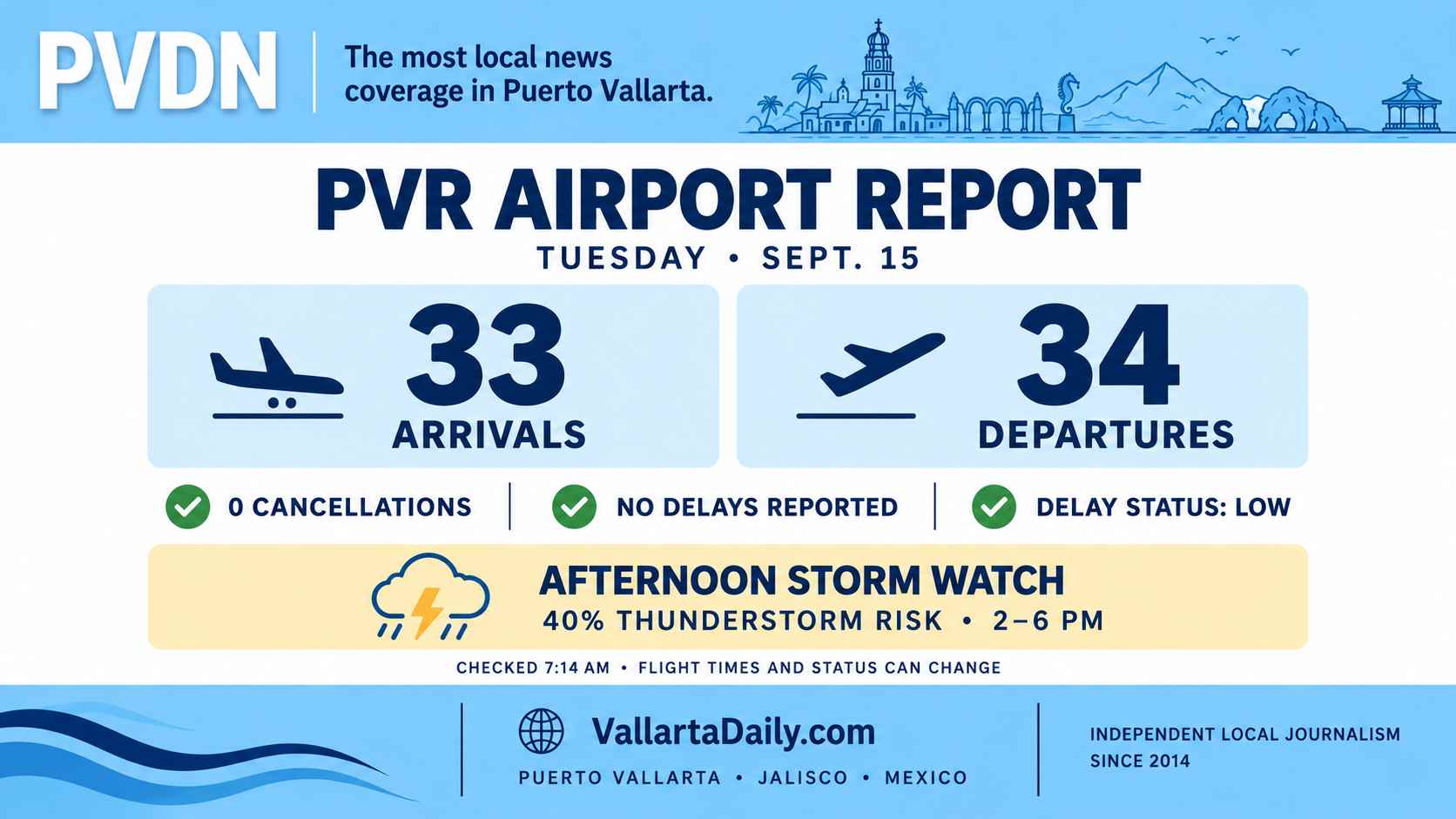
Then check the airport board. Grupo Aeroportuario del Pacífico, the operator of Puerto Vallarta’s airport, keeps a Puerto Vallarta flight information board for arrivals and departures. Look at both sides of the board. A departure delay often starts as an arrival problem when the aircraft scheduled to take you out of Vallarta has not yet reached PVR.
Vallarta Daily also maintains a Puerto Vallarta Airport page featuring the larger airport picture, recent coverage, and daily flight board reporting. The daily PVR flight report is part of that daily watch, meant to help residents, visitors, and property owners see when the public board starts showing delays, cancellations, or unusual status changes.
For a second look, flight-tracking tools such as FlightAware, FlightRadar24, or FlightStats can help you follow the inbound aircraft. These trackers are useful when the airline app still shows “on time,” but the aircraft assigned to your flight is running late elsewhere. Treat those trackers as a warning system, not the final word. The airline still controls boarding and rebooking.
The weather deserves its own check during the summer months. Puerto Vallarta’s rainy season can bring fast afternoon changes, and delays at larger connecting airports can ripple into PVR even when local conditions are fine. Vallarta Daily’s Puerto Vallarta weather guide explains the seasonal pattern, and past storms have already shown how the weather in Mexico City can disrupt flights to and from Puerto Vallarta.
A delay on a screen is not the same as permission to arrive late.
Before changing your airport plan, confirm three things: the airline’s posted departure time, the check-in or bag-drop deadline, and whether the airline has formally changed your boarding time. If those details are unclear, plan around the original schedule.
This matters most for international flights. Check-in counters can close before the delayed departure time, and a flight that was pushed back can sometimes recover part of the delay. Missing the counter because the board looked slow is still your problem unless the airline told you otherwise.
Screenshots help. Save the airline notice, airport-board status, boarding pass, receipts, and any chat or email from customer service. If the delay turns into a compensation claim, documentation is worth more than a memory of what the screen said.
Mexico’s passenger-rights rules are strictest when the delay is attributable to the airline. That can include operational issues such as crew, aircraft, scheduling, maintenance, or other airline-controlled problems. Weather, air traffic restrictions, airport closures, security incidents, and other external factors may affect the compensation owed.
The clock matters.
For airline-caused delays of more than one hour and less than four hours, passengers are entitled to compensation under the airline’s registered policy. That can include discounts on future flights, food, and drinks, as well as access to phone calls or email, depending on the length of the delay and the airline’s policy.
Once the delay is more than two hours but less than four, the compensation cannot be less than 7.5% of the ticket price.
When the delay exceeds four hours, Mexico treats it much like a cancellation for passenger-rights purposes. At that point, the passenger may choose among remedies such as a refund for the unused ticket or unused portion of the trip, transportation on the first available substitute flight, or transportation on a later date that works for the passenger. When the passenger chooses a refund or later transportation, compensation must be at least 25% of the ticket price or the unused part of the trip.
If the airline places the passenger on the first available substitute flight, it must provide basic care while the passenger waits. That can include phone calls or email access, food based on the waiting time, lodging when an overnight stay is needed, and ground transportation between the airport and hotel when applicable.
Profeco maintains a public table of airline compensation policies that travelers can use to compare registered airline policies. It is worth checking the specific carrier because benefits can vary in how they are delivered, even when the legal floor is the same.
Do not start with a complaint. Start with a clear request.
Ask the airline to confirm the reason for the delay and the estimated departure time. If the cause is airline-controlled, ask what compensation applies at the current delay length and what changes if the delay passes two or four hours.
If the flight is canceled or delayed more than four hours, ask the airline to put your options in writing before you accept a voucher. A voucher may be useful if you want to travel with the same airline later, but it should not replace a refund or compensation to which you are legally entitled.
For long delays, ask for meal vouchers before buying food. If an overnight stay becomes necessary, ask the airline to arrange lodging and transportation rather than promising reimbursement later. Keep receipts anyway.
Compensation and indemnity payments are generally due within 10 calendar days after the claim, while food, lodging, and communication support should be handled during the disruption when those services are needed.
If the airline refuses to explain the delay, denies compensation without a clear reason, or pushes only a voucher when you want to understand your legal options, contact Profeco.
Profeco’s air-travel passenger rights guide lays out the basic rules for delays, cancellations, baggage, and other airline issues in Mexico. Travelers can also use Concilianet for online complaints with participating companies, or seek faster help through Conciliaexprés when the airline is enrolled.
Profeco’s consumer phone lines are 55 5568 8722 and 800 468 8722. Have your reservation code, ticket number, route, screenshots, receipts, and the airline’s explanation ready before you call or file.
Check the airline first, then the PVR airport board, then the inbound aircraft if something looks off. Leave for the airport based on the original check-in deadline unless the airline clearly changes it.
Once the delay begins, watch the clock. In Mexico, the difference between one hour, two hours, and four hours can change what the airline owes you. That is the part many travelers miss while they are refreshing the board.