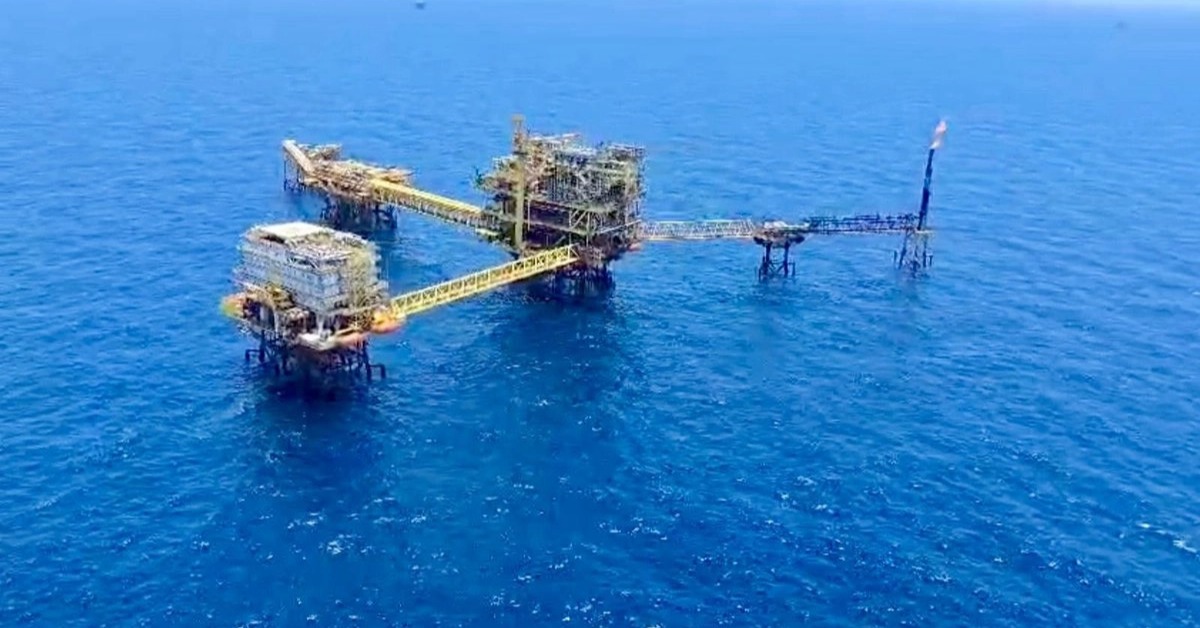
A new aerial inspection over the Gulf of Mexico has added another layer to Mexico’s ongoing oil-spill investigation. Federal inspectors saw hydrocarbon plumes near Cantarell, while Pemex linked the marks to a known natural seep. The finding does not settle the larger questions around the February spill, but it keeps attention on offshore infrastructure, coastal cleanup, fishing communities, and how closely Mexico is monitoring one of its most important oil-producing zones.
New Gulf slicks renew scrutiny of Pemex spill response
Federal environmental inspectors detected hydrocarbon dispersion plumes during an aerial inspection over the Gulf of Mexico, part of the continuing response to the spill that has affected Mexico’s Gulf coast since February.
The inspection was carried out by the Agency for Safety, Energy, and Environment (ASEA), with support from the Navy and Pemex. The flight began at Pemex’s air terminal in Ciudad del Carmen and covered offshore production areas in the Sonda de Campeche.
The new findings do not confirm a new leak. Pemex linked the visible plumes near Cantarell to the area’s chapopotera, a natural seep where hydrocarbons can reach the surface. Still, the inspection keeps the February spill in the public spotlight, especially among coastal communities tied to fishing, tourism, and marine conservation.
What inspectors saw near Cantarell
Inspectors observed plumes near the Akal-C processing area in the Cantarell production asset. Pemex said those marks were associated with the Cantarell natural seep.
A similar plume was seen near Akal-B, where inspectors reported a whitish tone on the water. Additional plumes were also observed nearby, again linked by Pemex to the same natural seep.
In the Batab area, part of the Abkatún-Pol-Chuc production asset, inspectors detected a white-silver plume. Pemex said it had not recorded a loss-of-containment event there and described the mark as coming from Cantarell’s seep activity.
During the flight, inspectors also saw a vessel carrying out mechanical dispersion using water. That work was described as part of the response actions already underway in the area.
Other offshore sites were reviewed
The inspection also covered several Pemex offshore facilities. Authorities reported normal operations at parts of the Ku-Maloob-Zaap production area, including Ku-S, Ku-A, Ku-M, Ku-H, and Zaap-C.
At the Yúum K’ak’ Náab FPSO, inspectors reported normal operations and did not observe surface iridescence. That facility is used to process, store, and transfer hydrocarbons offshore.
At Abkatún-D, inspectors did not report iridescence on the water. They did observe black smoke from a flare, which was associated with the presence of hydrocarbon gases.
The inspection adds to the monitoring record after the February spill, which federal authorities later linked to Pemex infrastructure near Abkatún-Cantarell.
A spill still under review
The Gulf spill has been under scrutiny since hydrocarbons began appearing along parts of the coast earlier this year. Federal findings later tied the incident to a loss of integrity in a 36-inch undersea pipeline known as Old AK C, near the Abkatún-Cantarell area.
The case has raised questions about offshore maintenance, public communication, and how quickly agencies respond when hydrocarbons reach open water. It also led to administrative action inside Pemex and a complaint by ASEA against whoever may be responsible.
Coastal impacts have stretched across hundreds of kilometers of shoreline. The latest inspection account referred to 680 kilometers of affected Mexican coastline since February, while earlier public accounts used lower estimates. The overall picture remains serious, even as cleanup and monitoring continue.
What coastal communities are watching
For people living along Mexico’s Gulf coast, the issue is not only technical. Oil on the water can affect fishing, seafood sales, tourism, turtle nesting sites, and confidence in beach conditions.
The latest flight does not close the case. It shows that federal agencies are still inspecting offshore production areas and trying to distinguish natural seepage activity from possible operational issues.
That distinction matters because Cantarell has both long-standing natural hydrocarbon seepage and major oil infrastructure. When slicks appear in the same region, authorities must show clearly what caused them, what was inspected, and whether any additional risk remains.