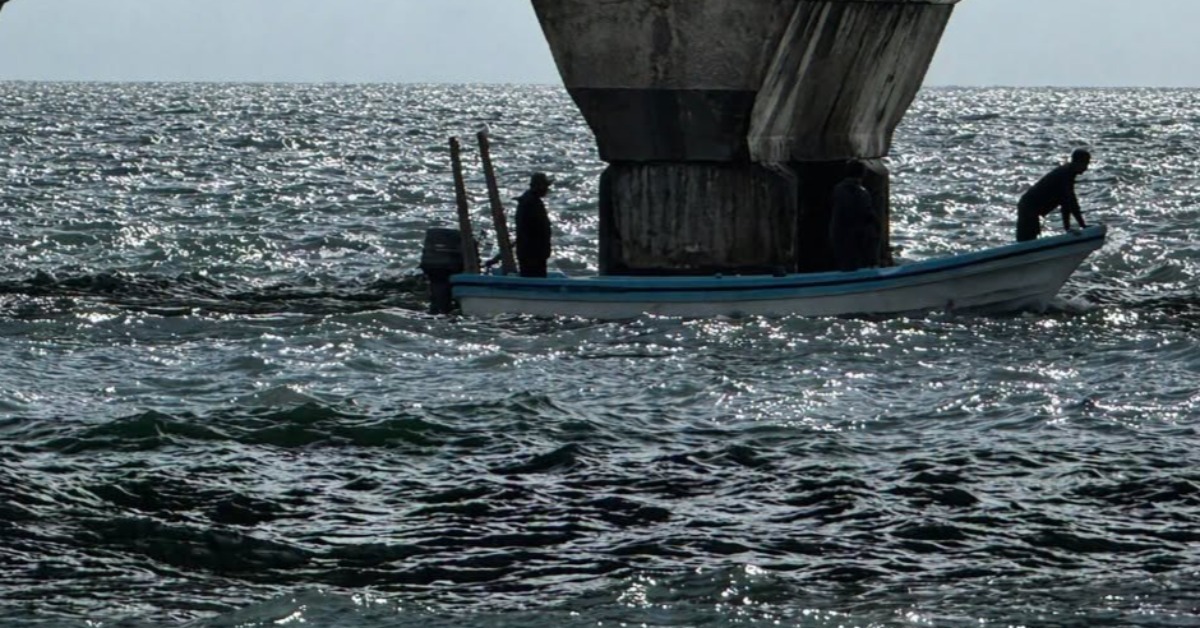
Personnel from the Navy and Pemex worked in waters off Progreso on Monday after hydrocarbon slicks were reported near shore. Local reporting placed one slick about 300 meters from the beach near the fiscal pier and another about 150 meters from shore. Crews deployed orange containment barriers and began inspections in the affected area. By Monday afternoon, authorities still had not publicly confirmed the exact substance or its source.
That uncertainty is central to the story. Residents and fishermen were not describing a problem that appeared out of nowhere that morning. Several said oily residue had been visible for weeks or even months, and that earlier warnings brought little visible action. Their concern is practical, not abstract. Fuel in shallow coastal water can foul nets, push fish away from familiar grounds, and quickly damage confidence in beaches that depend on a clean image.
Other local reports published Monday suggested the suspected leak could involve submerged fuel-transfer infrastructure near the port. That point had not been officially confirmed. For now, the only firm public facts were the visible slicks, the containment effort, and the presence of federal and Pemex personnel offshore.
Why this matters beyond one beach
For many readers outside Yucatán, Progreso is more than a beach town. It is the state’s main port and an important point for maritime commerce and fuel supply. It also depends heavily on fishing, local commerce, and beach activity. That is why even a relatively small slick close to shore can matter.
A spill does not need to be massive to cause disruption. If contamination spreads with currents, it can move from an environmental problem to an economic one in very little time. Fishermen may avoid productive zones. Beachgoers may stay away. Restaurants, vendors, and service businesses can feel the impact long before officials finish identifying the source.
That is also why local concerns focused so quickly on tourism and marine life. In coastal towns like Progreso, those two issues are tightly linked. When the water looks unsafe, the damage reaches beyond the shoreline.
A more sensitive moment for Pemex
This incident is drawing sharper attention because it comes only days after Pemex acknowledged responsibility for a separate spill in the Gulf of Mexico. Federal officials said evidence pointed to a leak in a 36-inch pipeline near Abkatún-Cantarell, first detected on February 8 and repaired by February 18. Three officials were removed after the company said the incident had not been properly reported to senior leadership.
That admission does not prove the Progreso slick came from the same event or even from the same type of infrastructure. No authority had made that connection on Monday. Still, the broader context matters. A coastal contamination report that might once have been treated as a local nuisance now arrives amid a broader debate over oversight, transparency, and response times in the Gulf.
For residents, that changes the threshold for trust. It is no longer enough to place barriers and send personnel to the scene. Authorities will face pressure to explain what was found, how long it may have been happening, whether the slick was fully contained, and what risks remain for the beach and nearby fishing activity.
What remains unanswered
The biggest unanswered question is still the origin of the contamination. Officials had not publicly identified the source of the slick: a pipeline, a vessel, port operations, or another source. They had also not released an estimated volume, environmental monitoring results, or a detailed public timeline.
Those details will determine whether Progreso is dealing with a limited local leak or another sign of deeper problems along the Gulf energy infrastructure. Until then, the scene offshore looks less like a closed incident and more like the start of a larger test. The test is whether authorities can move faster on facts than the slick moves on water.