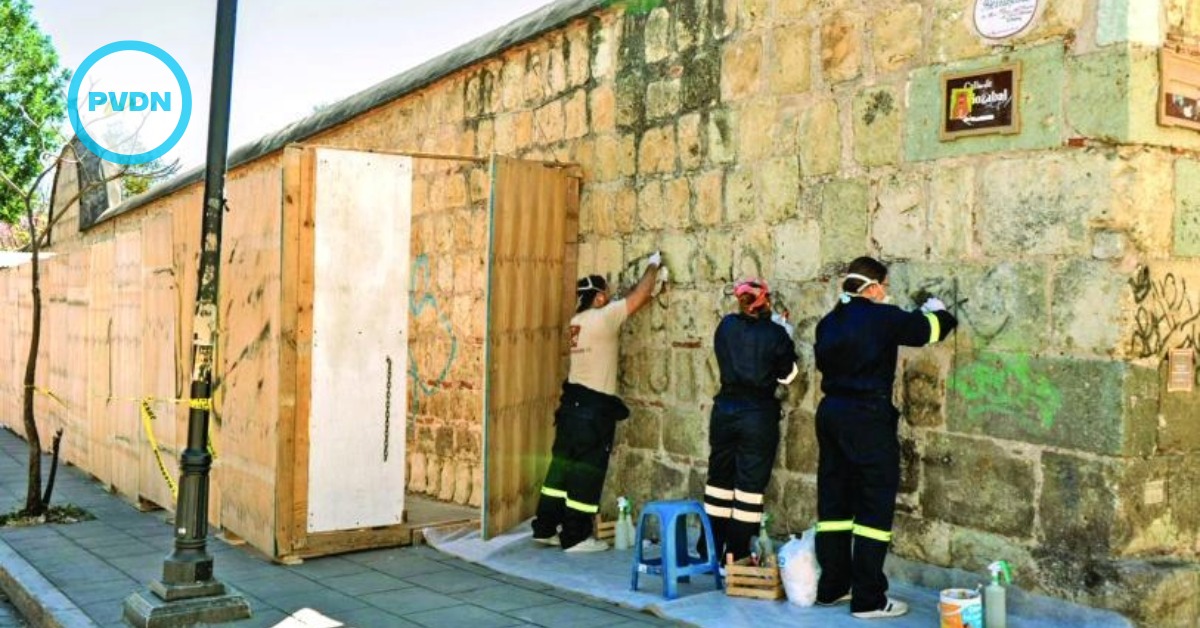
A colonial-era stone wall in Oaxaca’s famed Santo Domingo convent complex has recently been marred by graffiti. But the response is far from a simple cleanup. Mexico’s National Institute of Anthropology and History (INAH) has stepped in with a meticulous restoration plan. As specialists carefully tend to the historic surface, they’re also preserving a record of the graffiti itself — and taking steps to shield the wall from future incidents. The approach reveals a thoughtful balance between protecting heritage and understanding the messages left behind.
Graffiti scrawled across the historic stone perimeter wall of Oaxaca City’s Santo Domingo de Guzmán convent complex is now being carefully erased. Specialists from the National Institute of Anthropology and History (INAH) — the federal body tasked with protecting Mexico’s cultural heritage — have launched a restoration project to repair the damage on this centuries-old wall. The site is one of Oaxaca’s most iconic landmarks: the Ex Convento de Santo Domingo de Guzmán, a 16th-century convent that today houses the Museo de las Culturas de Oaxaca (Museum of Oaxacan Cultures) and forms part of the city’s UNESCO-listed historic center. For many locals and expats alike, the Santo Domingo complex is a beloved piece of Oaxaca’s colonial heritage, making the sight of its walls covered in graffiti especially jarring.
Cleaning Up with Care
The restoration work began on Monday, January 26, and is expected to conclude by April 2026. The project covers roughly 560 square meters of the convent’s perimeter wall along Calle Berriozábal. But rather than rushing in with power washers or harsh chemicals, the INAH team’s first step is documentation. Every graffiti “pinta” on the wall is being carefully photographed and catalogued. By creating a detailed record of the spray-painted slogans and markings, the experts are transforming an act of vandalism into a source of insight. INAH intends for this graffiti log to serve future research on social movements and public sentiment—preserving the messages and context behind the graffiti even as the paint is removed.
Once the wall’s colorful layer of protest art has been fully documented, conservators will begin the delicate task of removing the paint. They plan to use materials and methods compatible with the historic masonry, ensuring that the centuries-old stone — the same locally quarried cantera that gives Oaxaca’s colonial buildings their distinctive golden hue — isn’t damaged in the process. It’s a painstaking effort, because removing modern spray paint from antique stone requires striking a balance: clean thoroughly, but gently. As one of Mexico’s leading heritage authorities, INAH brings extensive experience to this challenge, having restored countless monuments and archaeological treasures across the country. Their expertise guides them in choosing solvents or cleaning techniques that dissolve graffiti without damaging the original stonework.
Protecting a Historic Landmark
In the final phase of the project, the restoration team will add a protective “sacrificial” layer to the convent’s wall. This invisible coating acts like a clear shield on the stone surface. If new graffiti appears in the future, the sacrificial layer will bear the brunt of the paint. The idea is that fresh spray paint will adhere to the coating rather than the stone, making subsequent cleanups much easier and preventing long-term damage to the wall. When graffiti strikes again — as it often does during Oaxaca’s frequent protest cycles — restorers can simply remove the sacrificial layer (and the graffiti along with it) without harming the underlying masonry. Afterward, a new protective coating can be applied. It’s a forward-looking strategy that acknowledges a difficult truth: graffiti is likely to recur, especially on a wall that has become a canvas for public expression. By preparing the wall for that possibility, INAH is trying to minimize future harm to this treasured site.
The perimeter wall of the Santo Domingo complex isn’t just any wall; it’s an artifact of Oaxaca’s history. Built during the colonial era to enclose the convent’s extensive orchard and gardens, the high stone barrier has stood for hundreds of years. Today, behind those walls lies Oaxaca’s renowned ethnobotanical garden, but on the public side, the wall faces the busy streets of the city center. In recent years, as social and political movements have swept through Oaxaca, even these venerable stones have not been spared from graffiti and protest art. Marches and demonstrations often leave behind bold slogans, stencils, and colorful tags on buildings across the city — and the Santo Domingo wall, unfortunately, has been no exception. What some see as defacement, others might view as voices asserting themselves in the urban landscape.
Recognizing this dynamic, INAH’s approach to the graffiti cleanup is notably thoughtful. The institute isn’t treating the graffiti as purely criminal vandalism to be hurriedly scrubbed away in secrecy. Instead, by documenting each marking, INAH acknowledges that the graffiti has meaning and context worth preserving, at least in archives. “Monuments aren’t static or untouchable,” the restoration team seems to suggest; they’re part of a living city, subject to dialogue and even dissent. The officials in charge have indicated that historic structures like Santo Domingo’s wall can serve as both heritage to protect and as backdrops for contemporary social commentary. The current restoration effort embodies this balance. On one hand, INAH is fulfilling its duty to restore and guard an important cultural monument, ensuring that Oaxaca’s colonial architecture remains beautiful for generations to come. On the other hand, by recording the graffiti and applying a reversible protective layer, the team shows an understanding that new messages may yet appear on this wall, and that those, too, will become part of the ongoing story of Oaxaca.
When the project wraps up by April, visitors and residents will once again see the stone wall of Santo Domingo in its full historic splendor, free of spray paint — at least for now. The golden-hued blocks will stand clean against the Oaxacan sky, and the convent complex will regain its pristine look, complementing the ornate façade of the adjoining Santo Domingo church. But thanks to the INAH team’s careful work, the recent graffiti won’t be entirely lost to memory. It will live on in photographs and archives, available for scholars or anyone interested in studying what was written and why. And if new graffiti ever finds its way onto these walls, the protective measures now in place should ensure that removing it is a far less arduous task.
For Oaxaca’s expat community and locals alike, this episode is a reminder of the delicate care that Mexico’s heritage sites require — and the thoughtful stewardship that organizations like INAH provide. A walk past Santo Domingo will soon be a pleasure again, unmarred by neon paint, yet the wall will carry an unseen layer of protection and a story of how modern voices briefly left their mark on an ancient monument. It’s a subtle coexistence of past and present: the convent wall stands as a piece of history, even as it continues to witness history in the making.