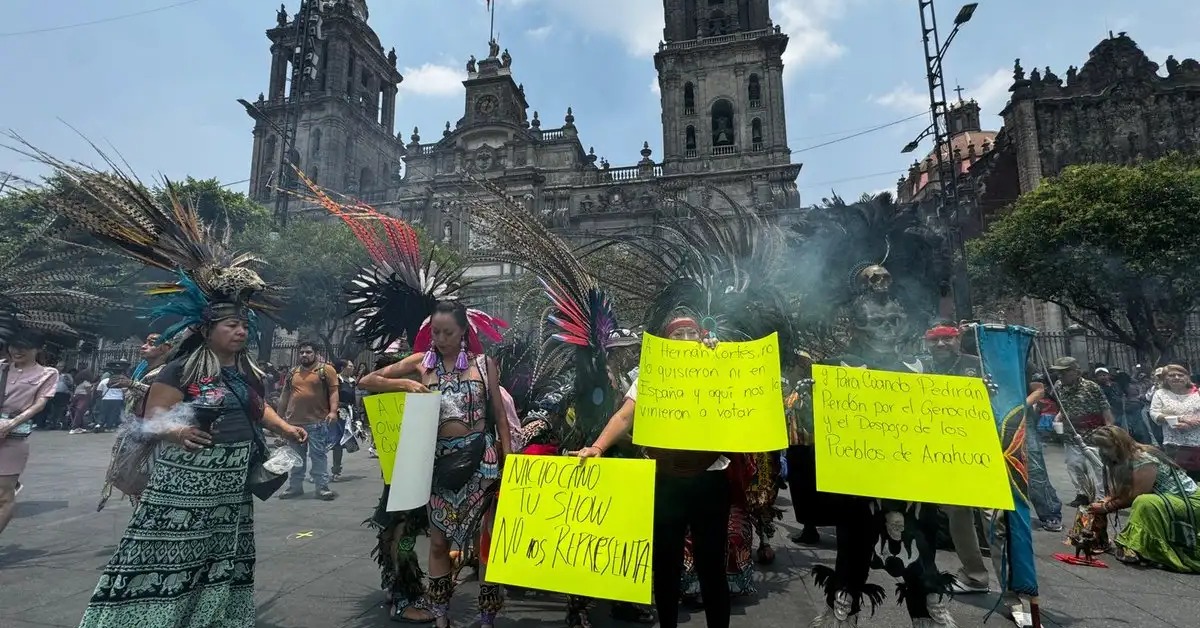
A canceled ceremony at Mexico City’s Metropolitan Cathedral did not end the controversy. Indigenous groups and danzantes still gathered outside the cathedral to reject what they saw as a tribute to Hernán Cortés. The dispute now reaches beyond one religious event, touching old wounds over the Spanish conquest, Mexico’s Indigenous history, the figure of Malinche, and the ongoing demand that Spain recognize colonial abuses.
Protest outside the Metropolitan Cathedral
Indigenous groups and danzantes protested outside the Metropolitan Cathedral in Mexico City on Monday, May 4, over a planned religious event tied to Malinche and Hernán Cortés.
The ceremony had been promoted under the name “Celebration for Evangelization and Mestizaje in Mexico. Malinche and Cortés.” It was scheduled at the cathedral, one of the country’s most symbolic religious sites.
The event was canceled before it took place. Church authorities said the production team behind the musical Malinche did not obtain all the required permits to record inside the cathedral.
Even with the cancellation, protesters gathered outside the building. Their concern was not only the permit issue. They said the event appeared to honor Cortés, the Spanish conquistador linked to the fall of Tenochtitlán and the beginning of Spanish colonial rule in Mexico.
Some protesters carried signs rejecting the framing of the conquest as a celebration. Messages included phrases such as “The conquest was violence, not evangelization” and “Genocide is not blessed.”
Why Cortés remains such a sensitive figure
For many Mexicans, especially Indigenous communities, Hernán Cortés is not a neutral historical figure. He is tied to invasion, violence, forced conversion, loss of land, and the collapse of Indigenous political power.
Cortés led the Spanish campaign that ended with the fall of Tenochtitlán in 1521. The city later became the foundation of colonial Mexico City. The Metropolitan Cathedral itself stands beside the Zócalo, in the same historic center built over the former Mexica capital.
That is one reason the location mattered. A ceremony involving Cortés and evangelization inside the cathedral carried heavy symbolism. For protesters, it placed a religious blessing over a history still linked to suffering and dispossession.
The dispute also reflects a broader debate in Mexico. Some people describe mestizaje as the foundation of modern Mexican identity. Others argue that celebrating mestizaje can ignore the violence that produced it.
The role of Malinche in the controversy
The event’s reference to Malinche added another layer. Malinche, also known as Malintzin or Doña Marina, was an Indigenous woman who served as an interpreter and intermediary for Cortés.
For generations, she was often portrayed as a traitor in Mexican history. That view has changed in recent years. Many historians and cultural figures now describe her as a woman caught in a violent colonial process, not as a simple symbol of betrayal.
This reassessment matters because Malinche’s story is often used to discuss Mexico’s origins. She is linked to language, survival, gender, coercion, and the birth of mestizo identity.
That makes public events using her image especially sensitive. A musical, a ceremony, or a political speech about Malinche can quickly become a debate about who gets to tell Mexico’s history.
Isabel Díaz Ayuso and the Spain question
The planned event also drew attention because Isabel Díaz Ayuso, president of the Community of Madrid, was expected to attend. Her visit came during a period of renewed discussion over Spain’s colonial past.
Protesters called on Díaz Ayuso to ask forgiveness from Indigenous peoples in Mexico and across the Americas. Their demand fits into a larger diplomatic issue that has shaped Mexico-Spain relations for years.
In 2019, then-President Andrés Manuel López Obrador asked Spain and the Vatican to apologize for abuses committed during the conquest. Spain rejected the request at the time.
President Claudia Sheinbaum has kept the issue alive. Spain has recently made more conciliatory statements about colonial abuses, but Mexico’s call for a fuller apology has not disappeared.
That is why Monday’s protest was not just about one canceled mass. It connected to a much larger argument about memory, dignity, and how powerful institutions describe the conquest.
Church says the ceremony was not a tribute
The Archdiocese of Mexico said the canceled ceremony was not meant to honor Cortés. Church authorities said the Eucharist was intended as a prayer for evangelization, mestizaje, and peace among peoples.
The explanation did not satisfy critics. The event’s title, its connection to the musical Malinche, and Díaz Ayuso’s expected attendance were enough to draw protest.
The production behind the musical has described the show as a celebration of Mexico, mestizaje, and the union of two worlds. Critics argue that such language can soften or erase the violence of conquest.
This gap in interpretation is at the center of the dispute. Supporters see mestizaje as a shared inheritance. Opponents say any public celebration involving Cortés must first recognize Indigenous suffering.
A modern debate over an old wound
The protest shows how colonial history remains active in Mexico’s public life. The conquest is not only a subject for textbooks. It appears in politics, religion, theater, tourism, monuments, and diplomatic relations.
For international residents in Mexico, the controversy is a reminder that historical memory here is not abstract. The names Cortés, Malinche, and Tenochtitlán still carry emotional and political weight.
The central question is not whether history should be discussed. It is how it should be discussed, who is included, and whether Indigenous voices are treated as central to that discussion.