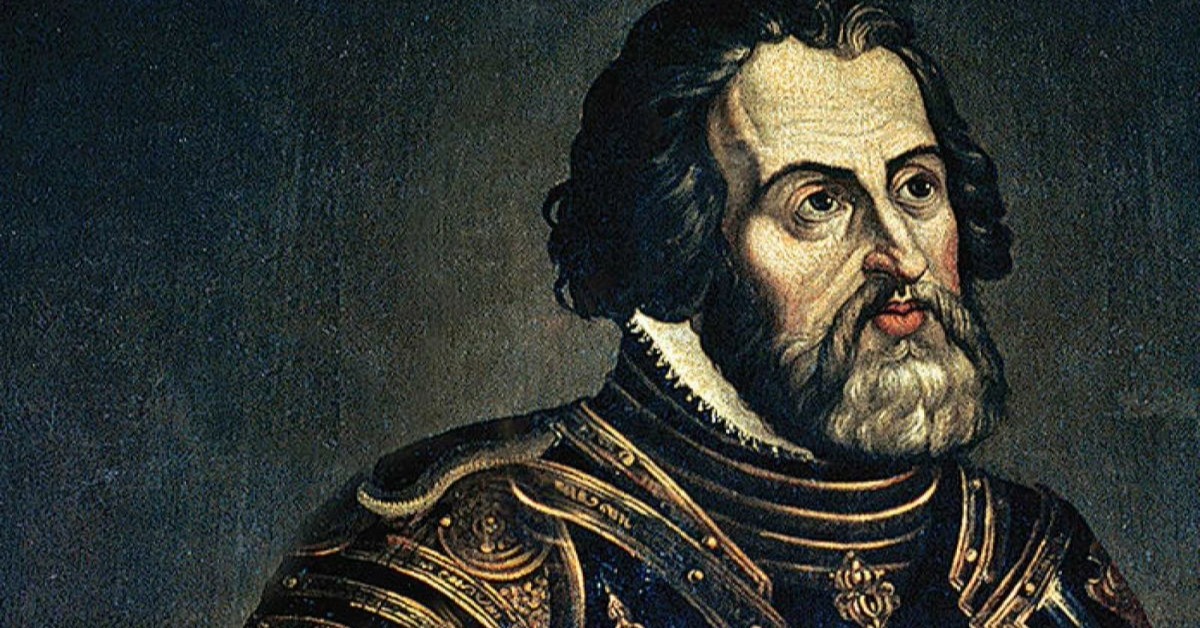
The remains of Hernán Cortés sit behind a modest plaque inside a church in Mexico City. Now, a Mexican writer wants them removed and sent to Spain. The request comes during a politically sensitive visit by Madrid’s regional president, Isabel Díaz Ayuso, and touches old wounds in Mexico’s relationship with Spain. It also raises a larger question: who gets to honor, keep, or return the physical traces of a difficult shared past?
Writer asks INAH to remove Cortés’ remains from Mexico
Mexican writer Pedro Miguel has asked the National Institute of Anthropology and History to exhume Hernán Cortés’s remains and turn them over to Spanish authorities.
The request was addressed to INAH Director General Joel Omar Vázquez. It asks the institute to arrange the exhumation and packing of Cortés’ remains, which are held inside the Templo de Jesús Nazareno in Mexico City’s Historic Center.
The remains are in a niche at República del Salvador 119, near the Hospital de Jesús. The site is linked to Cortés himself, who founded the hospital in the 16th century.
Pedro Miguel linked the request to the visit to Mexico by Isabel Díaz Ayuso, president of the Community of Madrid. Her official agenda includes an event honoring Cortés at the Metropolitan Cathedral in Mexico City.
The request comes during Ayuso’s Mexico visit
Ayuso is in Mexico from May 3 to May 12 as part of a 10-day institutional trip. Her agenda includes stops in Mexico City, Monterrey, Aguascalientes, and Xcaret Riviera Maya.
The Community of Madrid says the visit is meant to strengthen economic and cultural ties. The agenda includes business meetings, academic events, the Feria Nacional de San Marcos in Aguascalientes, and meetings with Spanish regional groups in Mexico.
The planned event honoring Cortés has drawn attention because Ayuso is not a national Spanish official. She is a regional leader in Spain, but she has become a public voice in debates over Hispanidad, the Spanish conquest, and Spain’s role in Latin America.
Pedro Miguel’s letter argues that if Spanish political figures want to honor Cortés, they should do so in Spain. He also suggested that Mexico could ask Spain to return cultural objects, including the Códice Tro-Cortesiano, also known as the Madrid Codex.
Why Cortés’ remains are still in Mexico
Hernán Cortés died in Spain in 1547, but his remains were moved several times after his death. They eventually returned to Mexico, where they were placed at the church tied to the Hospital de Jesús.
The remains were rediscovered in 1946 after being hidden for many years. In 1947, they were reinterred in the same church, where a bronze plaque now marks the site.
The tomb is not a large public monument. It is a quiet and often overlooked place inside a working church in the center of Mexico City.
That low profile reflects the complicated place Cortés holds in Mexican memory. He is central to the history of modern Mexico, but he is also tied to conquest, colonization, violence, and the collapse of the Mexica empire.
Why the issue remains sensitive in Mexico
Cortés led the Spanish expedition that entered central Mexico in 1519. With Indigenous allies who opposed Mexica rule, Spanish forces eventually took Tenochtitlan in 1521.
That event opened the way for Spanish colonial rule in Mexico. It also reshaped language, religion, government, land ownership, and Indigenous life across the region.
For many people in Mexico, Cortés is not simply a historical figure. He represents a painful period that still affects public debates over identity, race, inequality, and cultural memory.
For others, the conquest is discussed as the beginning of mestizaje, or the blending of Indigenous and Spanish ancestry and culture. That view is common in Spanish conservative circles, where Cortés is often framed as a founder of a shared Hispanic world.
Those two views are not easy to reconcile. That is why an event honoring Cortés in Mexico carries more weight than a normal cultural ceremony.
Mexico and Spain are trying to repair ties
The dispute also comes as Mexico and Spain have been working to improve relations.
Tensions grew after former President Andrés Manuel López Obrador asked Spain and the Vatican to apologize for abuses committed during the conquest. Spain rejected that request at the time.
President Claudia Sheinbaum has continued to say that historical harm should be recognized. At the same time, her government has taken steps to normalize relations with Spain.
Spain has also shifted its tone. Spanish officials have acknowledged pain and injustice suffered by Indigenous peoples during the conquest, though Mexico’s demand for a formal apology remains politically sensitive.
That makes Ayuso’s visit more delicate. She is closely associated with a different political message, one that defends Spain’s imperial legacy more openly than Spain’s national government has done in recent months.
Cultural goods are part of the larger argument
Pedro Miguel’s letter also raises the issue of cultural restitution. This has become a growing topic in Mexico’s foreign policy and cultural work.
Mexico has sought the return of archaeological pieces, manuscripts, and other heritage objects held abroad. Some have been recovered through cooperation with foreign governments and law enforcement agencies.
The Códice Tro-Cortesiano is one of the clearest examples of why these debates are difficult. The codex is held by the Museo de América in Madrid and is considered one of the few surviving original Maya books.
For Mexico, such objects are not only museum pieces. They are part of the written memory of Indigenous civilizations. For institutions abroad, they are often treated as part of established public collections.
The request to exchange Cortés’ remains for cultural goods is not a formal diplomatic agreement. It is a political and symbolic proposal. Still, it points to a larger question that keeps returning in Mexico’s cultural debates: how much of the country’s history remains outside the country?
What happens next
As of Monday, there was no public indication that INAH had approved the request or begun any process to exhume Cortés’ remains.
An exhumation would not be a simple political gesture. It would likely involve health and heritage rules, as well as coordination with religious or custodial authorities affiliated with the church.
For now, the request appears to be mostly symbolic. But symbols matter in this case.
A small tomb in Mexico City has become part of a larger argument over conquest, diplomacy, and who controls historical memory. The debate is not only about Cortés’ bones. It is about how Mexico and Spain choose to handle a shared past that is still very much present.