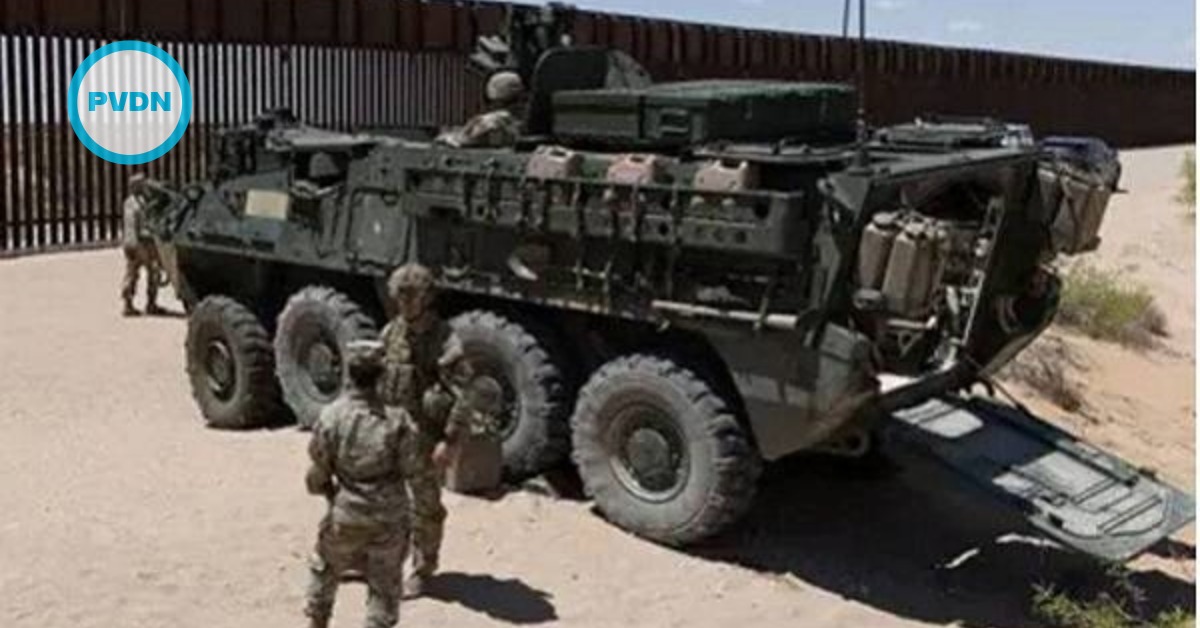
The U.S. has handed a long stretch of the California–Mexico border to the military, expanding a “militarized zone” that lets troops detain migrants.
The U.S. government has created a new “militarized zone” along the California–Mexico border, handing control of a wide band of public land to the armed forces under a three-year national defense designation. The move allows troops to detain people they suspect of entering the country unlawfully and exposes migrants to harsher criminal penalties than in civilian-run areas.
The Interior Department says the zone is meant to close security gaps on one of the busiest stretches of the southern border. Jurisdiction along much of California’s international boundary with Mexico is being transferred to the U.S. Navy, which will oversee operations across roughly 760 acres of federal land that until now fell under civilian management.
From the Arizona state line west toward the Otay Mountain Wilderness, the new designation covers desert, canyons and farming communities in the Imperial Valley, including the small border town of Tecate. For people who live and work here, the change blurs a line they have long relied on: the one that keeps the military at arm’s length from everyday law enforcement.
How the California Mexico militarized zone works
Under the order, large parts of the border have been labeled “militarized zones” since the spring, starting with a 170-mile stretch in New Mexico and later spreading to sections of Texas and Arizona. California is the latest addition. More than 7,000 service members are now deployed along the U.S.–Mexico border, supported by helicopters, drones and other surveillance systems.
In these areas, troops can detain migrants and anyone accused of trespassing on Army, Air Force or Navy installations that lie along the border. Those arrests can trigger additional criminal charges for entering restricted military property, adding possible prison time to immigration cases that once moved only through civil courts. The administration argues that combining immigration enforcement with military jurisdiction will deter crossings and disrupt smuggling networks.
The legal basis rests on a national emergency declaration issued earlier this year. That declaration has pushed the armed forces into a frontline role on U.S. soil, a role traditionally handled by civilian agencies. Constitutional scholars warn that using troops this way brushes up against long-standing limits on domestic military policing, even if soldiers are technically operating on federal land reclassified as a defense zone.
On paper, the Interior Department describes the California corridor as a “high-traffic” area for unlawful entry. Yet Border Patrol data show arrests along the southern frontier have fallen to their lowest pace since the 1960s, raising questions about why such an expansive step is being taken now. Critics say the mismatch between current migration levels and the scale of the deployment suggests a political decision as much as a security calculation.
Local fears, legal battles and what comes next
For border residents, the California Mexico militarized zone is not an abstraction. Farmers in the Imperial Valley worry about having uniformed soldiers and heavy equipment near fields where migrant laborers already face frequent stops from Border Patrol. Families split between California and Baja California are bracing for longer waits at rural crossings and more aggressive questioning at checkpoints that once felt routine.
Migrant shelters in nearby Mexican cities are preparing for more rapid expulsions under military custody. Advocates fear that asylum seekers picked up inside the zone could be rushed through procedures or discouraged from asserting their rights, especially if they first encounter uniformed troops instead of immigration officers trained in humanitarian screening. Medical volunteers who monitor the desert warn that pushing people away from controlled crossings and deeper into remote terrain will mean more dehydration, injuries and deaths.
The expansion in California also comes amid a power struggle over who commands the state’s security forces. On the same day the militarized zone was announced, a federal judge blocked Washington’s attempt to keep thousands of California National Guard members under federal orders in Los Angeles, ruling that control of the Guard remains with Governor Gavin Newsom. The decision underscored how unusual it is to have federal troops and state forces pulled into immigration enforcement at this scale.
For now, the new zone is set to last three years, though the order can be renewed. Residents, migrant advocates and civil liberties groups are watching how often troops actually carry out detentions and how those cases move through the courts. They are also tracking whether the U.S. president and federal agencies treat this California experiment as a template for even broader military control of the border.
On a map, the change is a line drawn across public land. On the ground, it is soldiers, fences, floodlights and surveillance towers pressing closer to homes, farms and fragile ecosystems that straddle the boundary. The question for people who live here is whether a policy sold as border security will, in the end, make anyone safer at all.