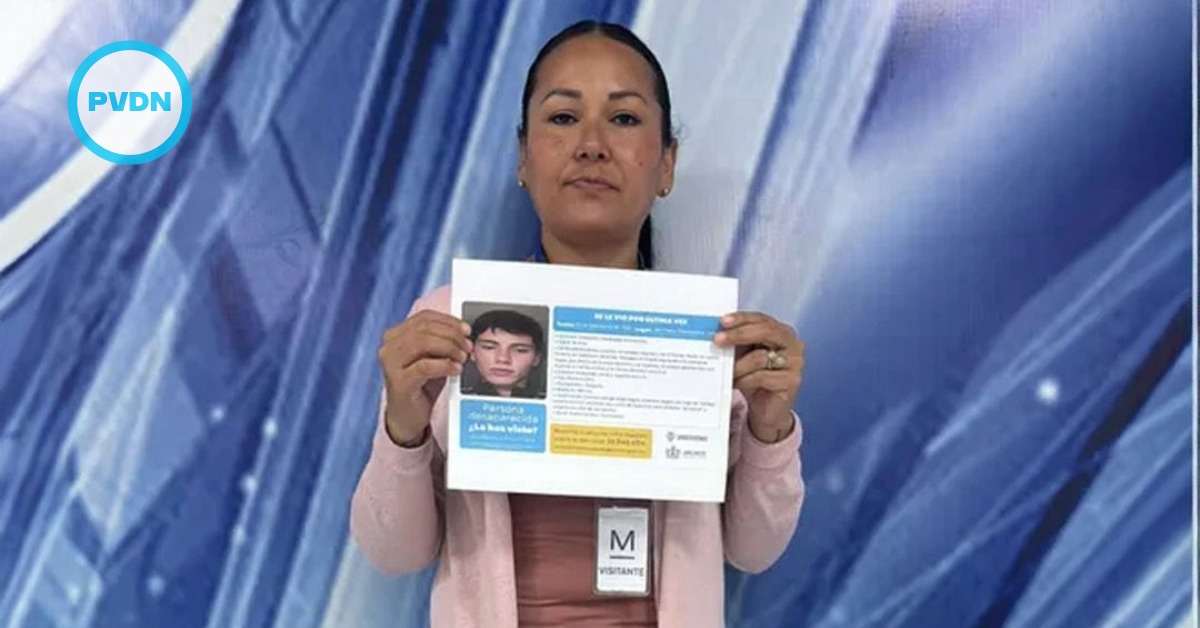
After demanding answers about her missing son, a Jalisco searching mother was beaten, threatened and forced to flee the state.
Beatriz remembers the words more than the blows. It was November 16, a Sunday afternoon, and she had just stepped out of Mass in the Guadalajara metropolitan area when several men surrounded her. They pushed her to the ground, kicked and punched her and delivered a message: this was the third and final warning. She had to leave Jalisco.
For months, she had been that woman on the marches with a photograph held high, the one who refused to sit quietly in the waiting rooms of government offices. Her son, Sebastián Menéndez, left Querétaro on 4 September after a supposed job offer in Guadalajara. He was 18, born in Veracruz, and excited about the chance to work. He called home when his bus reached the station in Tlaquepaque, then took a ride-share toward Zapopan for what was meant to be an interview. No one has heard from him since.
Within hours, Beatriz boarded her own bus toward Jalisco. Like so many parents in her position, she became a searcher overnight. She joined brigades combing lots and ravines, gave interviews, and challenged officials she felt were more worried about the image the state will project during the 2026 World Cup than about the thousands of people who have vanished. Each day without answers hardened her voice. Each new disappearance added to her fear.
The attack outside the church changed something more fundamental. At the urging of ministerial authorities, she filed a complaint and left the state “to let things cool down.” She is now displaced from the territory where her son disappeared, forced to continue the search from afar and to weigh every public word against the risk of another warning that might not stop at threats.
Jalisco searching mothers under attack
What happened to Beatriz does not stand alone. Jalisco has become a central stage in Mexico’s disappearance crisis, particularly for young people. Federal data on the national registry of disappeared and missing persons show hundreds of complaints this year alone for children and youth under 29 in the state, with nearly half of those young people still unaccounted for and several already found dead. At the same time, local authorities insist that new disappearance reports are falling and highlight monthly drops as signs of progress.
Those two realities collide in the numbers that rarely make it into official speeches. Public databases and independent analyses place Jalisco’s accumulated disappearances at around sixteen thousand people, the highest figure for any state in the country, even after controversial adjustments to how cases are recorded. Human rights groups and search collectives accuse past state administrations of “shaving” the figures by changing criteria and removing files, a practice that relatives describe as an attempt to disappear the disappeared from statistics as well as from everyday life.
Nationally, the picture is even starker. Mexico has crossed the threshold of more than 130,000 people registered as disappeared or not located. New reports continue to rise year after year, according to civic monitoring projects that track official data. Behind those numbers is another, less visible count: the relatives, mostly women, who are forced into the role of investigators, forensic aides and public advocates, often without training, pay or security.
Recent human rights research focused on women searchers documents just how dangerous that role has become. Surveys of hundreds of women across the country show that almost all of them have faced some form of violence while searching, from threats and extortion to physical attacks, forced displacement, sexual violence and killings. Separate investigations map at least several dozen searchers murdered or disappeared since 2011 while looking for a child, partner or sibling. Jalisco appears repeatedly in those lists.
The state is also at the centre of a series of mass grave investigations that illustrate the scale of the violence families confront. In recent months, families and authorities have documented at least 456 bags with human remains recovered from several sites near the Estadio Akron in Zapopan, a World Cup venue, and more than 220 bags in a large property known as Las Agujas. Many of the remains still wait for identification. For mothers like Beatriz, those figures are not abstractions; they represent the possible fate of their children.
Protection that never reaches the searchers
Mexico has a General Law on disappearances and formal protection mechanisms intended to shield human rights defenders and journalists under threat. On paper, those tools should extend to families searching in places dominated by organised crime. In practice, women on the front lines describe a gap between what the law promises and what actually reaches them when they ask for help.
The new research on women searchers paints a consistent pattern. The vast majority of those interviewed reported facing repeat aggressions, but only a small fraction had filed formal complaints or requested protection. Many say they do not trust the authorities they must accuse, fear leaks of sensitive information about their movements, or simply do not believe they will be taken seriously. Others explain that the measures offered—such as occasional patrols or recommendations to move house—do little to lessen the risks they face on the ground.
Beatriz’s experience fits that pattern. After the attack, she did what she was told: she went to the prosecutor’s office, recounted the beating and the threat, and then left Jalisco as recommended. For her, that advice felt less like a safety plan and more like an eviction notice from the state where her son vanished. The people who attacked her remain unidentified. The investigation into Sebastián’s disappearance continues at a slow pace, split between the authorities in Jalisco and those in Veracruz and Querétaro.
From where she is now, Beatriz still spends her days on the phone with other families and officials, pushing for search operations, checking morgue lists and monitoring social media pages where new disappearance flyers appear every day. She talks about the 456 bags of remains found near the stadium, about the hundreds of young people who left home for promised jobs and never came back, and about the mothers and fathers who have already been killed for asking too many questions.
What weighs on her most is not only the risk to her own life, but the message her case sends to others. If a mother can be beaten in the street and effectively forced out of the state for insisting on answers, how many relatives will decide it is safer to stay quiet? How many will choose not to join a search brigade, or to stop attending protests, because they cannot afford to put their remaining children at greater risk?
Beatriz’s voice still breaks when she talks about the physical work of searching. She remembers long days in Jalisco walking over open fields, feeling for the soft spots where the soil gives way, and digging with whatever tool she had at hand. She has said more than once that she cannot understand how the burden of excavation has fallen on those who have already lost the most.
Her story captures the double punishment that Jalisco searching mothers face today. First, they lose a loved one to disappearance. Then, when they stand up to demand that the state search, they risk losing their home, their health and, too often, their lives. As long as the safest option authorities can offer them is to leave, the message is clear: the people who search are still more exposed than the people who make them disappear.