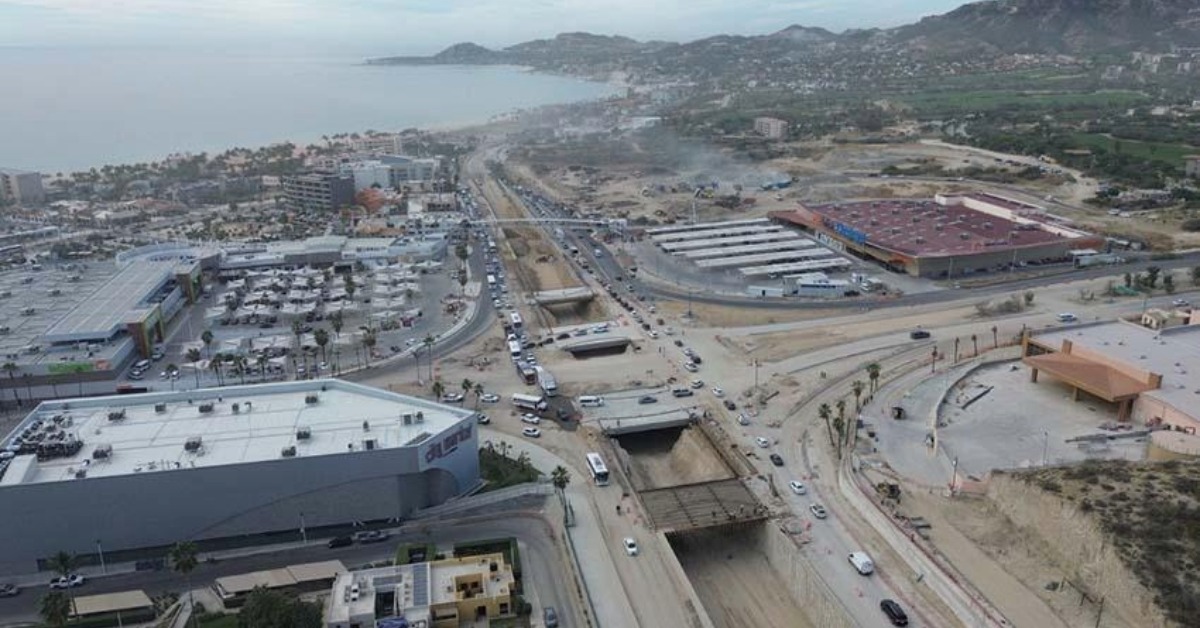
A short stoppage at one of Los Cabos’ busiest road projects has ended, but the pause raised fresh questions about timing, traffic, and what this underpass is supposed to fix. Officials now say the Fonatur project is in its final stretch. For many drivers, though, the bigger issue is whether the long disruption at this key junction will finally deliver the relief that has been promised for months.
Fonatur underpass resumes with finish line in sight
Work on the Fonatur underpass in San José del Cabo has resumed after a brief stoppage due to unpaid transport bills for workers. Authorities now say the project is about 90 percent complete and could finish by late April or in the first week of May. That matters because the site sits at one of the busiest road junctions in Los Cabos, where local traffic, airport runs, hotel access, and through traffic all converge.
The latest conflict centered on payments owed by the contractor to transport workers linked to CATEM. The dispute led to a partial blockage and a short interruption in work earlier this week. Officials said a partial payment was made and crews returned to the site. That appears to have prevented a longer delay, but it also pushed the public completion window slightly beyond some earlier expectations.
Why this project matters beyond one road
For readers new to the area, this is not a minor local job. The project is located at the former Fonatur roundabout, now officially known as the Glorieta de las Mujeres Libres. It is a critical point on the corridor between Cabo San Lucas and San José del Cabo. The underpass is meant to separate through traffic from local movements, easing one of the most persistent bottlenecks in the municipality.
Authorities have described the work as a broader mobility redesign rather than a simple lane expansion. Public descriptions of the project show a main underpass section with four traffic lanes, plus pedestrian improvements, safer crossings, sidewalk space, and bicycle infrastructure. Officials have also said the site connects key routes to the Los Cabos airport, the San José hotel zone, the toll road, and the Transpeninsular highway. That helps explain why even a short stoppage became a local issue quickly.
Why the timeline kept moving
The finish date has shifted more than once as the project advanced. In January, local officials said the work was running ahead of schedule, with completion still linked to the middle of the year. By late March, public reporting suggested the final phase could wrap up in mid-April. After the payment dispute and stoppage in early April, the latest estimate moved to the end of April or the first week of May.
That change is not dramatic in calendar terms, but it is important for drivers who use the corridor every day. It also shows how vulnerable major public works can be in the final stretch. At that stage, even short interruptions can affect paving, traffic control, and the sequence needed to open lanes safely. In practical terms, a project can be mostly built and still remain disruptive until those last pieces fall into place.
What drivers and residents should watch next
For residents, the bigger story is not only when the ribbon is cut. It is whether the project actually improves daily movement through this part of Los Cabos. Traffic studies tied to the work have warned that vehicle volumes at the junction could rise sharply over the long term if current patterns continue. Officials have argued that the redesign is needed to reduce congestion and improve safety for both drivers and pedestrians.
Until the job is fully delivered, motorists should still expect changing traffic patterns near the site. Final paving, lane shifts, signal adjustments, and cleanup work often cause short disruptions even when a project is nearing completion. For residents, that means commutes may remain uneven for a little longer. For visitors, it can still affect transfer times between the airport, hotels, and other parts of Los Cabos.
If the underpass opens smoothly and traffic begins moving as planned, the project will likely be framed as a visible win for mobility in the area. If bottlenecks simply move to nearby streets, pressure will shift to whatever comes next. For now, officials are presenting the resumed work and the 90 percent figure as proof that the long disruption near Fonatur is finally entering its last stretch.
Deep Dive:
Los Cabos Airport Transfer Times to Fall Thanks to New Infrastructure
San José del Cabo mobility plan starts with four one-way reversals