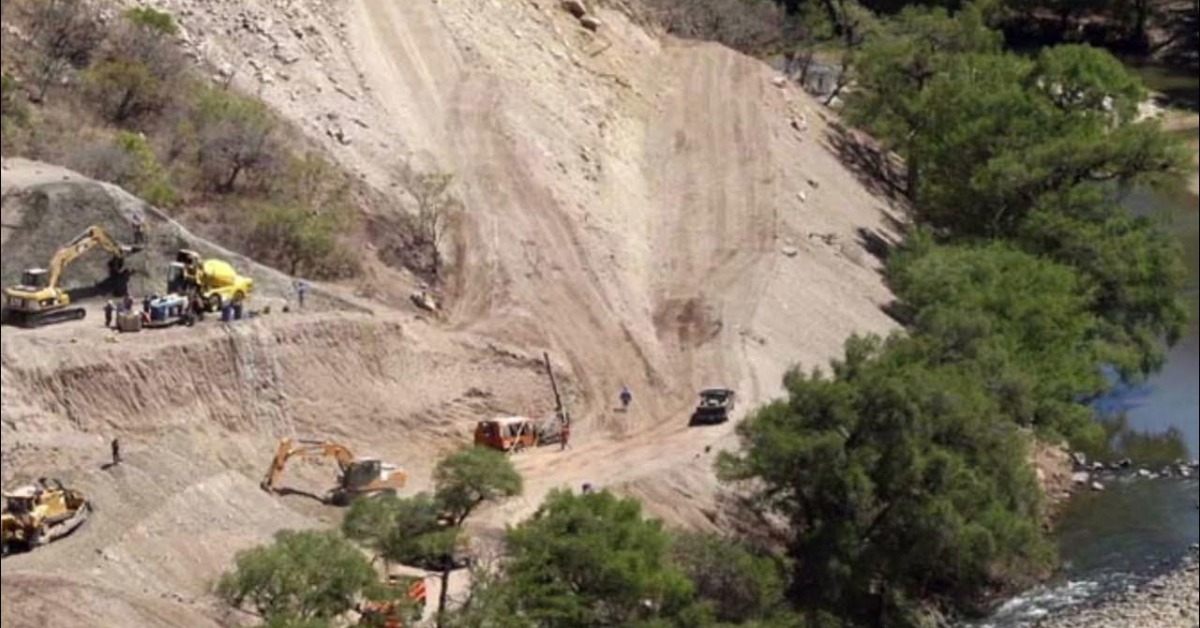
Residents of San Vicente Coatlán say the state’s flagship water project—now branded the Margarita Maza dam—cannot move forward. At the same time, a decades-old land conflict with Villa Sola de Vega remains unsettled. They warn that pressing ahead risks clashes on territory they consider ancestral. State officials frame the dam as a solution to Oaxaca City’s water shortages. Civil groups allege the absence of environmental studies, opaque contracting practices, and a lack of formal consultation. The dispute is not new, but the project’s restart and rebrand have thrust it back to the surface.
Margarita Maza dam
San Vicente Coatlán’s agrarian authorities cautioned that construction of the dam—long known as Paso Ancho—could “spark violence” if the state and federal governments do not first resolve a dispute over roughly 19,000 hectares with Villa Sola de Vega. The community says at least 40 people have been killed and one person is missing in episodes tied to the conflict since the 1970s, and it has asked President Claudia Sheinbaum for an urgent meeting.
Why the community is alarmed
San Vicente Coatlán argues that part of the new works would sit on contested lands and points to past bloodshed as a warning. Historical records show deadly flashpoints: in 2012, six residents were killed amid the same feud, according to national press coverage at the time. The community also faults court decisions, it says, which it claims compounded the boundary dispute and left residents vulnerable.
What the government says
Oaxaca’s government rebranded Paso Ancho as the Margarita Maza project in March, pitching it as a two-year construction project that would deliver 1,000 liters per second to the metro area and benefit more than 640,000 people. Officials put the price tag at 4.6 billion pesos and have framed the works as part of the national water plan.
A subsequent state update in August stated that bidding and supervision milestones were on track, the storage capacity would be approximately 20 million m³, and the site would be located in Rancho Viejo, Sola de Vega. The state also asserted that the current layout is not the same project as the earlier Paso Ancho effort.
A project with a long, troubled history
Paso Ancho dates back more than a decade. Regulators halted work in 2014 over environmental irregularities. The current restart links the dam to a larger package of national hydraulic projects, and officials have again cited an aqueduct of ~100 km as part of the delivery system. Civil groups counter that authorities have not presented a public Environmental Impact Statement and did not run a proper prior consultation with affected communities.
In recent weeks, the Observatorio Comunitario del Agua (OCCAMA) and its allied organizations have renewed these concerns, stating that the process lacks transparency and consultation, and flagging irregularities in the early contracting phase. They also argue the scheme emulates the “failed” Paso Ancho approach and risks repeating past mistakes.
The money question
Cost estimates have drifted. While the state cites 4.6 billion pesos, a federal investment fiche updated in August lists an estimated 7.78 billion pesos, and civil groups have warned that the figure has already climbed toward 7.84 billion, with overrun risks typical of large dams. The government maintains that the project will stabilize the supply for Oaxaca City; opponents say fixing leaks and enforcing river protections could deliver faster gains at a lower cost.
What happens next
San Vicente Coatlán’s position is not a blanket rejection of water works; it is a warning conditioned on the settlement of the boundary dispute and a transparent, lawful process. The community has requested high-level talks, while the state claims it is engaging with nearby towns and advancing studies. The tension sits at the fault line between an urgent urban water need and unresolved rural land rights. How Oaxaca balances those imperatives—through transparent studies, genuine consultation, and a negotiated land outcome—will determine whether the Margarita Maza dam eases scarcity or deepens conflict.