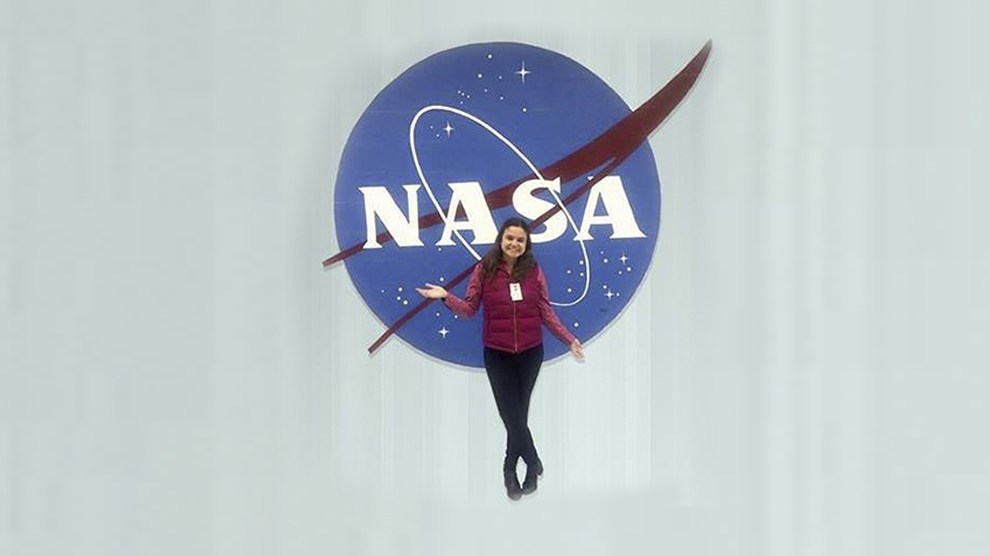
Maria Regina Apodaca Moreno, a graduate student in physics from the Faculty of Sciences (FC, for its acronym in Spanish), stayed at NASA’s Ames Research Center, which allowed her to develop a model for Scale helicopter that will fly on Mars.
“The experience helped me develop my work, which will be about a helicopter that NASA will fly on Mars in the mission planned for 2020,” the student said in a statement from the National Autonomous University of Mexico (UNAM, for its acronym in Spanish).
The 22-year-old student joined the program to become a NASA intern, after a year and a half of the application.
Apodaca Moreno recalled that her first contact to achieve this was a Physics professor, Guillermo Govea Anaya, who believed in her professional dreams and encouraged her.
“He saw the NASA announcement on the page of the Mexican Space Agency. He knew my interest in becoming an aerospace engineer and encouraged me to send my papers”, she recalled.
She commented that in her stay she was one of five foreign inmates; the other four came from Sweden, attended the masters and from the group she was the only Mexican and with a bachelor’s degree. “There were also other inmates from the United States, of different ages,” she said.
The commitment was to make the thesis on an issue related to an investigation of the American agency. That way, she developed a scale model of a helicopter that NASA will fly on Mars in the mission planned for 2020. It will be the first vehicle to take off and land several times off the planet.
“I made the helicopter model as a children’s dissemination project that will explain what we are doing. I made a toy version respecting the most important characteristics of the equipment”, she explained.
In her thesis, Regina approaches the study of the interaction between air and soil sand, during the takeoff and arrival of the helicopter.
“When this equipment lands in the sand, as in Afghanistan, they generate a huge cloud of dust. As on the surface of Mars there is something like sand, we do not want it to damage sensors or the helicopter itself,” explained the student.
She pointed out that the project consists of taking the first steps to determine if the cloud of dust would be a problem for the Martian mission, because if it is very dense a stronger sensor must be made.
The helicopter on Mars is a proof of concept to determine if you can fly in an atmosphere as thin as that site. “We want to demonstrate that we have the technology to do it on another planet,” she said.
Regina’s thesis is in progress, several simulations are still missing and her task is supported by Carlos Málaga, researcher of the Institute of Physics, to do the simulation of fluids.
Next year the university student will complete her degree and apply for a postgraduate course abroad, either in the United States or Europe.
NTX/BCG/SGR/JCG