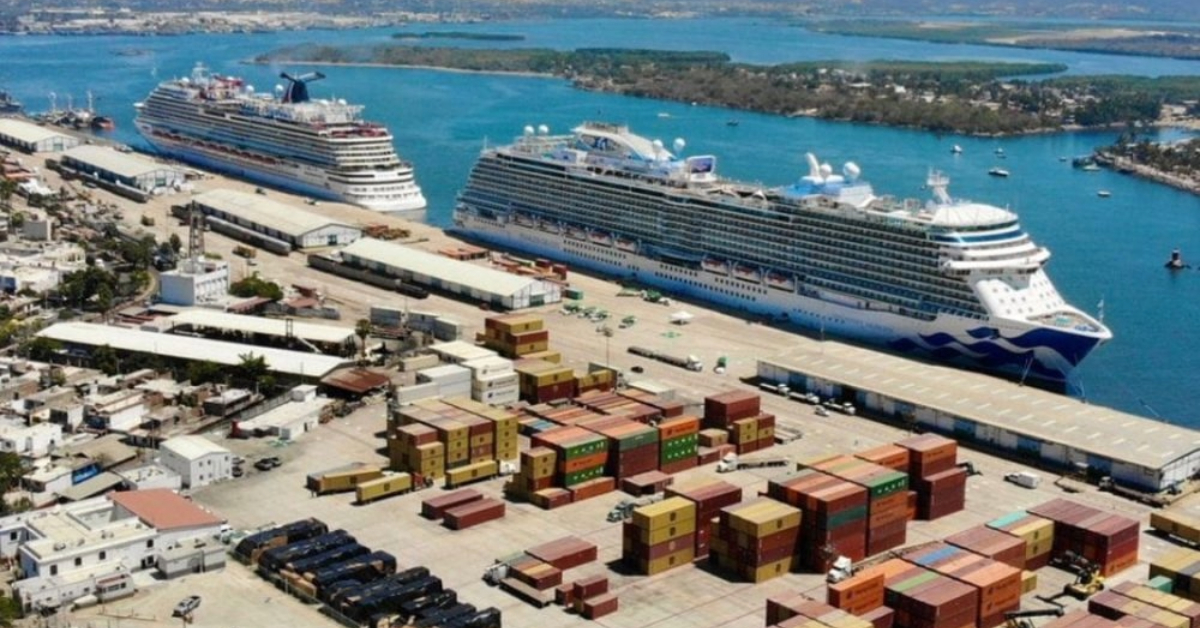
Mazatlán port faces declines in containerized cargo, oil products, and vehicle exports due to international conflicts, despite a slight increase in total cargo moved in early 2025.
International tensions are taking a toll on the maritime trade industry in Mazatlán, where port officials report a slowdown in container cargo, oil-related shipments, and vehicle movement—despite a modest year-over-year increase in total cargo volume.
According to the Mazatlán National Port System Administration (Asipona Mazatlán), the port handled 1,922,595 tons of merchandise from January through May 2025. That figure represents a 3% increase compared to the 1,861,888 tons recorded during the same period in 2024. However, a closer look at the monthly data reveals a worrisome trend, especially in high-value shipments like automobiles and petroleum derivatives.
Declines in Key Cargo Categories
The most notable reductions came in the areas of containerized cargo, petroleum products, and imported/exported vehicles—all heavily affected by disruptions in global supply chains caused by geopolitical instability.
Mariel Aquileo Ancona Infanzón, Director General of Asipona Mazatlán, acknowledged the challenging environment. “It’s normal given the current situation around the world. Importers are watching closely and adjusting. Still, we’re making progress. We’ve maintained more or less the same level as last year, and we’re entering new markets—such as importing live cattle,” he said.
Loose vs. Containerized Cargo
The port continues to rely heavily on loose cargo—products not transported in containers—which includes automobiles, rebar, sheet metal rolls, machinery, frozen tuna, and various bulk goods. From January to May, the figures in this category remained relatively stable.
Containerized cargo, however, showed less resilience. Though early months like March saw growth—41,146 tons versus 27,158 tons the previous year—by April and May the numbers flattened and then declined. In May, containerized cargo dropped slightly to 38,364 tons compared to 39,720 in May 2024.
Notable items in container shipments include lumber, coffee, fishmeal, chickpeas, mango derivatives, and salt. These goods come from or are destined for markets in Asia, Europe, and Latin America, including Japan, the Netherlands, Korea, China, Chile, and Guatemala.
Petroleum and Oil Products Show Mixed Trends
Oil and petroleum derivatives, another critical component of port activity, saw fluctuating volumes. After a peak in February with 110,984 tons, the numbers dipped in March to 107,199 tons and dropped further in April and May to 124,353 tons—down from 150,971 and 148,452 respectively in the same months last year.
Vehicle Movement Down 6 Percent
Vehicle imports and exports remain one of the clearest indicators of international trade sensitivity. From January to May 2025, vehicle traffic through Mazatlán declined by 6%, totaling 73,686 units compared to 78,249 during the same period in 2024.
January saw the steepest drop, with only 9,172 vehicles imported and none exported, compared to 18,135 imports and 1,969 exports the year prior. While imports rebounded somewhat in the following months, exports remained significantly limited.
- February: 14,708 vehicles handled (500 exported) vs. 20,641 (453 exported) in 2024
- March: 16,453 vehicles (no exports) vs. 10,168 (no exports)
- April: 14,004 vehicles (no exports) vs. 10,613 (no exports)
- May: 17,341 vehicles (1,508 exported)
The most frequent sources of imported vehicles and related parts are Japan, China, and Peru, with destinations primarily in the states of Mexico, Jalisco, Morelos, Sinaloa, Chihuahua, and Puebla.
Diversifying Trade Despite Challenges
While the numbers reflect disruption, Asipona Mazatlán is pushing into new markets. For example, the port has begun importing cattle and continues to see exports of chickpeas to Algeria, the United Arab Emirates, Greece, Iraq, and Turkey. Mango derivatives are headed to destinations including Japan, the Netherlands, Korea, and Cyprus.
Frozen tuna, fishmeal, and other seafood products remain strong exports, particularly to Asia and Latin America, while containerized lumber and coffee continue to arrive for domestic consumption and redistribution.
Cruise Tourism Slightly Down
The cruise sector also saw a slight dip. From January through May, 57 cruise ships arrived, carrying 200,300 passengers—a decrease compared to 216,261 passengers during the same timeframe last year.
Outlook for the Second Half of 2025
Despite a rocky start to the year, Mazatlán’s port is holding relatively steady thanks to a strong base of regional trade and efforts to expand into new import-export categories. However, continued volatility in global shipping routes—driven by conflict, inflation, and logistical bottlenecks—could make the remainder of 2025 unpredictable.
Port officials say they remain cautiously optimistic but are preparing for a year that may require further adaptation and outreach to emerging trade partners.
Mazatlán port, maritime trade Mexico, 2025 import export, Mexican ports, international shipping, Sinaloa economy, container cargo Mazatlán, vehicle exports Mexico