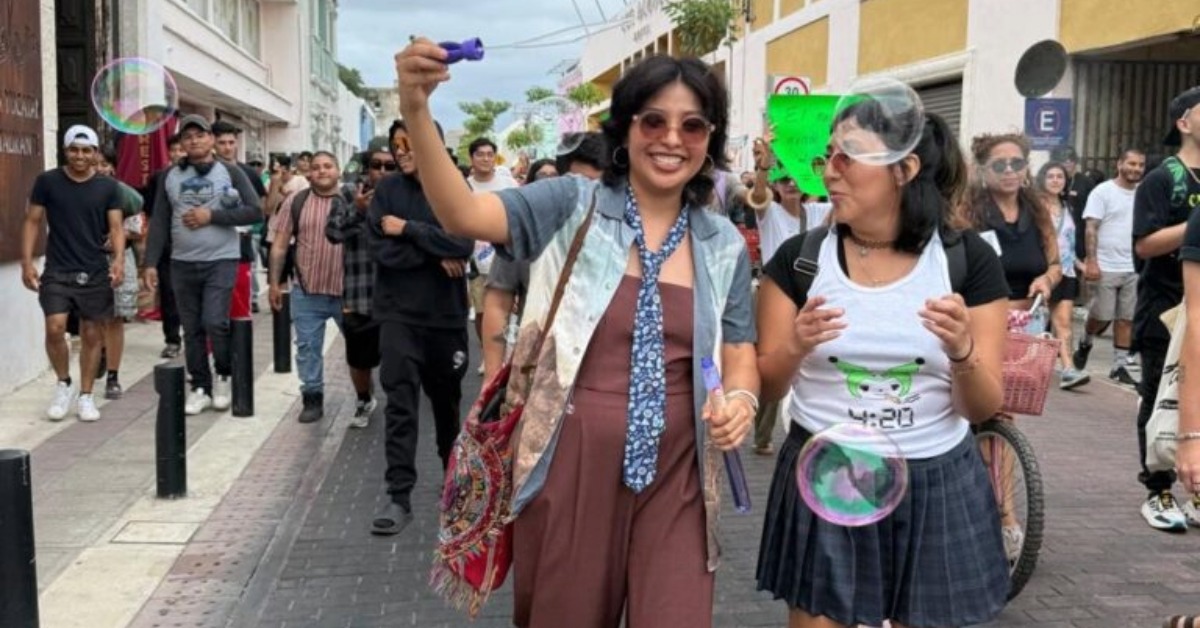
A peaceful cannabis march in Mérida drew more than 120 people into the city center, but the reaction along the route showed how unsettled the issue remains. Some tourists supported the demand for legal regulation, while some local residents pushed back. Behind the street-level debate is a larger national problem: Mexico’s courts have moved faster than Congress, leaving cannabis users in a legal gray area that still affects residents, visitors, and police enforcement.
Mérida cannabis march puts Mexico’s legal gap on display
More than 120 people marched in Mérida to demand cannabis regulation and an end to the criminalization of users, adding Yucatán to a national debate that remains unresolved years after Mexico’s Supreme Court struck down the country’s absolute ban on recreational use.
The march took place on Sunday, May 3, and began at the Remate de Paseo de Montejo. Participants moved toward the Government Palace in the historic center, where they called for clearer rules on possession, cultivation, and adult use.
The demonstration was peaceful, but the reaction along the route was mixed. Some tourists showed support, reflecting the fact that cannabis is legal or more clearly regulated in parts of the United States, Canada, and other countries. Some local residents supported the march, while others verbally confronted participants.
A public march in a city still divided
The march was organized by cannabis-rights activists who argue that Mexico’s current rules leave users exposed to police discretion, social stigma, and legal uncertainty. Participants called for safe, rights-based regulation instead of a system that still treats many users as suspects.
Demonstrators also rejected common stereotypes about cannabis users. Their message centered on regulation, personal freedom, and the right to consume without harassment.
Organizers also collected signatures to support a formal request for action. The petition is expected to be presented to state officials as activists seek a broader conversation about regulation in Yucatán.
For Mérida, the march placed a national issue in a very local setting. Paseo de Montejo and the Government Palace are among the city’s most visible public spaces. That made the demonstration difficult to ignore, especially for residents and visitors who crossed paths with the march.
Mexico’s cannabis law remains unfinished
The legal context is important. Mexico has not created a fully regulated recreational cannabis market. There are no legal cannabis stores similar to those in many U.S. states or Canadian provinces.
In 2021, Mexico’s Supreme Court invalidated the absolute prohibition on recreational cannabis use. The court said the ban violated the right to free development of personality, a constitutional principle that protects certain personal choices from unjustified state interference.
That ruling did not create a simple retail system. It also did not settle every practical question about buying, selling, growing, or consuming cannabis in public.
Adults can seek authorization from the federal health regulator for personal use and cultivation, but the process has often required legal steps. Civil groups have argued that this creates unequal access. People with time, money, and legal support have a better chance of obtaining protection than ordinary users.
That is the gap activists keep pointing to. The court opened the door, but Congress has not completed a clear national framework for adult-use cannabis.
The five gram rule is not full legalization
Many foreigners hear that Mexico allows possession of small amounts and assume cannabis is legal. That is not accurate.
Mexico’s General Health Law includes a table for personal and immediate consumption. For cannabis, that amount is five grams. Under certain conditions, prosecutors are not supposed to pursue criminal action against a consumer carrying an amount at or below the table limit.
But that rule has limits. It does not create a legal supply chain. It does not authorize open public consumption everywhere. It does not protect people who buy or sell cannabis. It also does not prevent every police encounter or detention.
For expats and visitors, the safest takeaway is simple: Mexico’s cannabis rules are still uneven and risky in practice. Something that may be legal at home may not be treated the same way in Mexico.
Medical cannabis is also different from recreational cannabis. Mexico has rules for medical and pharmaceutical cannabis products, but those rules involve health regulation, permits, and authorized uses. They do not amount to open recreational sales.
Why tourists and locals may see the issue differently
The split reaction in Mérida is not unusual. Cannabis debates often look different depending on a person’s background, age, family experience, legal exposure, and cultural views.
Tourists from countries with regulated cannabis markets may see legalization as normal. Some may view cannabis as similar to alcohol, especially where licensed stores, taxes, and age limits are already part of daily life.
Many Mexican residents see the issue through a different lens. For some, cannabis is tied to public disorder, drug violence, or concerns about youth use. Others support regulation because they believe prohibition has failed and created more room for corruption and abuse.
That difference helps explain why the Mérida march drew both support and rejection. The debate is not only about the plant. It is also about public space, policing, health, safety, and who gets treated as a criminal.
The debate now moves beyond one march
The Mérida march was one local expression of a larger national push. Cannabis-rights groups in Mexico have continued to press for regulation, cultivation rights, safe-use spaces, and an end to police harassment.
The issue is likely to return in more cities as activists pressure lawmakers to act. Without federal legislation, the legal system will remain difficult for residents, police, businesses, and foreign visitors to understand.
For Mérida, the demonstration showed that cannabis is no longer a private debate. It is now part of public life, especially in cities with growing international communities and changing social attitudes.
The march did not resolve the question. It did, however, show the challenge facing Mexico: the country has court rulings, social pressure, and public use, but still lacks a clear legal system that tells people what is allowed, what is not, and how rules should be enforced.