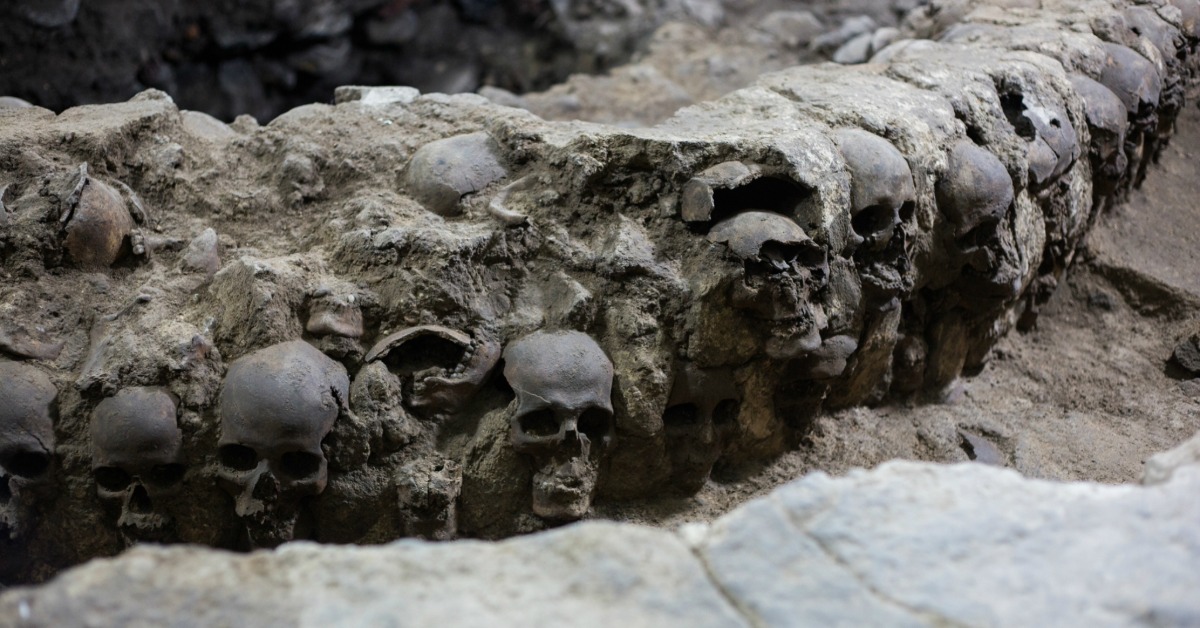
A major Mexica structure beneath Mexico City’s historic center continues to reshape how researchers explain ritual life in Tenochtitlan. The Huei Tzompantli, found under Guatemala 24, held human skulls tied to sacrifice, power, and religious meaning. But archaeologist Raúl Barrera Rodríguez says the site should not be read solely through the lens of horror. Researchers are still studying hundreds of skulls and thousands of bone fragments before any wider public opening.
Huei Tzompantli was a ritual site tied to life
An INAH archaeologist says the Huei Tzompantli beneath Guatemala 24 in Mexico City was understood by the Mexica as a “life-generating temple,” not just a display of death.
Raúl Barrera Rodríguez, who leads the Urban Archaeology Project, said the structure was tied to the idea of planting and renewal. In that reading, bones were treated as seeds. The ritual meaning was connected to the hope of generating new human life.
The structure was used to display skulls from people sacrificed in rituals. Some were prisoners. Others were part of the Mexica ceremonial life. Stone-carved skulls were also linked to this type of structure.
The site sits in the historic center, near the Templo Mayor, where the main ceremonial center of Tenochtitlan once stood.
Hundreds of skulls remain under study
The Huei Tzompantli was found beneath Guatemala 24 during reinforcement work on a private building. Archaeological work at the site began after the discovery in 2015.
Researchers have found 665 skulls, broken into about 11,000 bone fragments, according to the project’s latest account. A little more than 200 have been analyzed so far.
Most of the analyzed remains belonged to men. A significant share belonged to women. Researchers have also identified a small number of remains that may belong to minors.
INAH has also reported that a sample of 214 skulls has been cleaned, stabilized, and conserved. Those remains are being studied through physical anthropology, genetic work, and isotope analysis.
Those studies may help researchers understand where some individuals were born, how they moved, and how the structure changed over time.
Why the site is not fully open yet
Barrera said the Guatemala 24 site remains in a study phase. A rushed public opening could put the archaeological remains at risk. It could also create safety problems for visitors.
The structure includes a circular element made with skulls joined by lime and clay. Some skulls face inward. Others face outward. INAH has said the remains preserve part of a larger architectural system.
The site also includes evidence of construction stages tied to the late Mexica period. The surface includes holes where wooden posts once supported horizontal rods that held skulls.
The site is part of a wider network of archaeological windows in the historic center. Some can already be visited. Others remain restricted because they are still inside buildings under study or construction.
The Huei Tzompantli is expected to join that network when the analysis and conservation work allow public access.