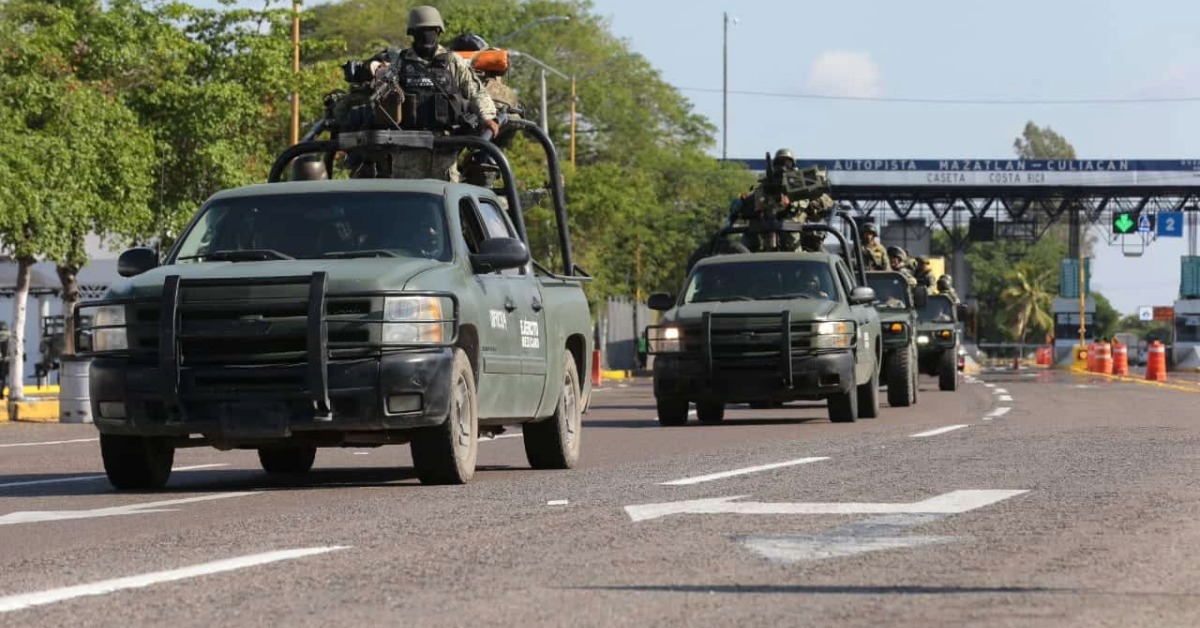
CULIACÁN, Sinaloa — The Mexican Army sent 1,500 additional soldiers to Culiacán on August 2, marking the latest and largest tranche in a weeklong security buildup meant to blunt a persistent and deadly wave of violence in the state. The new contingent brings the total number of army personnel injected into Sinaloa since late July to roughly 4,000, including special forces and paratroopers deployed in stages.
The reinforcements arrive amid deepening concern over a violent internal conflict within the Sinaloa Cartel that has left residents on edge, businesses scaling back operations, and disappearances and killings rising across the region.
Cartel feud and rising violence
Security officials say the escalation of forces responds to a nearly yearlong internal struggle between rival factions of the Sinaloa Cartel, commonly referred to as “Los Chapitos” and “Los Mayos,” which has deteriorated into open confrontations, targeted killings, disappearances, arson, vehicle thefts and public shootouts. Residents have reported sharp drops in foot traffic and many businesses have reduced hours or closed because of safety fears.
The violence intensified in late July. Over the weekend of July 26–27, at least 22 people were killed in a spate of homicides across the state, and despite the presence of more than 1,600 federal agents already deployed, attacks and killings continued, underscoring the limits of earlier efforts to stabilize the situation.
The broader security picture has tested the federal government’s strategy. President Claudia Sheinbaum’s administration has struggled to slow the bloodshed even as it pours resources into the state; the violence has left hundreds dead and contributed to thousands of disappearances since September 2024, driving a sense of insecurity among ordinary people and eroding confidence in public safety.
Deployment timeline and strategy
Federal officials, through the Secretariat of National Defense (SEDENA), have coordinated the phased buildup since July 22. According to local reporting, the initial wave included roughly 1,800 troops from elite units such as the Special Forces and the Parachute Riflemen Brigade, followed by smaller reinforcements—a group of 90 on July 27, another 300 on July 31, and 300 more on August 1—before the arrival of the 1,500-strong contingent on August 2. With those movements, federal forces have inserted at least 3,990 army personnel into Sinaloa in little more than a week, with some local outlets placing the cumulative number over the past two weeks at about 4,290.
SEDENA has framed the newest deployment as part of an integrated, multi-level security push with state and municipal authorities. The incoming troops are expected to focus on high-crime zones, establish checkpoints, conduct increased patrols and provide logistical and operational support to local law enforcement, which has been overwhelmed by the scope and volatility of the cartel infighting.
The buildup in Sinaloa mirrors a broader pattern of federal pressure on organized crime in recent weeks, with coordinated operations across multiple states aiming to disrupt cartel logistics, weapons flows and leadership structures.
Local impact and what’s next
The visible increase in military presence has already altered daily life in Culiacán and surrounding municipalities. Many shop owners report guarding their premises more closely, shortening business hours, or temporarily shuttering for fear of getting caught in crossfire. The sustained deployment aims not only to suppress immediate violent incidents but also to restore a modicum of normalcy so that commerce and public services can resume with less fear.
Officials have not released detailed maps of troop positioning, but local coverage indicates the deployments will concentrate on hot spots where cartel factions frequently clash and on transit corridors. The success of the strategy will depend in part on intelligence sharing and cooperation with municipal police, whose capacity has been strained by years of infiltration, corruption, and direct threats from criminal groups.
For now, residents and local leaders remain cautious. Past surges in federal deployments have yielded mixed results, with violence ebbing briefly before flaring again amid the shifting dynamics of cartel rivalry. The latest reinforcements represent a bet by federal authorities that quantity, coordination and pressure can blunt the internal feud long enough to break patterns of killings and disappearances.
Federal officials have not provided a public timeline for drawing down the new forces. Observers say sustained presence, paired with targeted arrests and follow-through on corruption probes, will be necessary to turn the tide.