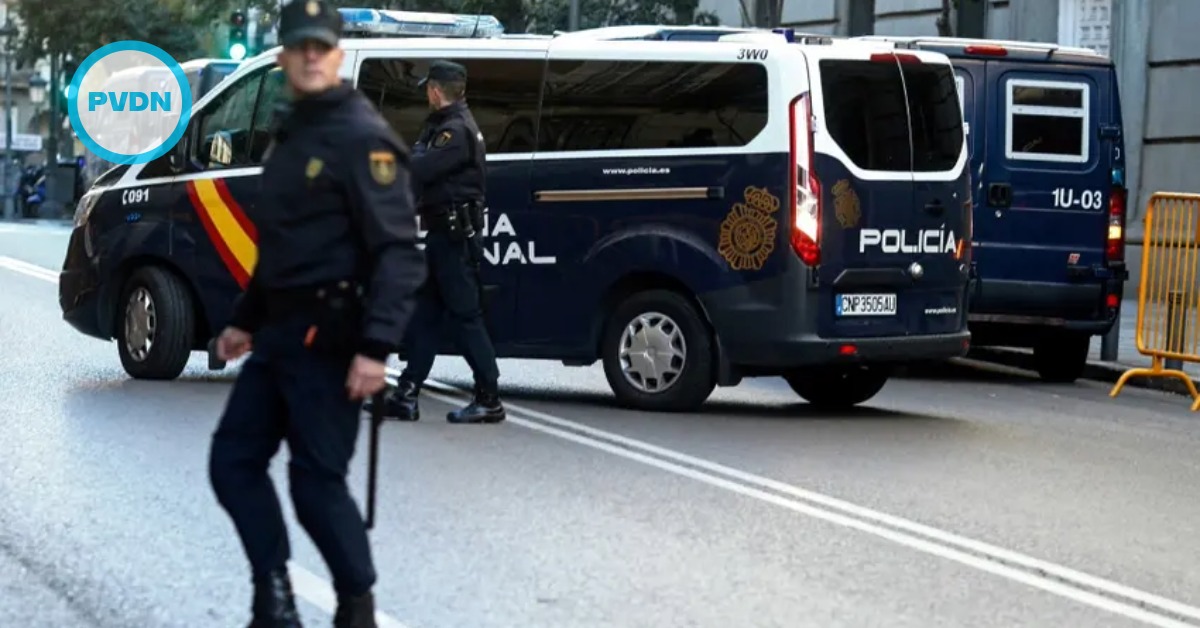
When Spanish officers moved on a rural estate near the town of La Adrada, west of Madrid, they were not just chasing another cocaine shipment. The raids, part of an operation known as Oyamel, led to the arrest of 20 people linked to the Jalisco New Generation Cartel, or CJNG, and exposed a full-service hub built to serve the European market.
From that base and several other properties, investigators say the group brought in large consignments of cocaine and amphetamine hidden inside heavy industrial machinery shipped from South America. Police seized close to 1.9 tonnes of cocaine, hundreds of kilos of amphetamine, cash, cryptocurrency, firearms, vehicles, and even bars of silver. Among those detained were two targets flagged as priorities by U.S. drug agents, as well as alleged members of Italy’s Camorra who helped move the drugs onward to other EU countries.
The network also relied on a Spanish businessman who allegedly created and used a web of front companies to receive the machinery, move the drugs, and launder the profits. For investigators, the structure looked far less like an imported Latin American crew and far more like a cartel franchise grafted onto European soil.
How Mexican cartels in Europe changed their role
For years, officials in Europe saw Mexican groups mainly as wholesalers, shipping cocaine by sea and leaving local gangs to handle the rest. That picture has shifted. A joint strategic report by Europol and the U.S. Drug Enforcement Administration describes Mexican “cooks” helping run methamphetamine labs and cocaine conversion facilities inside the EU, including a string of laboratories dismantled in the Netherlands and Belgium in 2019 and 2020 with Mexican and other Latin American suspects on site.
According to that same assessment, Mexican criminal actors now share know-how as much as product. They bring in specialists who can squeeze more yield from chemical precursors, recycle waste, and turn out stronger, more profitable crystals of meth. They also help set up shell companies and infiltrate real transport firms, hiding drugs in normal trade flows while money launderers recycle profits through trade-based schemes, underground banking, and cryptocurrencies.
European policymakers are sounding the alarm. A senior official in the European Commission’s home affairs department recently warned that criminal organisations from Mexico, once marginal in Europe, have intensified their activities, especially in cocaine and crystal meth. He described operational centres spread across the Netherlands, Belgium, Portugal, Germany, France, and Romania. He said they even attempted to use private aircraft that refueled off the coast of Africa before delivering loads to Italy, where the ‘Ndrangheta took over.
The alliances are not only Italian. A recent U.S. Treasury designation detailed how an Albanian family network used casinos, restaurants, and other companies in countries including Poland to launder millions of dollars for the Sinaloa cartel. That case, built on financial intelligence, underscored how Balkan groups have become key partners in moving and disguising cartel money tied to the European market.
Northern Europe is feeling the pressure, too. Police in Ireland have repeatedly warned that Mexican cartels, particularly the Sinaloa organisation, appear to be using the island as a distribution point from which cocaine can be pushed deeper into the continent. Ireland’s ports, logistics links, and financial services sector make it attractive as both a gateway and a place to park capital.
Taken together, these developments show why European officials increasingly speak of Mexican cartels in Europe as embedded actors. They are no longer just distant suppliers sending containers across the Atlantic. They are co-investors in labs, silent partners in logistics firms, and backroom players in casinos and other cash-heavy businesses scattered across the EU.
Europe scrambles to respond to a quiet expansion
Politically, the response is still catching up. In October, members of the European Parliament’s delegation for relations with Mexico called for a stronger joint mechanism with Mexico’s Congress, arguing that the advance of Mexican networks in Europe’s cocaine, methamphetamine, and money-laundering markets demands a “more energetic” form of cooperation. They pointed to recurring images of drug-laden vessels and semisubmersible craft intercepted near Iberian ports, and to rising violence around key commercial hubs such as Rotterdam and Antwerp.
European officials also worry about what comes next. The Europol–DEA report notes that a larger Mexican presence could bring more violence and that the same networks moving cocaine and meth could, in theory, help expand other synthetic markets. It mentions seizures of fentanyl and related precursors at a handful of sites in Europe, though it stresses that there is no clear evidence yet of Mexican cartels actively producing fentanyl for European users. The concern is less about today’s overdose numbers than about how quickly markets can change once infrastructure is in place.
On the other side of the Atlantic, Mexican diplomats remind European partners that their own government has dismantled thousands of meth labs, seized tonnes of drugs, and arrested tens of thousands of suspects, including members of groups like CJNG and the Pacific cartel. They argue that every lab destroyed and every shipment seized in Mexico also protects consumers in Europe and the United States. But even as they list arrests and seizures, European lawmakers see traffickers adapting, shifting routes through West Africa, diversifying front companies, and embedding deeper into local criminal ecosystems overseas.
For ordinary people in Europe, the changes are mostly invisible. Street-level dealing still looks local: the same bars, the same corners, the same faces. But behind those familiar scenes, the supply chain is more global and more professional than ever. When a rural estate in central Spain turns out to be the “office” of a Mexican cartel, with trusted links to Italian and Balkan mafias, it suggests a different kind of threat. It is not only about the volume of drugs but about the corruption, intimidation, and financial distortion that follow.
Operation Oyamel will be held up by authorities as proof that international cooperation can still hit these networks hard: Spanish police, U.S. agents, and European partners working together, twenty suspects in custody, and tonnes of cocaine taken off the market. At the same time, the case underlines how far Mexican groups have travelled from their home turf, and how deeply they have learned to plug into foreign societies.
Whether Europe can match that level of adaptation is the open question. Building tougher port controls and better financial oversight is one part of the answer. The other is political will, in Brussels, in national capitals, and in Mexico City, to treat this as a shared security issue rather than someone else’s distant war. The story of Mexican cartels in Europe is no longer about drugs crossing an ocean. It is about what happens when they decide to stay.