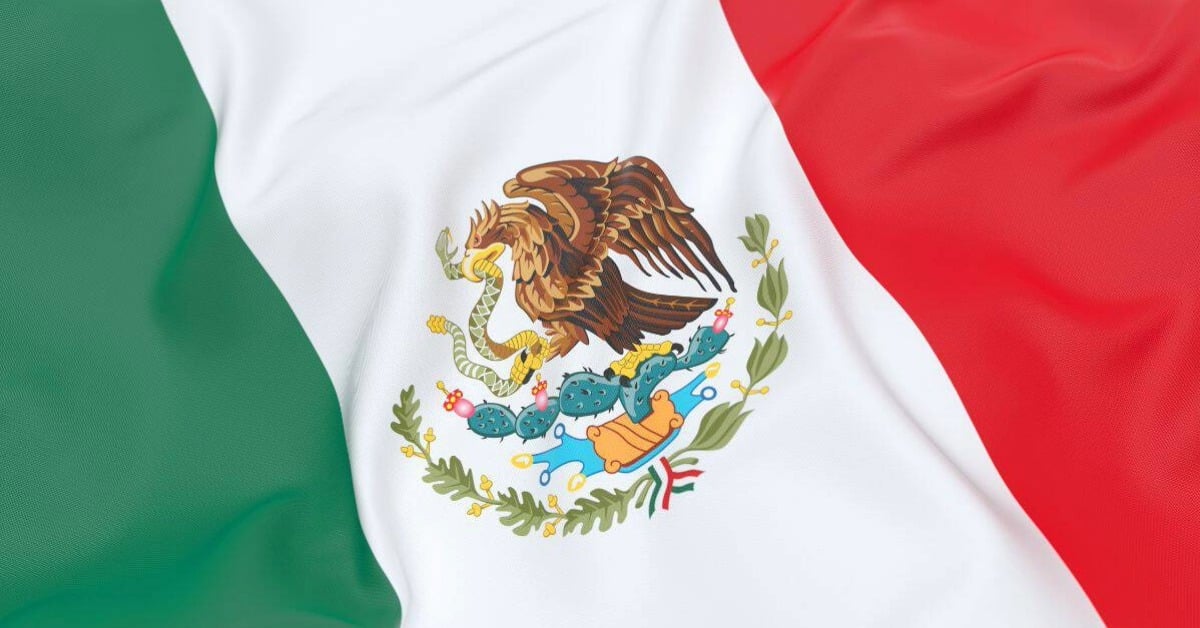
You can stand in Mexico City’s Zócalo, watch the huge flag rise in the morning wind, and forget that its center once floated on a lake. The eagle, cactus, and serpent feel like a logo now, something printed on passports and football jerseys. Yet that tiny scene on cloth is really a compressed history of migration, conquest, faith, and survival.
According to Mexica tradition, the god Huitzilopochtli ordered his people to leave their homeland and wander until they found a sign: an eagle perched on a cactus that grew from a stone in the middle of a lake. After generations on the move—archaeologists and historians often speak of a journey lasting about 175 years—the Mexica finally reached a small island in Lake Texcoco and founded Tenochtitlan in 1325, the city that would later become Mexico City.
That origin story appears in several colonial-era Indigenous manuscripts, including the Codex Boturini, which traces the pilgrimage as a long chain of footprints and place glyphs marching toward the lake. For Mexica communities, it was less a fairy tale and more a charter: a way to remember who they were, why they settled on waterlogged ground, and how their city was meant to sit between the earthly and the divine. Archaeologist Eduardo Matos Moctezuma has described the tale as a symbolic retelling of real historical movement, rather than a literal travel diary signed by a god.
Even the details carry layers. In pre-Hispanic thought, the eagle stood for the sun and Huitzilopochtli himself, the militant energy that fed the empire. The cactus, covered in fruit, evoked Tenochtitlan, the “place of the prickly pear on the stone.” The serpent, far from being an automatic villain, was often linked with wisdom and powerful deities such as Quetzalcóatl and Coatlicue. Many original Mexica images of the city’s founding show an eagle alone, or clutching a war glyph rather than a snake, which reminds us that the version on today’s flag is not a simple copy of an ancient drawing.
From sacred omen to city emblem
When the Spanish conquered Tenochtitlan in 1521, they smashed temples but did not erase the island city beneath them. Hernán Cortés ordered a new colonial capital built partly from the stones of the Mexica sacred structures, including the great Templo Mayor. The Old City Hall on the edge of today’s Zócalo, where Mexico City’s government now sits, rose in 1522 using that salvaged stone. Its walls still stand above buried pyramids and offerings. Under the cathedral and surrounding streets, archaeologists have uncovered the Templo Mayor’s layered foundations and famous finds such as the Coyolxauhqui Stone, renewing public awareness that the modern city literally rests on an older one.
At the same time, the eagle-on-cactus image began a second life in European hands. In 1523, Emperor Charles V granted Mexico City a formal coat of arms: an eagle on a nopal rising from water, framed in a style that fit Spanish heraldic taste. For colonial rulers, this was a way to claim the Mexica capital’s power while announcing that it now belonged to the Spanish crown.
Missionary orders quickly realized the symbol’s usefulness. Franciscans, Dominicans, and others carved and painted eagles and cactus pads into cloisters, façades, and altarpieces across New Spain. It was a visual bridge: Indigenous people could see echoes of their founding myth, while friars pointed to Christian meanings.
That is where the serpent’s role changed. A mistranslation in a Nahuatl chronicle helped some friars argue that the eagle was meant to be devouring a snake. From there, writers such as Diego Durán cast the scene as a drama of good defeating evil: the noble eagle (now read as Christian virtue) crushing the sinful serpent. Jesuits and other orders embraced this reading. By the 17th century, many depictions of Mexico City’s emblem included the serpent, which fit neatly into European ideas about the Bible and moral struggle.
Fast-forward to today, and that story is being retold again inside the same colonial walls where much of this visual politics played out. The new exhibition “Un escudo, un emblema, un símbolo de identidad” at the Antiguo Palacio del Ayuntamiento walks visitors through seven centuries of the emblem, from Mexica codices to modern seals. It is one of the flagship events marking 700 years since the founding of Tenochtitlan. In speeches during the commemoration, Mexico City’s government has framed the old city not as a vanished world but as a “heartbeat” still felt beneath the pavement—a reminder that the capital’s identity did not begin in the 16th century.
Mexican flag symbol
By the time Mexico won its independence in the 19th century, the eagle, cactus, and serpent were deeply associated with the capital and with New Spain as a whole. Revolutionary leaders did not toss that image out; they claimed it. The First Mexican Republic adopted a national coat of arms in 1823 based on the colonial emblem: an eagle perched on a prickly pear cactus, holding a serpent, now framed by oak and laurel branches rather than a royal crown.
From there, the design kept shifting with politics. Some 19th-century versions showed the eagle facing one way, then the other. Under specific regimes, it wore an imperial crown; under others, it perched without one, signaling a republican spirit. The serpent changed shape too, moving from an aquatic snake to a rattlesnake that looked more “Mexican” to modern eyes.
The version most people know today dates to the 20th century. In 1968, artist Francisco Eppens Helguera refined the coat of arms into the modern, tightly composed image: a golden eagle in mid-strike, wings raised, serpent clenched in beak and talon, balanced on a nopal that grows from a stone above the lake. Mexico’s government later fixed that design in law, alongside clear rules for the national flag. When you see the emblem on coins, passports, or the presidential podium, you are looking at that specific vision.
Yet the meanings people read into the Mexican flag symbol are not frozen in time. For some, it still tells the story of a divinely guided people who built a city where no one else dared. For others, it captures resilience: a reminder that Indigenous cultures survived conquest and found ways to leave their mark on institutions that once tried to erase them. Scholars continue to point out that the serpent was never simply “evil” in Mexica thought, and that the eagle and snake together can be seen as a meeting of sky and earth rather than a simple fight scene.
Look around Mexico City, and you can see the emblem’s many lives unfold at once. It hangs in polished bronze in government halls and appears in spray-painted form on protest banners. It is printed on school notebooks and reimagined in murals in working-class barrios. It hovers above a cathedral whose stones sit alongside the excavated Templo Mayor, linking two very different religious worlds in a single frame.
That is why a small exhibition in an old city hall matters more than it might seem. By placing Mexica codices, colonial coats of arms, and modern flags in the same space, curators invite visitors to consider how a single image can travel through time, absorbing new meanings without losing its roots.
The next time you spot the flag over the Zócalo, you might picture that first island instead: a patch of rock and cactus covered in birds, surrounded by water and volcanic mountains. You might imagine people stepping out of canoes, told by story and ceremony that this was the place they had been walking toward for generations. The eagle on the cactus is still there, but so are the footsteps that led to it—and the city that rose, and rose again, around its shadow.