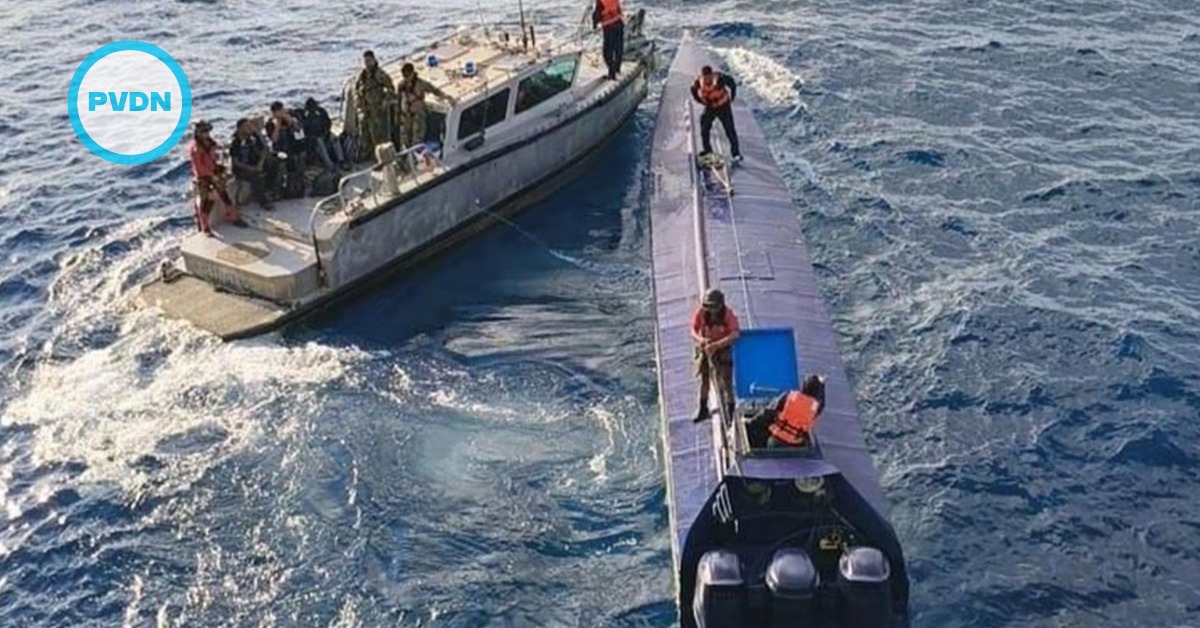
A gray, low-slung vessel barely above the Pacific swells is not the kind of thing most people imagine near Mexico’s beach towns. Yet that’s what patrol aircraft reportedly spotted off Colima: a semi-submersible, three people aboard, and 179 tightly wrapped bales believed to be cocaine. Officials say the load is measured in tons, not kilos. The operation also hints at something else—how much intelligence, and how far offshore, today’s drug war now runs.
What the Navy says it found
Federal authorities say Secretaría de Marina intercepted a low-profile “semi-submersible” in the Pacific carrying 179 bundled packages believed to be cocaine—an estimated load of roughly four tons—while detaining three people aboard. The interception was reported on Thursday, February 19, 2026, as part of ongoing maritime surveillance operations aimed at choking off criminal revenue at sea.
The reported location matters as much as the cargo. Officials placed the interception more than 250 nautical miles—about 463 kilometers—south-southwest of Manzanillo, off the coast of Colima. That is far beyond the range of anything most residents or visitors would ever see from shore, in waters where the ocean is less “coastal patrol” and more “open-sea chessboard.”
Authorities said the operation was run as a coordinated sea-and-air deployment, involving an ocean patrol vessel and multiple aircraft and interceptor units, and carried out alongside federal security and justice institutions, including Secretaría de la Defensa Nacional, Fiscalía General de la República, Guardia Nacional, and Secretaría de Seguridad y Protección Ciudadana. The detainees and the seized cargo were expected to be transferred to the appropriate authorities once the vessel reached port, where prosecutors can begin formal processing.
One important caveat: officials described the drug weight as an estimate. In Mexico, the definitive figure typically comes once seized narcotics are physically processed and weighed under prosecutorial authority at port. In other words, “about four tons” is the operational estimate based on packages recovered at sea, but the final number may change once authorities complete the formal weigh-in.
Why “semi-submersible” is the keyword
The term “semi-submersible” can be misleading if you picture a military submarine. In most drug-trafficking cases, the craft is better understood as a low-profile vessel engineered to ride extremely close to the surface—minimizing its silhouette and complicating detection.
A widely used classification framework in maritime counter-narcotics work distinguishes between larger self-propelled semi-submersibles (often described as “SPSS”) and the smaller, low-profile vessel category, often referred to as “LPV.” In that framework, LPVs are described as improvised, clandestine craft built to reduce radar and visual detection, frequently using materials such as wood and fiberglass. They are typically designed with a long, narrow body and a pointed bow, operating almost at the waterline, and commonly staffed by small crews. Reported operating characteristics for LPVs include speeds of roughly 10–20 knots and cargo capacity measured in tons, with some models described as one to four tons—strikingly consistent with what Mexican authorities reported in this case.
The same framework underscores why aviation assets are often decisive. Low-profile craft are difficult to spot because so little of the vessel sits above the surface; some analyses note that detection opportunities may be best during daylight and through visual observation from aircraft. That matches what officials described here: a multi-asset operation using maritime units and aircraft rather than a simple ship-to-ship boarding.
The offshore route and the international intelligence layer
Cocaine trafficking into Mexico is not a mystery route so much as a stubborn reality of geography and demand. The United Nations Office on Drugs and Crime has described a common pathway in which cocaine is transported from Colombia toward Mexico or Central America by sea, and then moved onward over land toward North American consumer markets. For Mexico’s Pacific coast, that maritime leg means the key battleground often sits beyond the horizon—well outside tourist corridors, but still tied to the same coastal states by logistics and proximity.
That offshore distance is also where intelligence-sharing becomes essential. In this case, authorities said the operation benefited from U.S.-provided intelligence, citing support from U.S. Northern Command and Joint Interagency Task Force South. JIATF South is publicly described by U.S. defense organizations as a detection-and-monitoring hub for illicit trafficking, tasked with helping enable interdictions across an enormous operating area from a base in Key West, Florida. The practical takeaway is simple: in the open ocean, where a small craft can disappear into thousands of square miles of water, interdiction often depends on fusing maritime patrols with intelligence cues rather than “happening upon” a target by chance.
Because the reported interception point was more than 250 nautical miles offshore—beyond the 200-nautical-mile limit widely used to describe the maximum breadth of an Exclusive Economic Zone under the UN Convention on the Law of the Sea—this operation also falls within the legal and operational space where international cooperation is common and often necessary.
What this likely changes for expats living here
For most expats living in Mexico—whether on the Pacific coast or inland—the immediate impact on daily life is usually indirect. This interception was not a street-level bust, and it did not happen in a neighborhood; it took place far offshore, in waters almost no civilian will ever traverse. If you live near the coast, you might notice at most the visible footprint of maritime security: patrol aircraft overhead, increased naval presence, occasional official footage, and a steady cadence of announcements as authorities try to show results.
But the broader significance is real. A multi-ton shipment moved by a low-profile vessel points to sophisticated, high-value logistics. It also reinforces what officials have been signaling more openly: maritime enforcement is being framed not just as “catching drugs,” but as pressuring the finances that make large criminal organizations resilient.
There is also a geographic footnote worth understanding: the reference point of Port of Manzanillo is not incidental. Manzanillo is routinely described by port authorities and international reporting as Mexico’s leading container port and among the most important logistics hubs on the Pacific. That does not mean the port is connected to this specific seizure; the interception occurred far out at sea. But it does help explain why the area remains strategically important—economically, militarily, and for traffickers seeking routes that blend into commercial reality.