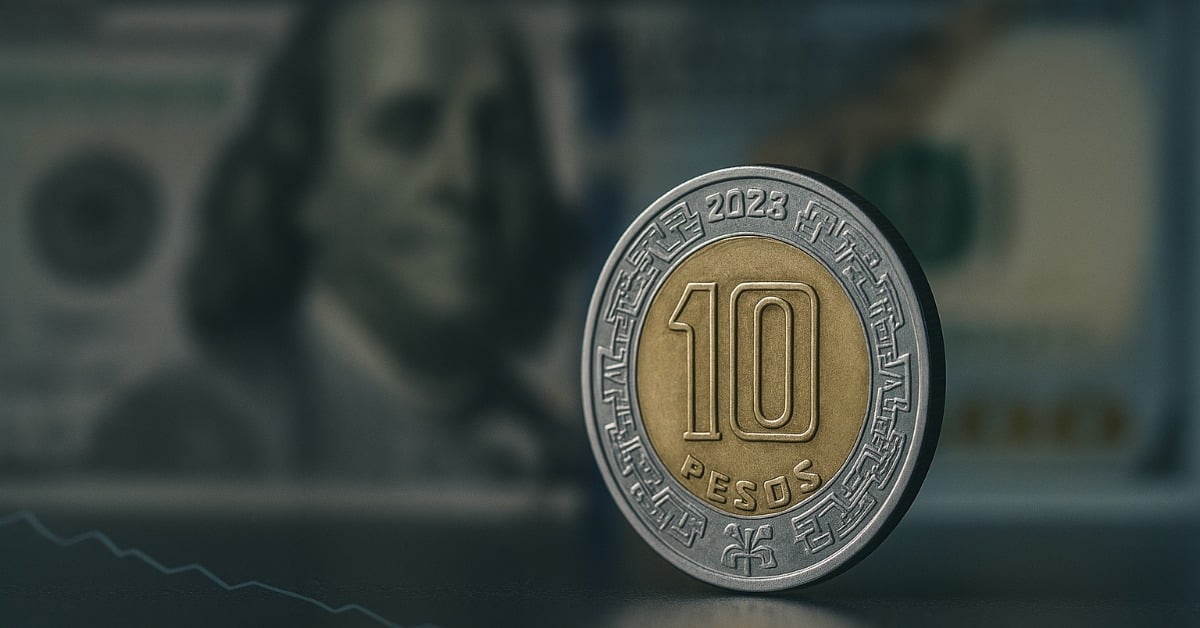
The peso slipped to 18.7807 per dollar on Monday, a modest 0.21% loss from Friday’s 18.7412 close. The move tracked a stronger greenback at the start of a week dominated by the Federal Reserve’s Jackson Hole symposium. Intraday, USD/MXN swung between 18.7167 and 18.8676, reflecting a market that was watchful rather than panicked.
The dollar’s broader tone did most of the work. The ICE Dollar Index hovered near a two-week high, up about 0.30% around 98.14, underscoring the bid for the greenback across majors. That backdrop tends to lean against high-beta currencies like the peso, and it did so again today.
Mexican peso depreciates against the dollar
Why now? Two catalysts framed the session. First, geopolitics: President Donald Trump hosted Ukraine’s Volodymyr Zelensky in Washington, a meeting paired with parallel European participation and intense speculation over any shift in the war’s trajectory. Markets dislike unknowns; they bought dollars.
Second, the Fed’s stage is set. Jackson Hole begins Thursday in Wyoming, with Chair Jerome Powell scheduled to speak Friday. When policy tea-leaf reading is on deck, positioning often tightens, and dollar demand can firm. That pattern was clear across Monday’s trading.
Local watchlist and data tone
At home, traders will parse the final second-quarter GDP print and June IGAE to gauge whether activity is cooling or holding up. Those updates won’t decide policy in Washington, but they will color how Mexico’s rate path interacts with the Fed’s. In that sense, local data may reinforce whether 18.60–19.00 remains the operative USD/MXN range or gives way to something broader. Monday’s close near 18.78 kept the debate alive without settling it.
On the day, the peso’s path matched the global playbook rather than any single domestic driver. That said, the upcoming data will matter for the relative-growth story that often steers medium-term currency trends. Traders will also keep one eye on remittances and trade flows, which can soften or amplify global shocks in the peso. (Background on Banxico’s benchmark series and methodology is linked in the Sources box.)
Technical picture, translated
Technically, Monday’s settlement clustered around the 50-day moving average, which many desks watch as a short-term pivot. Traders flagged resistance near 18.90 and 19.00 and support around 18.66 and 18.60—levels that lined up with intraday behavior. That map doesn’t predict the next move; it tells you where liquidity may thicken if headlines jolt the tape.
For households and businesses, the signal is practical. Importers facing dollar invoices should budget with a cushion while the Fed story plays out this week. Exporters can use intraday strength to layer hedges rather than chase end-of-day swings. Travelers and e-commerce buyers will feel small, day-to-day differences, but volatility remains moderate by recent standards, given the tight range.
As ever, one day does not make a trend. But Monday’s mix—a firmer dollar, geopolitical noise, and the Fed’s annual spotlight—was textbook. If Powell leans cautious about cuts, dollar strength could linger, and the peso may test resistance. If he nods to ease, watch support. Either way, Mexico’s own data in the coming days will decide whether those levels hold.