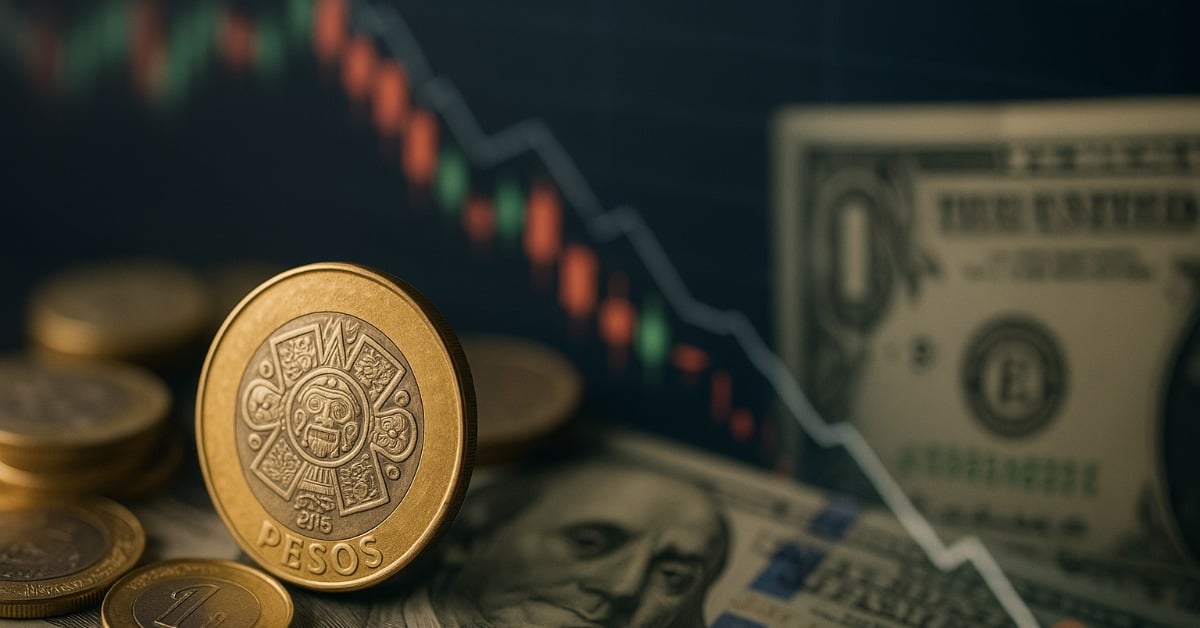
Mexican peso exchange rate
The peso weakened for a second session, with Banco de México’s interbank 48-hour value close at 18.8176 per dollar. That compares with 18.7807 at Monday’s finish, a modest 0.20% slide. Intraday, official Banxico data show trading roughly between 18.78 and 18.85. Market feeds captured a similar corridor.
The dollar edged up into the New York close, with the ICE U.S. Dollar Index at 98.28, up 0.11%. That gentle dollar bid helped lean on the peso through the afternoon.
What the dollar–peso (USD→MXN) is doing, why it’s moving, and how to get fair value when you pay or withdraw. Our Mexican Peso hub keeps the big picture, what’s changing now, and our best reporting in one place.
What moved the market today
There was little complex data on Tuesday. Positioning dominated ahead of the Jackson Hole Economic Policy Symposium, where Fed Chair Jerome Powell speaks on Friday. Investors are hunting for hints on the path of U.S. rates into September.
Local commentary echoed that setup. In notes circulated the region this week, desks highlighted the dollar’s pre-Jackson Hole bid as the primary driver of intraday FX moves. Banco Base, for instance, flagged the greenback’s strength in Powell’s remarks as a headwind for the peso.
Global crosscurrents
Geopolitics colored the backdrop. On Monday and Tuesday, U.S. President Donald Trump met Ukrainian President Volodymyr Zelenskiy alongside European leaders, talks framed as part of a push toward a negotiated end to the war with Russia. Headlines pointed to U.S. security guarantees under discussion. Such high-stakes diplomacy tends to keep risk sentiment guarded, reinforcing the dollar’s tone.
What to watch next in Mexico
Attention now turns to a tight domestic calendar. Banxico publishes the minutes from its August 7 policy meeting on Thursday, August 21. The central bank cut the policy rate by 25 bps to 7.75% at that meeting, and traders will parse the minutes for guidance on the pace of any further easing.
On Friday, August 22, INEGI releases the second-quarter GDP report. The timely estimate last month showed quarter-on-quarter growth of 0.7%; Friday’s publication will help confirm the mix by sector. Also on Friday, INEGI posts the first-half-August CPI, a closely watched gauge for Banxico’s reaction function.
The bigger picture
Even with two down days, the peso remains within its late-July to mid-August range, a channel technicians have been watching as a proxy for calm in Mexican assets. Local coverage has repeatedly described a sideways market that could break if U.S. policy signals or Mexico’s inflation surprise.
For households and businesses, the practical read is simple. A soft dollar helps near-term import costs; a firm dollar does the opposite. Over the next 72 hours, the Mexican peso exchange rate will be steered less by headlines out of Mexico City and more by Powell’s tone in Wyoming and by how both sets of minutes frame the inflation-growth trade-off.