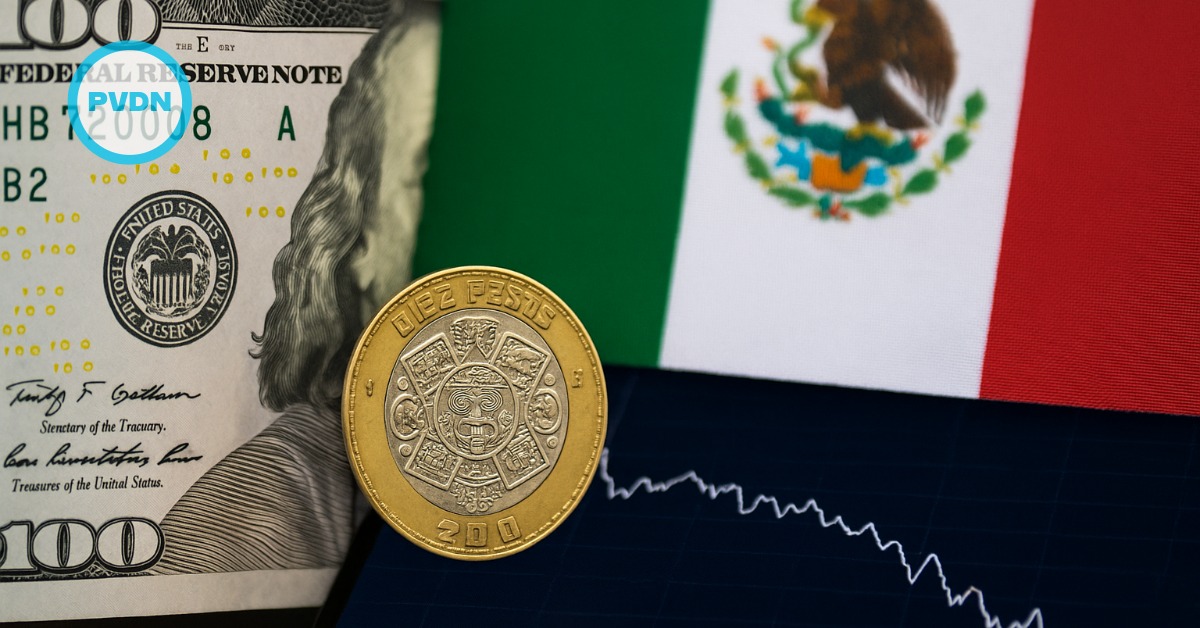
The Mexican peso started the week a little weaker against the dollar as local markets reopened on Tuesday after the Revolution Day long weekend. In a session marked by cautious trading and global risk aversion, the currency slipped only modestly, but enough to remind investors how sensitive it remains to shifts in sentiment around interest rates and growth.
According to official figures, the Mexican peso exchange rate ended the day around 18.3390 pesos per dollar in wholesale markets, a loss of 0.16%, or 2.88 centavos, compared with Friday’s close. At the same time, Bank of Mexico reference rates showed the official FIX published in the Diario Oficial at 18.3262 pesos per dollar and the rate used to settle dollar obligations at 18.2805 pesos, underscoring that the move was small in absolute terms.
Local desks noted that part of Tuesday’s adjustment reflected a simple reset after Monday’s holiday, when thin liquidity had exaggerated some intraday swings. Analysts at Monex described the move as a “downward correction” after the exchange rate was pushed higher on low volume during the Mexican holiday, adding that investor caution has grown as risk appetite cools and trading returns to normal volumes.
While the peso weakened, the dollar itself did not stage a major rally. The dollar index, which measures the U.S. currency against a basket of major peers, hovered near 99.6 points with only marginal changes on the day. That combination — a softer peso in the face of a mostly steady dollar — underlined that Tuesday’s move was driven more by local positioning and risk sentiment than by an outright surge in the greenback.
Mexican peso exchange rate under pressure
The backdrop for the day’s trading was anything but calm. Global equity markets extended a November pullback as investors questioned whether the powerful rally in big technology and artificial intelligence names had gone too far and trimmed expectations for rapid interest rate cuts from the U.S. Federal Reserve. Volatility gauges in U.S. markets climbed, and major indices in both the United States and Europe traded lower, reinforcing a risk-off tone that often weighs on emerging-market currencies.
For Mexico, the timing of that shift in mood matters. This is a data-heavy week at home and abroad. On the local front, markets are waiting for fresh numbers on manufacturing activity and the monthly indicators of economic activity, as well as a new estimate of third-quarter GDP. Later in the week, Bank of Mexico will publish the minutes from its most recent policy meeting, where board members cut the benchmark rate by another quarter of a percentage point, and investors will parse every line for hints on how far easing might go.
Abroad, the United States is set to release a backlog of key indicators following the end of the recent government shutdown, including labour-market reports and business surveys that could shape the debate inside the Fed. Recent commentary from Fed officials has highlighted deep differences over whether stubborn inflation or slowing hiring poses the greater risk, and futures markets have dialled back the probability of a December rate cut to roughly a coin flip.
In that environment, even modest daily moves in the peso take on extra meaning. A weaker currency can offer some breathing room to exporters and tourism operators paid in dollars, but it also threatens to import price pressures in an economy where inflation is still above the 3% target, forcing Banxico to walk a fine line between supporting growth and keeping prices under control.
What comes next for the peso
For now, most of the evidence points to consolidation rather than a sharp break in either direction. Monex analysts said they expect the exchange rate to trade overnight in a relatively tight band between 18.30 and 18.43 pesos per dollar, reflecting the return of Mexican market participants after the holiday and a light domestic calendar for Wednesday. That range sits close to recent levels and suggests that, barring a major surprise in upcoming data, traders see little reason to test the peso’s recent highs or lows in the very short term.
The bigger question is how investors will react once the new information arrives. Stronger-than-expected data on Mexican activity could ease worries about a slowdown and, paradoxically, reduce pressure on Banxico to cut rates quickly, which might help the peso stabilise or even regain some ground. On the other hand, a run of soft domestic indicators combined with signs of a weaker U.S. economy could revive concerns about growth on both sides of the border and keep markets in a defensive mood.
For households and businesses, the message from Tuesday’s session is that the currency remains in a delicate balance rather than at a turning point. The peso is still trading within the broad 18–19 per dollar range seen in recent weeks, and the day’s 0.16% depreciation is modest by the standards of a currency that can move far more on days of real stress. What will matter over the coming sessions is less the precise level of the exchange rate at the end of each day and more how the incoming data reshapes expectations for Banxico and the Fed — and, with them, the appetite to hold or shed Mexican assets.