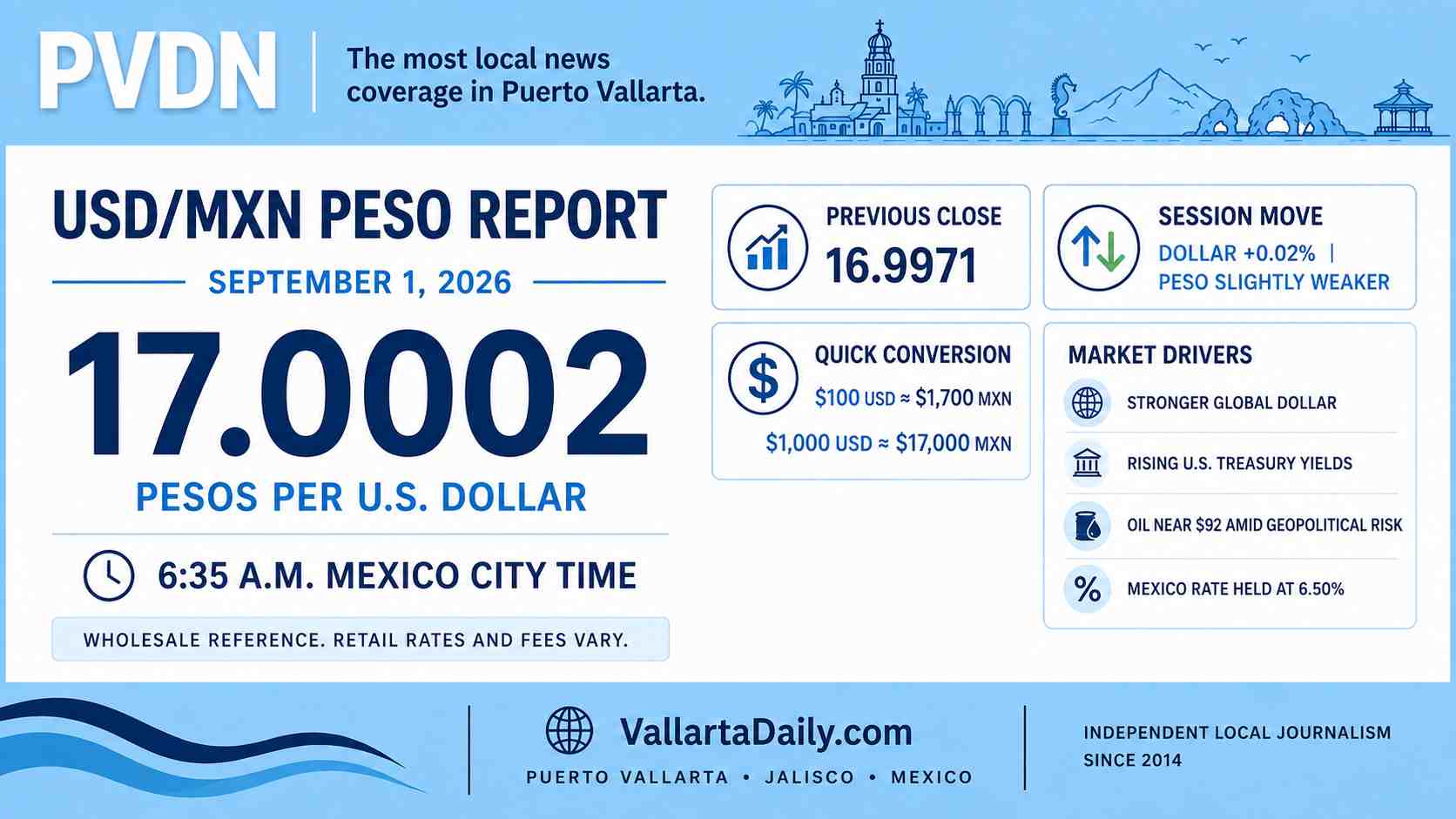
Puerto Vallarta, Jalisco, Sept. 1, 2026 – The Mexican peso opened September close to 17 per dollar, showing little change despite rising oil prices, higher global bond yields and renewed demand for the U.S. currency.
The live wholesale USD/MXN rate was approximately 17.0002 pesos per dollar at 6:35 a.m. Mexico City time. That placed the dollar about 0.02% above the quoted previous close of 16.9973, meaning the peso was fractionally weaker.
The latest Banco de México closing rate was 16.9971 on Monday, down from 17.0308 on Friday. That represented a peso gain of about 0.2% during the previous banking session.
Official rate differs from live market quotes
Banco de México’s official FIX rate published for dollar-denominated obligations was 17.0147 pesos for Sept. 1. The FIX is calculated from wholesale market quotes and is used for certain payments due in Mexico; it is not a retail exchange rate or a real-time trading price.
Banks, airport exchange counters, ATMs and money-transfer services set their own rates. Their customer prices may differ considerably from the wholesale market after spreads and fees are included.
Global markets favor the dollar
The peso’s narrow morning movement came as external conditions leaned toward a stronger dollar.
The U.S. currency gained ground as investors moved toward safer assets during a global bond selloff. The yield on the 10-year U.S. Treasury rose to 4.79%, its highest level since early 2025, while U.S. stock futures and European markets moved lower.
Brent crude climbed about 2% to $92.20 a barrel amid renewed U.S.-Iran fighting and concern about disruptions near the Strait of Hormuz. Higher oil prices were adding to inflation concerns and expectations that interest rates could remain elevated.
Oil is not a simple one-directional signal for the peso. Mexico receives export revenue from crude, but a sharp price increase tied to geopolitical tension can also strengthen the dollar, raise inflation expectations and reduce demand for currencies viewed as carrying more risk.
Traders were assigning a 65% probability to a Federal Reserve rate increase in September, up from 40% one week earlier, according to market pricing cited in the global markets report.
Mexican rates continue to support the peso
Domestic conditions were helping the peso resist the broader rise in the dollar. Banco de México held its benchmark interest rate at 6.50% in August, extending a pause in its rate-cutting cycle. Relatively high Mexican interest rates have continued to attract some short-term capital into peso-denominated assets.
The peso entered September about 5.6% stronger against the dollar than at the end of 2025. That longer rally has been supported by the dollar’s broader decline, Mexican interest rates and easing concern about immediate trade disruptions.
Uncertainty surrounding the United States-Mexico-Canada Agreement remains a counterweight. Preliminary figures show Mexico received nearly $35 billion in foreign direct investment during the first half of 2026, but only 7.8% represented new investment. New foreign investment fell 13% from a year earlier as companies delayed decisions amid uncertainty over future trade rules.
Those investment figures describe a medium-term risk for Mexico rather than a clear explanation for the peso’s small movement Tuesday morning.
Morning data could test the narrow range
U.S. economic releases scheduled for 8 a.m. Mexico City time include July job openings and the August manufacturing survey.
The U.S. Bureau of Labor Statistics scheduled its July Job Openings and Labor Turnover Survey for 10 a.m. Eastern time. The August manufacturing report is due at the same time.
Stronger readings could reinforce expectations for higher U.S. interest rates and support the dollar. Weaker data could reduce some of that pressure. The reaction will depend on how closely the results match market expectations.
Banco de México is also scheduled to release July remittance figures at 9 a.m. Remittances are an important source of dollar inflows for Mexico, although the monthly report does not always produce an immediate exchange-rate reaction.
Budgeting near the 17-peso line
At a wholesale reference rate of 17 pesos per dollar:
- $100 equals approximately 1,700 pesos.
- $1,000 equals approximately 17,000 pesos.
- 10,000 pesos costs approximately $588.
These calculations exclude bank spreads, card conversion charges, ATM fees and transfer costs. For Puerto Vallarta residents paid in dollars, a stronger peso reduces the number of pesos received when income is converted. People earning pesos but paying dollar-denominated expenses face the opposite effect.
The market rate was nearly unchanged early Tuesday, but the U.S. data calendar, oil prices and geopolitical headlines leave room for movement later in the session.