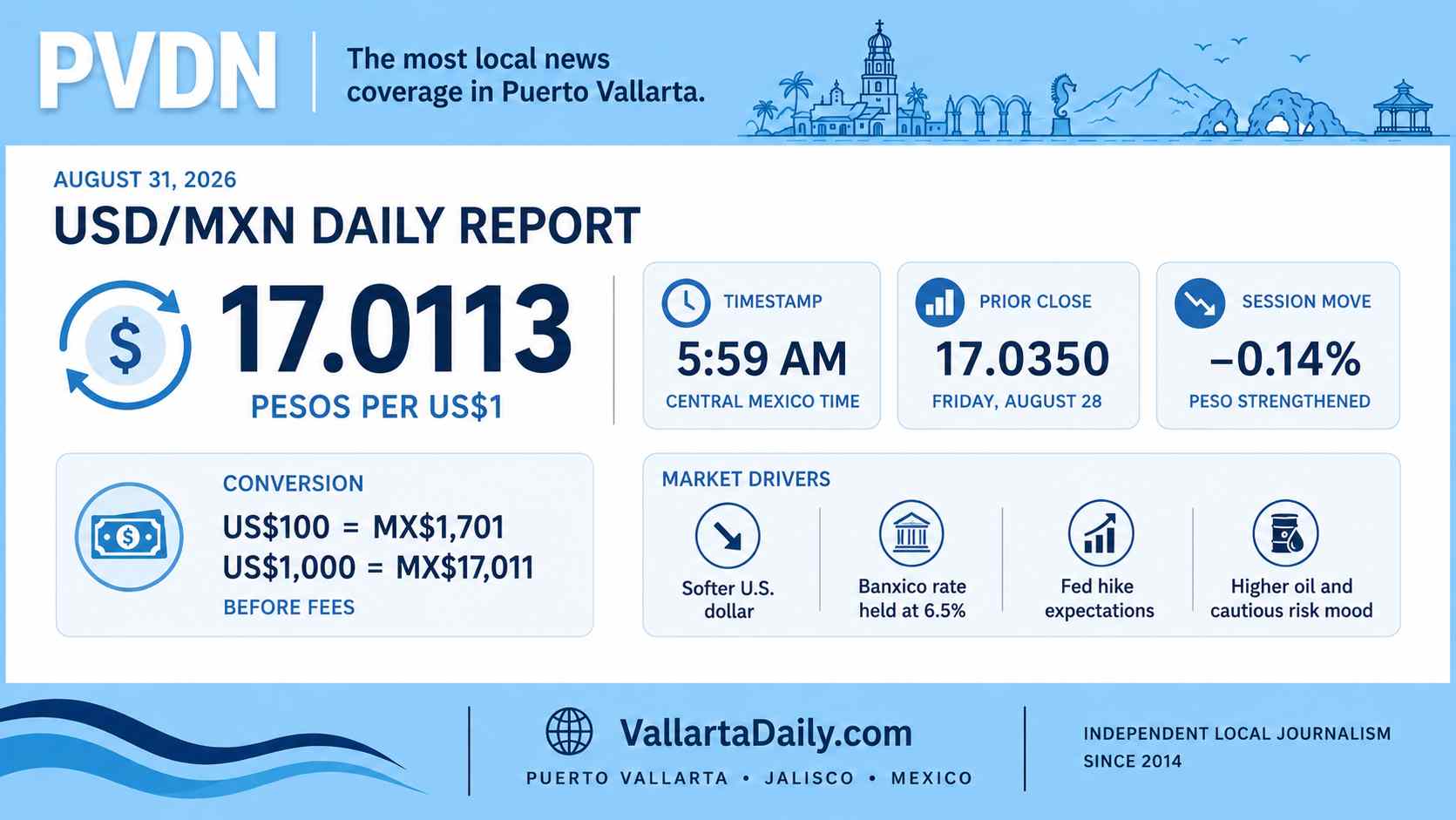
Puerto Vallarta, Jalisco, August 31, 2026 – The Mexican peso edged higher early Monday, with the USD/MXN exchange rate at 17.0113 pesos per dollar at 5:59 a.m. Central Mexico time.
The rate was 0.14% below Friday’s market close of 17.0350, meaning the peso had gained slightly against the dollar. Live wholesale market data showed the pair moving between 17.0038 and 17.0424 during the session.
Currency markets remain open throughout much of the day, and the rate available through Mexican banks, ATMs and exchange houses will include their own buying and selling margins.
Peso remains close to the 17-per-dollar line
Monday’s movement was small, but it kept the peso near a level that has become increasingly important for households, exporters and businesses with income or costs in both currencies.
The peso has strengthened by about 1.8% over the past month and nearly 9% over the past year, according to recent USD/MXN market data. It briefly moved below 17 pesos per dollar during August before giving back part of that gain late last week.
At Monday morning’s rate, US$100 converted to approximately 1,701 pesos and US$1,000 to about 17,011 pesos before fees. A 10,000-peso expense would require roughly US$587.84 at the wholesale rate.
The change from Friday was limited. US$1,000 converted at Friday’s close would have produced about 24 pesos more than at Monday morning’s rate.
Dollar pressure meets a cautious global market
The dollar slipped slightly against a basket of major currencies Monday, helping the peso recover some of Friday’s losses. That support was restrained by renewed concern over inflation, interest rates and conflict in the Middle East.
Oil prices climbed more than 3%, with Brent crude moving above $92 per barrel after new U.S. and Iranian military attacks. Global market reporting showed investors moving cautiously as higher energy prices pushed government bond yields upward.
The immediate effect of rising oil prices on Mexico is mixed. Higher crude prices can support oil-related revenue, but a sharp increase tied to military conflict can also reduce appetite for emerging-market currencies such as the peso.
Expectations for U.S. interest rates have also shifted. Markets were assigning about a 60% probability to a Federal Reserve rate increase in September following stronger inflation warnings from Fed Chair Kevin Warsh. That was up from less than 50% one week earlier.
A U.S. rate increase could narrow the interest-rate gap between Mexico and the United States, reducing one source of demand for peso-denominated assets. Traders will therefore watch Friday’s U.S. employment report and the September 11 inflation release closely.
Banxico’s rate pause continues to support the peso
Mexico’s benchmark interest rate remains at 6.5%, compared with the Federal Reserve’s 3.75% target rate. That difference has helped attract investors seeking higher returns in Mexico’s liquid bond and currency markets.
Minutes from Banco de México’s August meeting indicated that policymakers expect to keep the benchmark rate unchanged for an extended period. Officials cited persistent services inflation and uncertainty in the global economy.
Mexico’s annual inflation rate reached 3.26% during the first half of August, while core inflation remained higher at 3.93%. The economy also expanded 1.4% during the second quarter compared with the previous three months, according to INEGI’s latest gross domestic product estimate.
Those figures have reduced expectations for an immediate Banxico rate cut, although officials have not committed to how long the pause will last.
Trade relations with the United States remain a background risk. Mexico sends more than 80% of its exports to the U.S., leaving the peso sensitive to tariff announcements and negotiations surrounding the North American trade agreement. No new trade announcement appeared to be driving Monday morning’s movement.
A narrow change for dollar and peso budgets
For Puerto Vallarta residents paid in dollars, the stronger peso slightly reduces the local buying power of transferred income. The difference from Friday is modest, but the effect becomes more noticeable when the currency remains near 17 for several weeks.
People earning pesos face the opposite result when paying dollar-denominated expenses, including travel, imported goods and some online services. A stronger peso lowers the peso cost of those purchases.
Banco de México had not published Monday’s official FIX rate at the time of this report. The central bank normally releases that benchmark after noon on banking days. Its FIX rate for Friday was 17.0427 pesos per dollar, while its end-of-day reference rate was 17.0308.
Readers exchanging money should compare the final amount offered rather than the headline market rate. Bank spreads, ATM fees and exchange-house margins can outweigh a daily market move of one or two tenths of a percent.