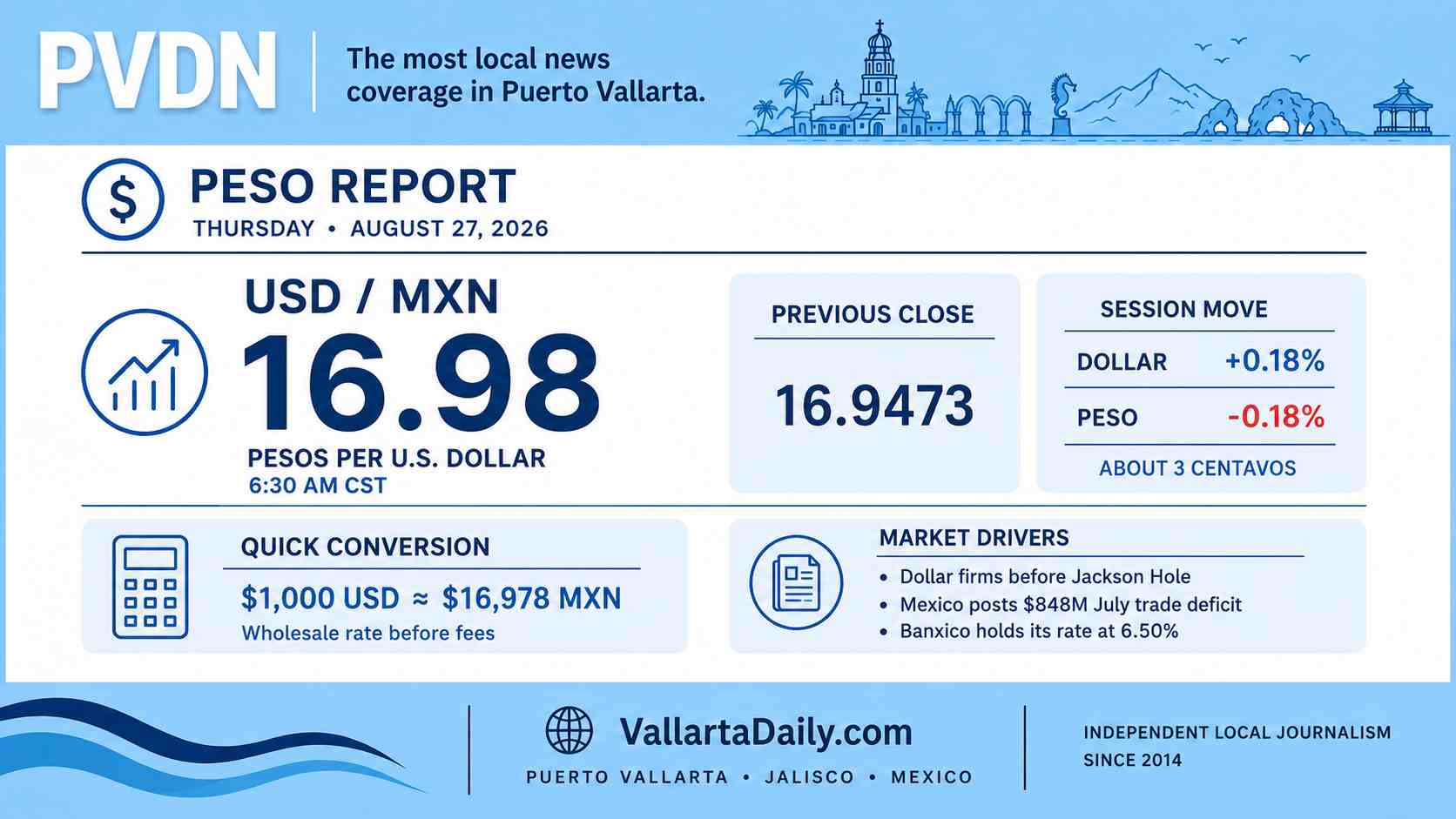
Puerto Vallarta, Jalisco, August 27, 2026 – The Mexican peso traded at 16.9776 per U.S. dollar at 6:30 a.m. Mexico City time Thursday, keeping the exchange rate just below the closely watched 17-peso level. Currency markets remain open around the clock, and the rate can change during the day.
The live wholesale quote placed the dollar about 0.18% above its previous-session reference, a move of roughly three centavos. Other market feeds showed a similar increase of 0.15% to 0.16%, meaning the peso was slightly weaker Thursday morning.
Mexico also released new trade figures at 6 a.m. The peso’s early retreat coincided with that report and a broader rise in the U.S. dollar, but the available price action does not establish that either development caused the move on its own.
Dollar Firms Before Jackson Hole
The dollar gained against several major currencies as traders prepared for the Federal Reserve’s Jackson Hole symposium and Friday’s scheduled remarks from Fed Chair Kevin Warsh.
The dollar index stood near 99.16 Thursday morning, up about 0.3% for the week. U.S. inflation data released Wednesday came in above expectations, while second-quarter economic growth was confirmed at an annualized 1.5%.
Interest-rate markets were pricing little chance of a Fed move in September but a 74% probability of at least one quarter-point increase by December. Expectations for higher U.S. rates tend to support the dollar, although those probabilities can shift quickly after economic data or Fed comments.
Oil was also elevated as markets followed developments in the Middle East. Higher petroleum prices can support Mexico’s export income, but they can also increase inflation concerns and strengthen expectations that U.S. rates will remain high. The net effect on the peso is rarely immediate or consistent.
July Trade Balance Swings to a Deficit
Mexico recorded a merchandise trade deficit of $848 million in July, reversing a revised $4.06 billion surplus in June, according to the official trade report released Thursday.
Exports reached $81.42 billion, up 43.7% from July 2025. Imports rose at a slightly faster 45% annual rate to $82.27 billion.
The headline deficit was less favorable for the peso than June’s surplus, but the details continued to show strong demand for Mexican manufactured goods. Non-automotive manufacturing exports increased 64.9% from a year earlier, while exports of electrical and electronic equipment more than doubled.
Mexico maintained a cumulative trade surplus of $9.26 billion during the first seven months of 2026. Non-petroleum trade produced a $28.14 billion surplus, partly offset by an $18.89 billion petroleum deficit.
Banxico Keeps a Rate Cushion in Place
The peso continues to receive support from Mexico’s comparatively high interest rates. Banco de México held its benchmark rate at 6.5% on August 6 and indicated that the current level would likely remain in place for now.
In its quarterly economic report published Wednesday, the central bank raised its 2026 growth forecast from 1.1% to 1.5%. The revision followed a 1.4% expansion in the second quarter, which reversed the economy’s first-quarter contraction.
Inflation remains part of the calculation. Mexico’s annual headline rate increased to 3.26% during the first half of August, while core inflation remained higher at 3.93%. Those readings help explain why Banxico has paused its rate-cutting cycle.
The interest-rate gap between Mexico and the United States has encouraged investors to hold peso-denominated assets. That support can weaken if U.S. rates rise, global investors reduce risk, or crowded peso positions are unwound.
Trade policy remains a background risk. The peso has gained nearly 20% against the dollar since January 2025, despite continued uncertainty over the United States-Mexico-Canada Agreement and its future annual reviews.
Budgeting Near 17 Pesos
At Thursday morning’s wholesale rate, $1,000 converted to approximately 16,978 pesos before bank spreads, transfer fees or ATM charges. The morning move added only about 30 pesos to that conversion compared with the previous session.
A 10,000-peso expense required about $589 at the wholesale rate. The actual dollar cost will usually be higher because banks and card issuers apply their own exchange rates and fees.
People receiving income in dollars benefit when USD/MXN rises because each dollar buys more pesos. Those earning pesos generally pay less for dollar purchases and imported goods when the peso is stronger. Dollar savings can also rise or fall in peso terms even when the account’s dollar balance does not change.
The wholesale market rate should not be confused with Banco de México’s FIX or retail exchange-counter prices. The official table listed an August 26 FIX of 16.9660 and a rate of 16.9460 for qualifying dollar obligations payable in Mexico on Thursday. Banxico publishes the new daily FIX after noon on banking days.
The 17-Peso Line Faces Fresh Tests
The peso remained close to 17 per dollar Thursday morning after several sessions of narrow trading. Its next moves will depend partly on U.S. jobless-claims data, the dollar’s reaction to Jackson Hole and any change in expectations for Federal Reserve rates.
Mexico’s July trade deficit gives markets another domestic figure to assess, while strong manufacturing exports and Banxico’s 6.5% interest rate continue to provide support. Exchange rates offered by banks, ATMs and transfer services may move independently of the wholesale quote throughout the day.