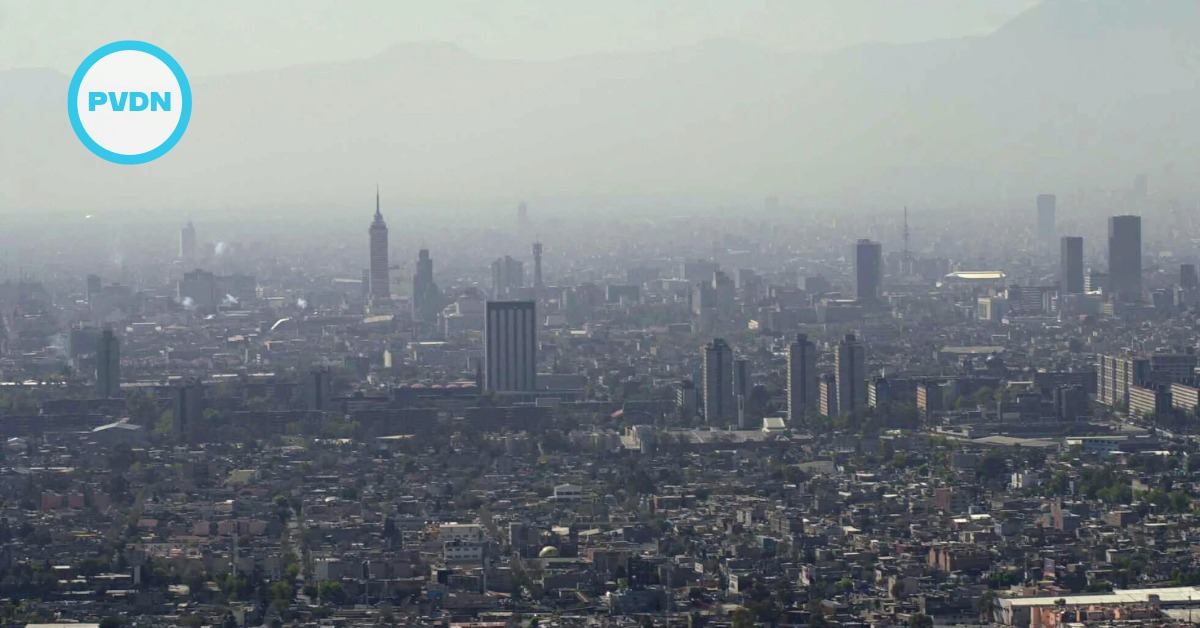
Mexico will tighten particle limits from 2026, sharpening air alerts in winter and pushing cities to confront persistent smog.
Mexico is about to change how it judges dirty air. From 2026, tighter limits on PM10 and PM2.5 will trigger health alerts sooner, especially during the cold, stagnant winter months when smog lingers over the Valley of Mexico. Officials say the tougher thresholds will not make factories or cars suddenly pollute more, but they will expose how often people breathe unsafe air. The real test will be whether cities can curb fireworks, trash burning and diesel exhaust enough to turn warnings into cleaner winter skies.
Mexico will tighten Mexico air quality standards from 2026, lowering the pollution levels that trigger official alerts for fine particles. The adjustment, announced by federal environment and health officials, focuses on PM10 and PM2.5, the tiny particles that lodge deep in the lungs and are tied to heart and lung disease. Instead of changing how monitors measure pollution, the country is changing what it considers acceptable before warning people to stay indoors.
Starting in 2026, the twelve-hour band that separates “acceptable” air from more dangerous levels will be tightened. For PM10, the upper limit of that band will fall from 60 to 50 micrograms per cubic meter, while for PM2.5 it will drop from 33 to 25 micrograms. Below those ceilings, the lower ends of the bands remain at 45 micrograms for PM10 and 15 for PM2.5, but the narrower window means fewer hours will qualify as acceptable and more will move into higher-risk categories.
Federal officials stressed that this shift is about health protection, not accounting tricks. The change stems from NOM-172-SEMARNAT-2023, the updated rule for calculating and communicating the national AIRE Y SALUD air-quality index, which took effect in July 2024. That norm requires index bands to track stricter health standards issued by the health ministry for particles and other pollutants, and it calls for more direct, easy-to-understand risk messages.
At the same time, NOM-025-SSA1-2021, the core health standard for PM10 and PM2.5, is pushing Mexico closer to World Health Organization guidelines, after years in which national limits were looser than international advice. Earlier versions of the rule allowed twenty-four-hour averages of 75 micrograms per cubic meter for PM10 and 45 for PM2.5, far above WHO’s recommended 50 and 25 micrograms. The 2021 update set a gradual path toward lower limits and acknowledged that particle pollution already contributes to tens of thousands of premature deaths in Mexico each year.
Officials know that, once the new thresholds take effect, many residents will feel like their city’s air suddenly “got worse.” They are already preparing that message: the air will be the same, but the yardstick will be more honest about the risks.
Mexico air quality standards
Behind the headline change is a dense web of technical norms that have shaped how Mexico judges its air since the 1990s. The health ministry regulates seven “criteria pollutants,” including ozone, nitrogen dioxide and particulate matter, through a set of official norms that set maximum concentrations over one hour, eight hours, twenty-four hours or a full year. Mexico’s national research institute on ecology and climate, working with SEMARNAT, runs a network of monitoring stations that feed those norms and the AIRE Y SALUD index.
One of the most sobering findings from the government’s own air-quality reports is how few monitoring stations meet even the older, more permissive particle limits. In the years leading up to the 2021 update of NOM-025, only a handful of PM10 stations and just one PM2.5 station complied with the twenty-four-hour standards. Most urban areas regularly exceeded those values, especially during the dry season and in metropolitan basins like the Valley of Mexico, where pollution tends to pool under thermal inversions.
The new 2026 thresholds do not change the physics of those inversions, or the fact that diesel trucks, construction dust, open burning and forest fires all feed the particle problem. What they change is when the state must admit that the air is unsafe, and how early vulnerable people are warned. NOM-172-SEMARNAT-2023 links the upper bound of the “acceptable” band in the AIRE Y SALUD index directly to the health norms for each pollutant. Once those norms tighten, the index must follow, and the colored maps many residents now check on their phones shift more quickly from green to yellow, orange or red.
This winter will serve as a preview. During the 2025–2026 cold, dry season, federal and Mexico City officials are already warning residents in the megalopolis that at least one pollution contingency is likely between Christmas and New Year’s Day, when the mix of stagnant air and human activity is at its worst. Along with calm winds and low temperatures, agencies point to a familiar list of triggers: night-time trash burning, bonfires, and a heavy dose of fireworks just after midnight.
Studies back up those concerns. Research in Querétaro using low-cost PM2.5 sensors found that New Year’s Eve fireworks can cause a sudden, sharp spike in fine particle concentrations, far above levels recorded on typical winter nights. Long-term data from the Mexico City region also show that Christmas and New Year’s Day almost always register as some of the most polluted days of the year, with fine particle levels high enough in some seasons to trigger emergency measures.
Protecting health in winter smog
Health experts worry less about the color of the index and more about what the particles are doing inside people’s bodies. Specialists from the National Institute of Public Health and other institutions have repeatedly linked PM10 and PM2.5 to short-term spikes in respiratory infections, asthma attacks and hospital admissions, as well as longer-term risks of heart disease, strokes and lung cancer. Official supporting documents for NOM-025 estimate that exposure to fine particles contributes to around 29,000 premature deaths in Mexico each year.
Fine particles pose a particular threat in winter because they weaken the body’s defenses against viruses and bacteria. When concentrations rise, people’s airways become irritated, the immune response in the lungs is blunted, and it becomes easier for infections like influenza and COVID-19 to take hold. Doctors report more emergency visits for bronchitis, pneumonia and asthma during these episodes, especially among older adults, children and people with chronic lung disease.
That is why officials are putting unusual emphasis on behavior this season. Alongside the technical talk about µg/m³ and index bands, they are asking families to skip or at least scale back fireworks, avoid burning trash or wood in the street, and keep an eye on daily air-quality updates before planning outdoor events. For diesel fleets, federal and local agencies are stepping up enforcement and self-regulation programs aimed at the most polluting vehicles, particularly heavy trucks that traverse the capital and its suburbs overnight.
None of that will be enough on its own. The tightened Mexico air quality standards are, at their core, a warning system. They make it harder to ignore the health cost of “normal” winter smog and the annual burst of fireworks-filled nights. Whether the country can turn earlier warnings into cleaner air will depend on decisions far beyond this winter: how quickly cities modernize public transport, how strictly industrial emissions are enforced, and how willing people are to leave old habits—like lighting up the night sky at New Year’s—behind.