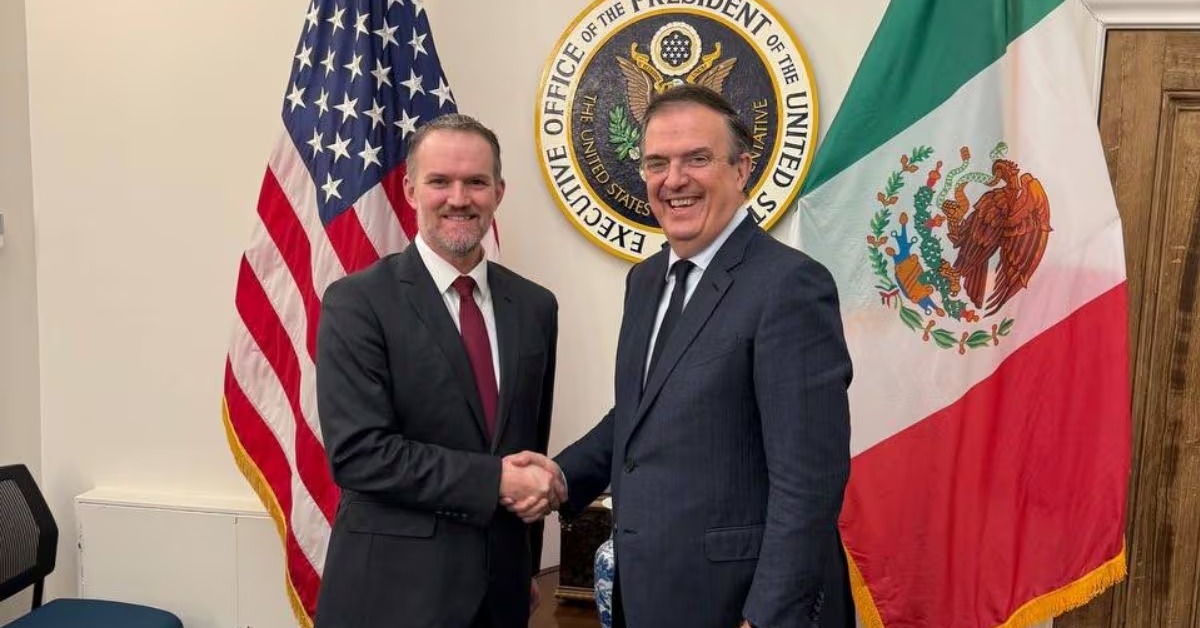
Mexico and the United States have scheduled the next round of pre-review talks on T-MEC for April 19 and 20 in Mexico City. Mexican media reports say the agenda includes rules of origin, supply chains, import substitution, and broader commercial policy. Those meetings follow the first bilateral round held in March and precede the formal joint review due on July 1, 2026.
That makes the April session more than a routine diplomatic stop. It is part of a structured process that will help determine whether the North American trade pact moves toward a smooth extension or a more contentious renegotiation. For businesses on both sides of the border, each preparatory round offers clues about what the United States and Mexico want to change, defend, or trade away before the formal review begins.
Why this review matters more than a normal trade meeting
The T-MEC, known in English as USMCA, replaced NAFTA and took effect in 2020. Its design includes a built-in six-year review. Under the treaty, the three governments meet on the sixth anniversary to assess how the agreement is working and decide on the next steps. If all three confirm they want to continue, the pact gets another 16-year term. If they do not, annual reviews begin for the rest of the agreement’s current life.
That legal structure matters because it gives the 2026 review unusual weight. This is not just a technical check-in. It is the first formal moment when the three governments must, in effect, say whether they still want the agreement’s current framework to anchor North American trade. For Mexico, that question is central to export planning, investment, and industrial policy. Roughly 80% of Mexican exports go to the U.S., so even small shifts in trade certainty can carry outsized economic consequences.
The real fight is over how North America makes products
The official agenda gives a strong clue about the coming battle. Rules of origin decide whether a product qualifies for duty-free treatment under T-MEC. In simple terms, the rules determine how much of a good must be made in North America, and sometimes where the most important parts must come from, before it can cross borders under the pact’s tariff benefits.
That issue is especially important in manufacturing. Autos remain the clearest example. Current T-MEC rules already require 75% North American content for duty-free treatment, with extra labor-value requirements for certain vehicles and parts. Those standards were meant to encourage more regional production and reduce dependence on outside suppliers. The fact that rules of origin are back at the center of the April talks suggests Washington believes the current rules still leave too much room for foreign inputs or transshipment through the region.
Why Washington is pushing harder now
The U.S. side has been increasingly direct about what it wants. Trade officials have said the coming talks will focus on tightening product rules of origin and limiting what they see as workarounds that allow goods to benefit from the pact without enough true North American content. U.S. officials have also tied the discussion to offshoring, arguing that the agreement should do more to support production and jobs within the region rather than simply encourage a shift of assembly to Mexico.
That position helps explain why supply chains and import substitution are now part of the same conversation. This is not only about customs paperwork. It is about industrial strategy. The United States wants a framework that makes it harder to rely on inputs from outside North America while still using the treaty’s preferences. Mexico, meanwhile, wants to preserve market access and investment momentum without accepting changes that could make its export platform less competitive.
Mexico’s challenge is to defend certainty without freezing change
For Mexico, the negotiation is delicate. The country benefits from being deeply integrated into North American manufacturing, but that same integration leaves it exposed when trade rules are reopened. Mexican businesses have broadly argued that the treaty should be preserved and strengthened, not subjected to a sweeping rewrite. That view reflects a practical concern. Investors can adapt to known rules more easily than to prolonged uncertainty.
At the same time, Mexico has reasons to engage the review rather than simply resist it. The government has pushed ideas tied to regional production, strategic industries, and a reduced dependence on Asian inputs in sectors such as electronics, semiconductors, and advanced manufacturing. In that sense, there is overlap between the two governments. The dispute is not over whether North American supply chains should deepen. It is over who benefits most, how strict the new conditions should be, and whether the review becomes targeted reform or something closer to a broader renegotiation.
Where Canada fits into a meeting it is not attending
The April 19 and 20 talks are bilateral, not trilateral. Canada is not part of this specific round in Mexico City. Even so, the larger review remains a three-country process under the treaty. Canadian and Mexican officials have both said they want to preserve the trilateral structure of the agreement, amid concern that Washington could prefer more bilateral bargaining.
That distinction matters because bilateral pre-talks can shape expectations before the three governments sit down together for the formal review. A Mexico-U.S. understanding on sensitive issues could stabilize the process. It could also create new pressure points if Canada sees its own interests being sidelined. For now, the immediate significance of the Mexico City meeting is that the two largest manufacturing partners in the pact are continuing to narrow the field of issues before July.
What readers in Mexico should watch next
The April talks are unlikely to produce a final outcome on their own. What they should produce is a clearer signal about the balance between continuity and confrontation. If both sides frame the meeting around technical adjustments, markets may read that as a sign of a manageable review. If the discussion hardens around tougher content rules, external tariff alignment, or broader political demands, the review could become far more disruptive.
For readers living in Mexico, the practical stakes are straightforward. T-MEC is not an abstract treaty. It influences factory investment, supplier decisions, logistics, jobs, and the long-term cost of doing business across North America. The April 19 and 20 meetings in Mexico City will not settle all of that. But they will show whether the review is moving toward a controlled update or a more volatile test of the region’s economic model.