Mexico’s largest criminal groups are adapting faster than the state. Reporting in Mexico on Monday warned that cartels are accelerating an arms race that now includes modified drones, improvised land mines, homemade mortars, heavier machine guns, and even 3D-printed components. The trend is being driven by three pressures at once: Mexico’s renewed security push, fiercer disputes between rival groups, and the prospect of a harder U.S. line that treats cartels like insurgents.
Mexico cartel drones
On the ground, drone warfare has shifted from novelty to routine. Authorities and independent analysts describe two primary uses: reconnaissance to track rivals and patrols, and precision strikes using improvised munitions dropped from commercial quadcopters. Mexico’s security forces have confirmed a sharp rise in drone-delivered explosives over the past two years, with deadly results for soldiers and civilians in Michoacán and neighboring states.
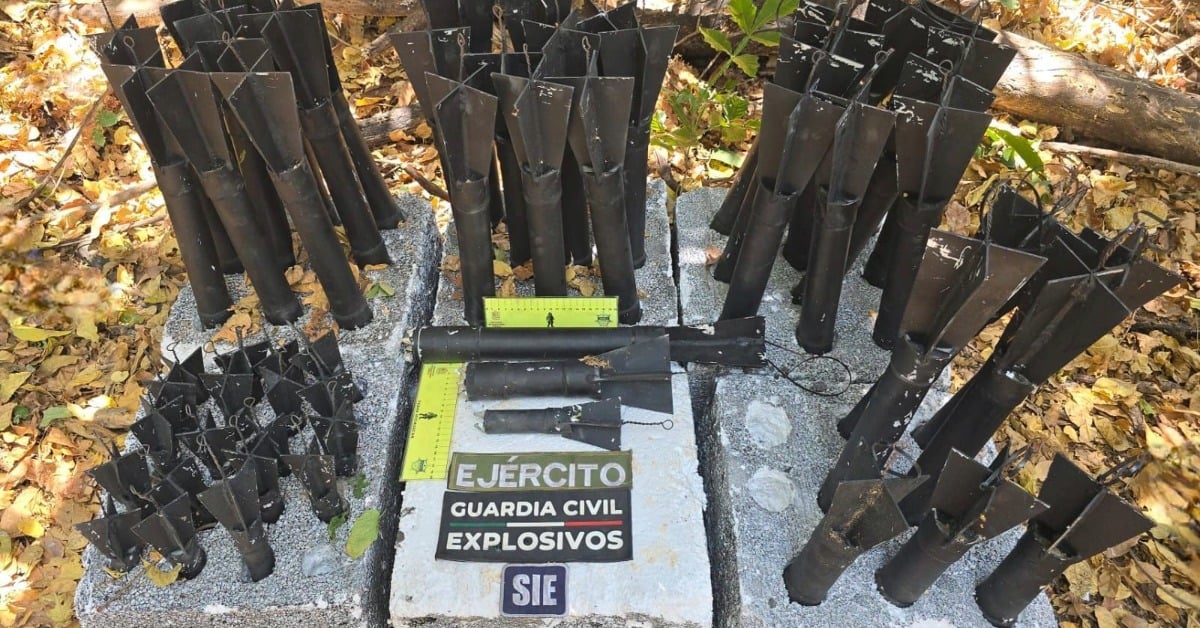
The technology is primitive but effective. In April, Michoacán’s security ministry said teams neutralized 68 improvised explosive devices and jammed five hostile drones in Apatzingán during a single operation. That snapshot matches a broader pattern of trenchwork, roadside bombs, and armored “narco-tanks” seen in cartel strongholds.
Toxic payloads raise the stakes
Officials and researchers have also documented cases where drones carried chemical agents. Local reporting in western Mexico and specialist briefs describe the use of agricultural compounds—such as aluminum phosphide—that release highly toxic phosphine gas when exposed to moisture. Symptoms reported by residents after suspected attacks include burning skin, coughing, and shortness of breath. The compound’s hazard profile supports those accounts.
Even when explosives are crude, the psychological effect is significant. A single drone strike that blows a hole in a roof or shreds a pickup bed signals to residents that the sky is no longer safe. El País chronicled how drone strikes and buried mines have become part of daily life in towns from Michoacán to Tamaulipas.
From IEDs to land mines
The most visible change is the spread of improvised explosive devices and buried mines, which have killed soldiers, police, and farmers. Associated Press and other outlets recorded multiple fatal mine incidents in late 2024, followed by further tragedies in early 2025. Mexico’s Defense Ministry has tallied dozens of personnel wounded by IEDs within months, underscoring how the battlefield is mutating.
This is not a uniform national picture—it concentrates in contested corridors—but it shows the cost of cartel territorial warfare. Where mines are used, security forces must move more slowly, evacuate fields, and clear roads, giving armed groups more time to maneuver.
Counter-drone gear enters the fight
Cartel factions are not only flying drones; some are also acquiring methods to counter them. Open-source imagery and expert analysis show members of a Sinaloa Cartel faction carrying a SkyFend “Hunter” counter-UAS device—a high-end jammer used to detect and disrupt hostile aircraft. While “radar” is often used as shorthand, what is documented in the field are portable counter-drone systems that can locate and interfere with signals. On the other side of the border, the U.S. Army has deployed ground-based radars in Arizona to track cartel drones, a sign of how seriously Washington views the problem.
Washington turns up the pressure
The U.S. approach is shifting from a pure law enforcement focus to a national-security framework. In an August interview on EWTN, Secretary of State Marco Rubio argued cartels “have to be treated as armed terrorist organizations,” language that aligns with new directives expanding military and intelligence tools against designated groups. Mexico’s government has pushed back on any notion of foreign troops operating on its soil, but bilateral surveillance and intelligence cooperation have deepened in 2025.
3D-printed parts and the gun pipeline
“Ghost gun” components and 3D-printed parts are showing up in cases tied to cross-border trafficking networks, which helps explain Mexico’s recent move to outlaw 3D-printed weapons and certain tactical accessories. The bigger pipeline, however, remains factory-made firearms sourced in the United States and smuggled south. A Government Accountability Office review found that about 70% of traced crime guns recovered in Mexico had U.S. origins. ATF’s international trace data for 2017–2021 reflect the same pattern.
For communities in Michoacán, Guanajuato, and beyond, these trends have a simple meaning: daily life depends on whether a convoy hits a buried charge, a drone appears overhead, or a farm road remains open. Mexico’s security forces have adapted with bomb squads, drone jammers, and more air support, but the tactics evolve as quickly as the state can respond.
What it means for 2025
Expect more skirmishes that resemble small-scale wars and fewer traditional firefights. Drones enable groups to monitor rivals and government patrols without deploying ground-based squads. Mine slows the Army and terrorizes harvests. Counter-drone tools are spreading, which will force each side to fly lower, spoof signals, and invest in better reconnaissance.
Mexico’s reforms—tightening arms-control rules, targeting clandestine workshops, and expanding cooperation with U.S. agencies—are steps toward reducing the flow of weapons and the lethality of clashes. But as long as cartels can cheaply buy, modify, or print the tools of war, and as long as high-margin markets endure, the arms race on both sides of the Sierra will continue.