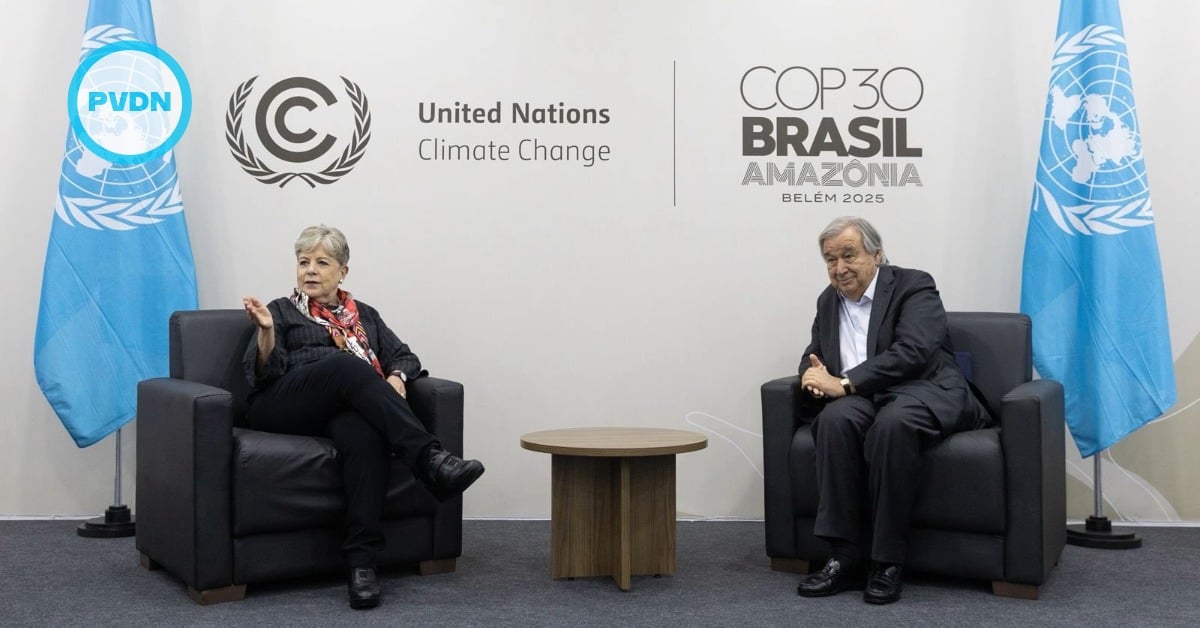
Mexico’s environment minister unveiled the country’s updated climate pledge, known as NDC 3.0, at the COP30 summit in Brazil. The plan commits Mexico to reach net-zero greenhouse gas emissions by 2050 and to cut projected emissions by roughly a third by 2035, while aligning climate action with a broader economic blueprint called Plan México. As part of that announcement, the minister said the government is now preparing, “with urgency”, a National Adaptation Policy designed to turn vulnerability into resilience and to anchor climate risk management in every sector of the economy.
This new policy comes as climate impacts already define daily life for millions. Official and academic assessments classify Mexico as one of the world’s most climate-vulnerable countries, with about 15 percent of its territory—but more than two-thirds of its population and economic output—highly exposed to hazards such as droughts, floods, hurricanes, and extreme heat. Recent years have brought record-dry conditions, three-year droughts in northern farming states, and repeated “Day Zero” fears in the Mexico City region, even as intense storms still trigger deadly landslides and flash floods.
Mexico climate adaptation
Behind the political slogan is a more technical effort known as ADAPTAMX, the label the federal government has given to the National Climate Adaptation Policy now under construction. Public briefing notes describe ADAPTAMX as a roadmap to 2035 that aims to strengthen the country’s capacity to adapt to climate change and improve people’s living conditions in line with global resilience goals. The process is being coordinated by the National Institute of Ecology and Climate Change, the federal body responsible for providing scientific and policy guidance on climate issues.
Under Mexico’s General Law on Climate Change, the federation, states, and municipalities all share responsibilities for mitigation and adaptation. The law calls for a national policy that reduces vulnerability, protects ecosystems and infrastructure, and integrates climate risk into development planning. Until now, however, adaptation has been scattered across sectoral programs—water management, agriculture, disaster risk reduction—without a single umbrella framework that sets priorities, tracks results, and holds institutions accountable.
A recent proposal supported by the Green Climate Fund was blunt in its diagnosis. It found that Mexico lacked a dedicated national adaptation policy instrument, that coordination between ministries was insufficient to integrate adaptation into development plans, and that there was no robust system to monitor adaptation actions, financial flows, or their effectiveness. The same assessment pointed to “insufficient operation of climate funds” and limited participation from the private and banking sectors in adaptation finance.
The new policy is meant to correct those gaps. In public statements, officials have framed ADAPTAMX as the “umbrella” that will harmonize national and state-level efforts, define clear responsibilities for federal agencies, and create mechanisms to consult communities, businesses, and civil society on climate risks. It is also expected to align with Mexico’s updated NDC, which, for the first time, includes a specific component on finance, capacity-building, technology transfer, and an integrated approach to loss and damage.
Will the new strategy protect those most at risk?
The timing of this adaptation push reflects hard physical realities. Analyses using global water-risk models project that, without strong adaptation measures, the number of Mexican states facing high water stress could almost double by mid-century, with around 60 percent of the country’s territory at risk of severe scarcity. Heatwaves are also expected to intensify, particularly in already hot regions where workers in agriculture, construction, and informal urban jobs have limited access to cooling or social protection.
Despite that urgency, experts who study Mexico’s climate policy warn that the country is still much better at drafting strategies than delivering concrete protection on the ground. Evaluations by national and international institutions note that, even with a relatively advanced legal and institutional framework, existing efforts “fall short” of the resilience gains the country needs. Deep inequality means that rural communities dependent on rain-fed agriculture, Indigenous towns, and residents of informal settlements on hillsides or riverbanks are hit first and recover last.
Recent reporting from drought-hit northern states illustrates the stakes. Farmers in regions such as Chihuahua and Sonora describe orchards and fields where production has dropped, wells run dry, and livestock is sold off because there is no water or fodder, while public support programs arrive late or not at all. In parallel, urban neighborhoods in Mexico City and other big cities still face chronic water cuts, even in years when the main reservoir systems recover thanks to heavy rains and infrastructure upgrades.
At COP30, Mexico’s environment minister stressed that “how” the adaptation strategy is implemented will matter as much as “what” is promised, calling for real, accessible, and predictable climate finance rather than short-term charity. Yet for now, the new policy exists mostly on paper and in technical planning documents. There is no detailed public breakdown of how much money will flow to adaptation by sector, which communities will be prioritized, or how progress will be measured in terms that people can see—fewer homes flooded, more secure water supplies, safer workplaces in extreme heat.
The coming months will show whether Mexico’s national climate adaptation policy becomes a turning point or another high-level plan that never quite reaches the neighborhoods and rural valleys most exposed to climate shocks. Delivering on the promise of resilience will require more than a new acronym. It will demand transparent budgets, strong local institutions, and a willingness to confront the tension between an ambitious industrial growth agenda and the limits of a hotter, drier, more volatile climate.