Mexico will co-host the 2031 Women’s World Cup, a record 48-team tournament. Four Mexican stadiums are proposed, but venues aren’t final.
Mexico City, Mexico, November 23, 2026 — Mexico is getting another World Cup. And this time, the women are taking center stage.
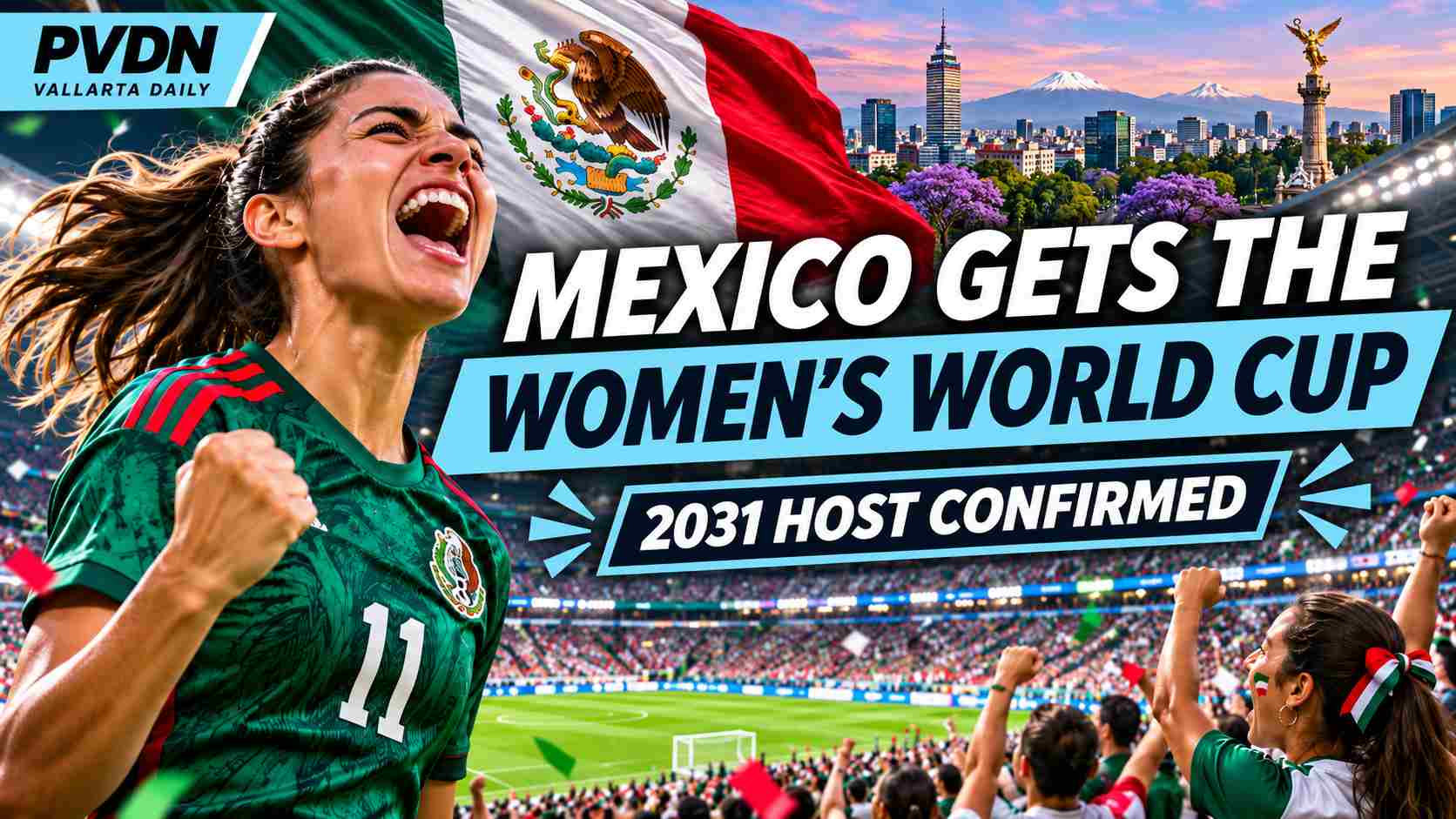
FIFA officially confirmed Monday that Mexico will co-host the 2031 Women’s World Cup alongside the United States, Costa Rica, and Jamaica. The decision gives Mexico its first opportunity to host matches in an official senior FIFA Women’s World Cup, just five years after sharing the men’s tournament with the United States and Canada.
And this won’t be an ordinary World Cup.
The 2031 tournament will be the largest Women’s World Cup ever held, featuring 48 national teams and 104 matches spread across four countries.
That’s a considerable jump from the 32 teams that competed in the 2023 tournament in Australia and New Zealand.
But here’s what makes Monday’s announcement particularly interesting for Mexico.
The country isn’t simply hoping to host a handful of matches. Mexican soccer officials want a much bigger role than they had during the men’s World Cup earlier this year.
And four Mexican cities are already part of the proposed hosting plan.
FIFA makes Mexico’s hosting role official
The decision came during an extraordinary FIFA Congress held by videoconference on Monday, November 23.
Representatives of FIFA’s member associations formally approved the joint bid submitted by the four countries, turning what had been a lengthy planning process into an official hosting commitment.
According to FIFA’s announcement, the host countries were appointed by acclamation after a bidding process that began in March 2025.
The United States, Mexico, Costa Rica, and Jamaica will now work together to organize the competition, with support from FIFA and Concacaf, the regional soccer confederation.
It’s the first time a senior Women’s World Cup will be hosted across four countries.
The same FIFA meeting also confirmed that England, Scotland, Wales, and Northern Ireland will host the 2035 Women’s World Cup.
FIFA President Gianni Infantino said the organization wants the tournaments to create opportunities beyond the matches themselves, including more women becoming players, coaches, referees, and soccer administrators.
That’s an ambitious objective.
But for Mexico, the immediate news is straightforward. After decades of hosting major men’s soccer competitions, the country will finally host an official senior Women’s World Cup.
This Women’s World Cup will be much bigger
The expansion to 48 teams is one of the biggest changes coming in 2031.
The Women’s World Cup featured 24 countries in 2019 before expanding to 32 in 2023.
Now FIFA is adding another 16 national teams.
The 2031 competition is expected to feature 12 groups of four teams, followed by an expanded knockout stage.
That brings the total number of matches to 104, compared with 64 in the previous 32-team format.
The United States Soccer Federation confirmed the 104-match format in its Monday announcement celebrating the successful joint bid.
For fans, that means more national teams, more matches, and more opportunities to see countries that have historically struggled to qualify for the competition.
For the four host countries, it also means a much larger organizational challenge.
Airports, hotels, stadiums, security, transportation, and training facilities will all play a role.
And because the tournament will stretch from North America into Central America and the Caribbean, travel planning will be especially important.
The exact tournament dates, match schedule, and distribution of games between the four countries have not yet been announced.
Which Mexican cities could host the matches?
Here’s the question many Mexican soccer fans are already asking.
Where will the games be played?
Mexico’s current proposal identifies four stadiums in four cities.
Proposed venues — not yet officially selected by FIFA
| City | Proposed stadium |
|---|---|
| Mexico City | Estadio Banorte, formerly Estadio Azteca |
| Guadalajara, Jalisco | Estadio Akron |
| Monterrey, Nuevo León | Estadio BBVA |
| Torreón, Coahuila | Estadio Corona at Territorio Santos Modelo |
The four stadiums are included in the hosting proposal reviewed by FIFA.
However, inclusion in the bid does not guarantee that every stadium will ultimately receive matches.
According to Mexico’s football federation, FIFA will announce the final host cities and stadiums after completing additional technical evaluations.
There is another interesting detail.
Mexico wants to host more than twice as many matches as it received during the 2026 men’s World Cup.
The men’s tournament brought 13 matches to Mexican stadiums.
For 2031, the Mexican Football Federation wants more than 26 matches.
That’s an objective, not an approved allocation.
FIFA still needs to decide how many games each country will receive, which cities will participate, and where the biggest matches will take place.
For Guadalajara, however, the opportunity is particularly relevant.
The city hosted men’s World Cup matches in 2026, and its stadium is again under consideration for an international tournament.
That could give Jalisco another major soccer event just five years after the previous one.
Mexico has a forgotten chapter in Women’s World Cup history
Here’s something that makes this announcement even more interesting.
Although 2031 will be Mexico’s first official FIFA Women’s World Cup, it won’t be the first time the country has hosted an international women’s soccer championship calling itself a World Cup.
That happened in 1971.
More than half a century ago, Mexico hosted an unofficial women’s world championship with six national teams.
Matches were held in Mexico City and Guadalajara, and the Mexican women’s team made it all the way to the final against Denmark.
The championship match took place at Estadio Azteca before an estimated 110,000 spectators.
Denmark defeated Mexico 3-0.
But the tournament was not recognized by FIFA, which did not organize its first official Women’s World Cup until 1991.
The story was largely overlooked for decades, despite the enormous crowds and the achievement of the Mexican players.
The Universidad Iberoamericana has preserved historical material from the 1971 championship, including photographs and records documenting the tournament.
It’s a remarkable piece of Mexican sports history.
Women were filling major stadiums to watch soccer long before the sport received the institutional support and commercial attention it has today.
Now, 60 years after that unofficial championship, Mexico will have the opportunity to host the FIFA-recognized version.
Women’s soccer in Mexico has changed dramatically
The women’s game has come a long way since 1971.
Mexico established Liga MX Femenil in 2017, giving women’s professional soccer a structured national competition.
Clubs such as América, Tigres, Monterrey, Chivas, and Pachuca have helped build a growing audience for women’s matches.
The league has also provided an important competitive environment for Mexican players and contributed to the development of national-team talent.
But that progress hasn’t happened equally everywhere.
Professional opportunities, player development, coaching, youth training, and infrastructure still need investment, particularly outside the country’s major soccer markets.
And that’s where the 2031 tournament could have an impact beyond the stadiums hosting matches.
The Mexican Football Federation says it hopes the World Cup will encourage more girls to play soccer while strengthening the country’s professional women’s league.
Of course, hosting a tournament doesn’t automatically create lasting opportunities.
That requires investment before and after the event.
For the players, the more meaningful legacy would be better youth programs, stronger professional clubs, improved training facilities, and more opportunities to pursue soccer as a career.
And the sport already has a presence far beyond Mexico’s major cities.
In 2022, Vallarta Daily reported that Puerto Vallarta’s women’s soccer team won the Copa Jalisco, demonstrating the talent developing at the local level.
A World Cup that encourages more support for those kinds of programs could have an impact long after the final match is played.
Could Puerto Vallarta benefit from another World Cup?
Puerto Vallarta isn’t among the proposed match-hosting cities.
But that doesn’t necessarily mean the tournament will have no local relevance.
The 2026 men’s World Cup already demonstrated how international sporting events can extend beyond the cities hosting matches.
Puerto Vallarta organized public viewing activities and World Cup celebrations, while tourism businesses hoped to benefit from visiting fans and increased travel throughout Mexico.
The results were mixed.
As Vallarta Daily reported after the 2026 tournament, many local restaurants did not experience the World Cup-related sales increase they had anticipated.
At the same time, Jalisco reported an estimated 438 million pesos in World Cup-related tourism activity for Puerto Vallarta and other tourism destinations.
Those two findings are a useful reminder that major sporting events don’t benefit every business or destination equally.
And no economic benefits from the 2031 Women’s World Cup can be assumed today.
Still, Guadalajara’s potential participation would again put a major international soccer tournament within regional reach of Puerto Vallarta.
That could create opportunities for visitors to combine match attendance with a vacation on Mexico’s Pacific coast.
It could also encourage local watch parties, youth soccer activities, and community events.
But all of that remains a possibility, not an announced program.
For now, no official 2031 Women’s World Cup events, fan zones, or tourism initiatives have been confirmed for Puerto Vallarta.
What still needs to happen before 2031?
Monday’s announcement settles the biggest question: the tournament’s host countries.
But most of the practical planning is still ahead.
FIFA and the participating federations must finalize the stadium selections, match assignments, scheduling, transportation requirements, and other organizational details.
Mexico will also need to determine what improvements are necessary at its proposed venues and how those costs will be covered.
The FIFA evaluation process considered infrastructure, transportation, commercial requirements, sustainability, and human rights as part of the host-selection process.
Those issues will remain important as planning moves forward.
Fans hoping to attend the tournament should also understand that no final ticketing schedule or official match allocations have been announced.
There’s no reason to make travel reservations based on rumored games or stadium assignments.
The next major developments will come when FIFA confirms which cities will actually host matches and how the tournament will be divided among the four countries.
Mexico’s next World Cup opportunity is now official
For Mexico, Monday’s announcement is another major moment in its soccer history.
The country hosted men’s World Cups in 1970 and 1986, shared the 2026 tournament with the United States and Canada, and will now help organize the largest Women’s World Cup ever held.
But the significance goes beyond adding another tournament to Mexico’s hosting record.
The country has a long history of women’s soccer that hasn’t always received the recognition it deserved.
The players who filled Estadio Azteca in 1971 helped demonstrate the sport’s potential decades before FIFA created its official tournament.
The women who helped build Liga MX Femenil have carried that progress forward.
And the next generation of Mexican girls will grow up knowing their country is preparing to welcome some of the world’s best female soccer players.
That’s the opportunity now sitting in front of Mexico.
The stadiums, match schedules, and final hosting arrangements are still to come.
But the decision itself is official.
The Women’s World Cup is coming to Mexico in 2031. And this time, the world governing body is bringing it.