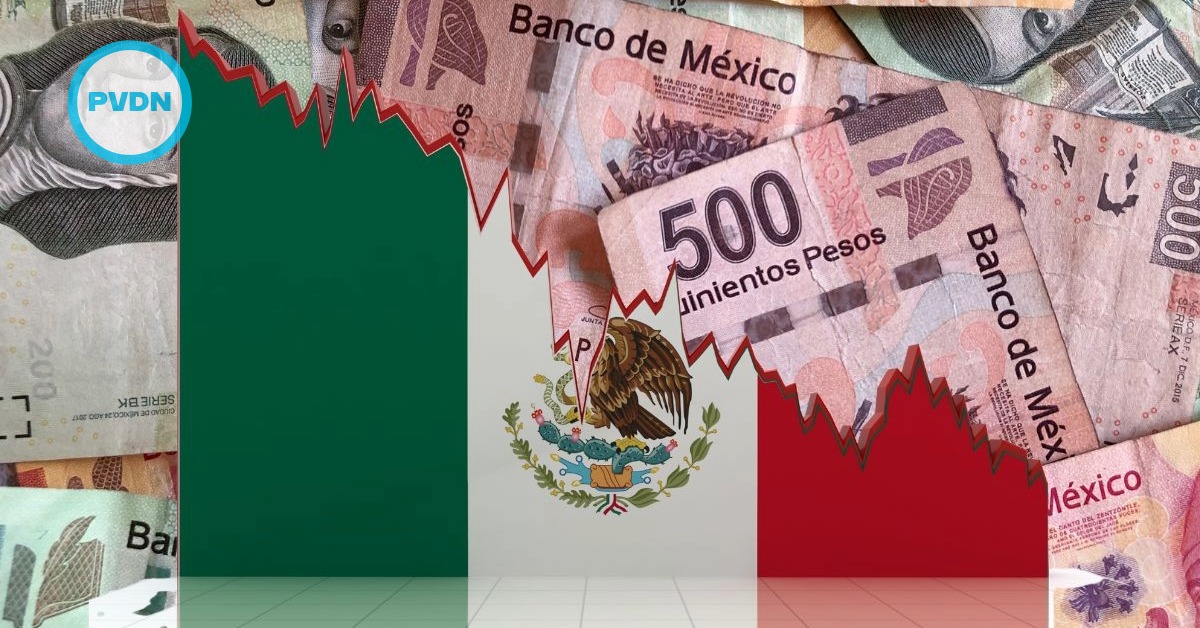
From Los Cabos, Gabriela Gutiérrez, national president of the Mexican Institute of Finance Executives (IMEF), said that Mexico remains in economic growth as a country, but “almost negative.” The remark came after a review of the institute’s latest indicators, which she has used throughout the year to flag a fragile recovery and rising downside risks.
Behind the short phrase sits a long list of weak numbers. Mexico escaped a technical recession in the first half of 2025 only to face another soft patch as the year wore on, with economic activity swinging between zero and marginal gains from one month to the next. Early estimates from the national statistics agency show that after flat growth in May and June, economic activity likely slipped 0.1% in July compared with the previous month and rose just 0.1% compared with a year earlier.
Mexico economic growth by the numbers
Official GDP figures for the second quarter showed a modest rebound: activity grew about 0.7% compared with the previous quarter and 1.2% year-on-year. But the momentum behind those figures was uneven. Agriculture jumped, while both industry and services posted slight contractions, underscoring how narrow the recovery has been. Earlier in the year, Mexico had already met the definition of a technical recession, with two consecutive quarters of falling output.
IMEF’s own indicators tell a similar story. In its May report, the IMEF Manufacturing Index stood at 47.4 points and its Non-Manufacturing Index at 49.4, both below the 50-point threshold that separates expansion from contraction. That marked the 14th consecutive month in which manufacturing remained in contraction territory and kept services and commerce effectively stalled. First-quarter GDP grew just 0.2% compared with the previous quarter and 0.6% versus a year earlier, confirming a fragile environment.
Expectations have retreated even faster than the real economy. Back in April, IMEF cut its forecast for 2025 GDP growth from 0.6% to only 0.2%. At that time, Gutiérrez warned that if current trends continued, Mexico could slip into a domestic recession, especially if the United States also slowed or contracted. Later in the year, as trade tensions eased slightly and some data improved, the institute nudged its forecast up, first to around 0.4% and then to 0.5%, a rate that Gutiérrez herself has described as “very poor” for a country of Mexico’s size and needs.
Other institutions echo the near-zero outlook. The Bank of Mexico’s most recent survey of private analysts puts expected growth for 2025 at about 0.18%, marking a string of downward revisions over the past year. The OECD projects Mexican GDP will grow by roughly 0.4% in 2025, while some private bank forecasts now see a slight full-year contraction of 0.1%. In contrast, the Finance Ministry has maintained an official forecast range of 1.5% to 2.3%, highlighting the distance between government messaging and independent projections.
At the same time, investment has turned into one of the biggest weak spots. Analyses of gross fixed investment show that after controversial constitutional reforms and political uncertainty intensified, investment began to fall year-on-year, with declines of around 7% to 8% reported in several recent months. Business surveys reflect that shift: nearly two-thirds of analysts now say it is a bad time to invest, and a large majority believe the economy is in worse shape than a year ago.
Nearshoring continues to be cited as a long-term opportunity, but the current numbers suggest that it has not yet translated into broad-based momentum. High interest rates, trade disputes with the United States, and domestic policy uncertainty have combined to keep many projects on hold, even as some sectors benefit from the relocation of supply chains.
What near-zero growth means on the ground
For businesses, “almost negative” growth translates into a cautious, stop-start environment. In an April briefing, Gutiérrez warned that the volatile tariff policy of the United States was disrupting global financial stability, drying up liquidity, and making credit harder to access. That dynamic, she said, was already dragging down expectations for Mexico and could tip the country into recession if it coincided with a slowdown north of the border.
Mexico’s central bank has begun to trim interest rates from the double-digit levels set during the inflation spike, but borrowing costs remain high in real terms. Analysts surveyed by the bank expect the policy rate to end 2025 at around 7.5%, still restrictive for many companies considering new investment or hiring decisions. Combined with a weaker outlook for external demand and ongoing uncertainty around trade rules, that keeps credit conditions tight for firms far from the export superstars that benefit from nearshoring headlines.
Households feel the slowdown in quieter ways. Inflation has eased closer to the central bank’s target, hovering in the mid-3% to 4% range, but wages and job creation are not accelerating. When the economy grows at or near zero, new jobs tend to appear more slowly and competition for better-paid positions intensifies. For families already stretched by high interest rates on mortgages, car loans, and credit cards, even small increases in prices or a reduction in overtime hours can erode spending power.
The political debate adds another layer. While fiscal authorities continue to project stronger growth, private forecasts from IMEF, the central bank’s survey, and international organizations cluster around a scenario of stagnation. That divergence can blur public understanding of the risks. From the perspective of a shop owner in Los Cabos, a factory worker in Nuevo León, or a family in the State of Mexico, the question is less about decimal points and more about whether their income keeps pace with rising costs and whether new opportunities appear in their local labor market.
Gutiérrez’s Los Cabos message, stripped of jargon, is that the margin for error has grown thin. With Mexico economic growth hovering just above zero, it would not take much—a weaker U.S. economy, renewed tariff fights, or a deeper loss of investor confidence—to push the country into outright contraction. At the same time, decisive improvements in legal certainty, public security, and infrastructure could help unlock stalled investment and turn nearshoring from a slogan into a broader engine of growth.
For now, the numbers support her caution. Mexico is still growing, but almost not at all. Whether those change will depend less on one month’s data and more on whether businesses and policymakers can rebuild confidence before the line between stagnation and recession is crossed.