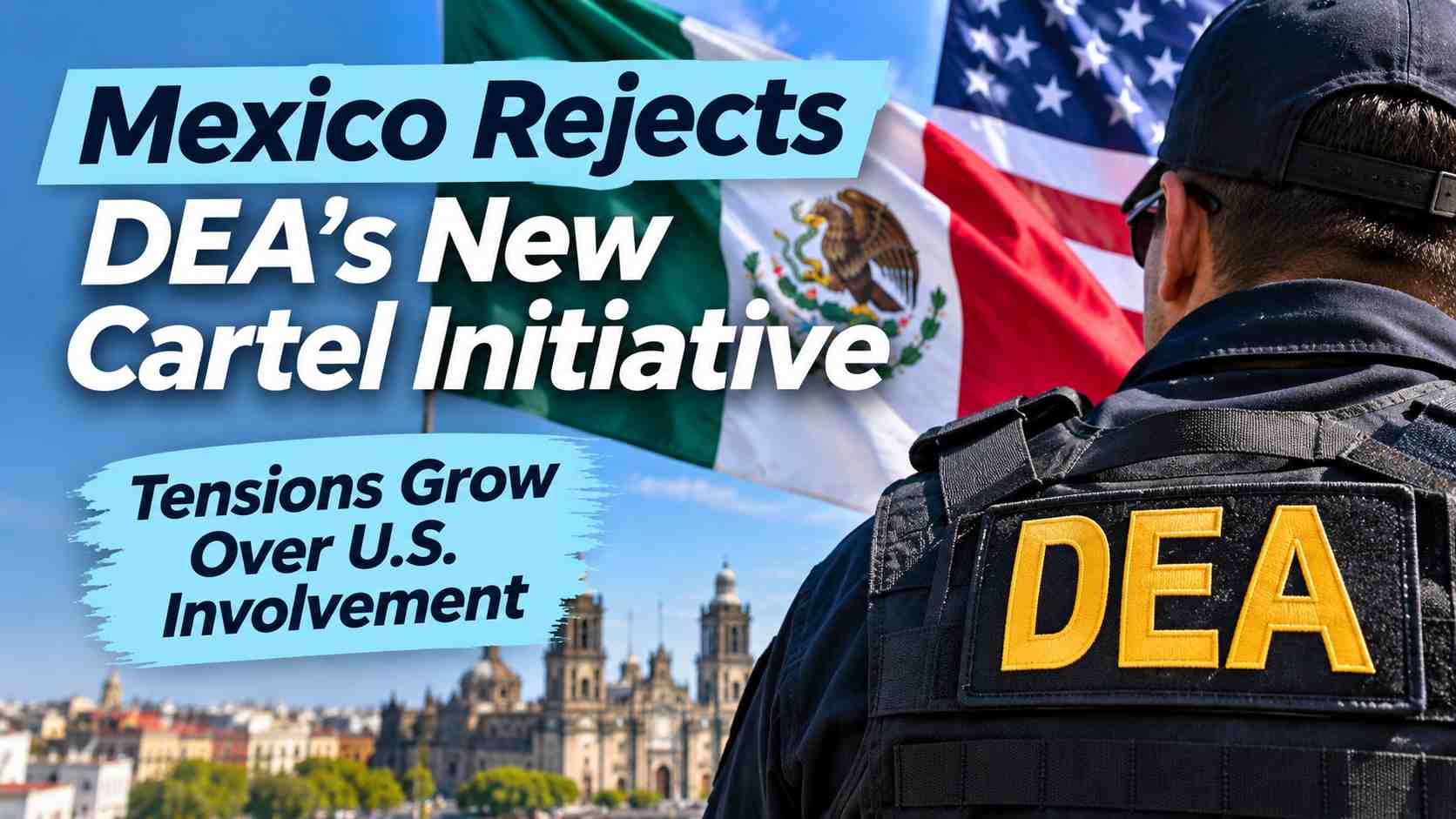
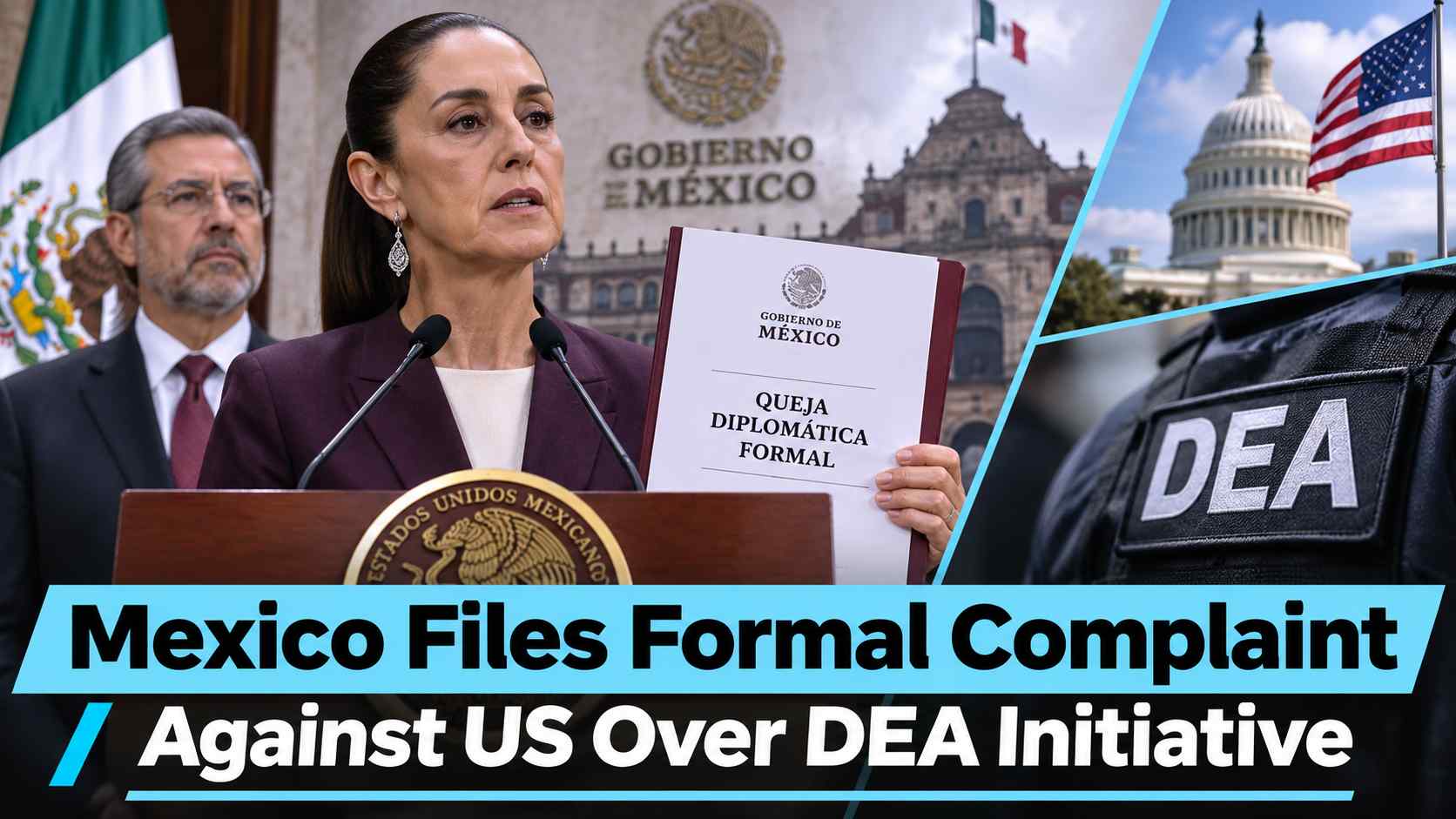
Mexico files a formal diplomatic complaint over the DEA’s cartel tip lines, raising fresh concerns about sovereignty and bilateral security cooperation.
Mexico City, Mexico, November 27, 2026 – What began Wednesday as an announcement by the United States Drug Enforcement Administration (DEA) has now become a formal diplomatic dispute between Mexico and its northern neighbor.
President Claudia Sheinbaum confirmed Friday morning that Mexico’s Ministry of Foreign Affairs has presented an official complaint to U.S. Ambassador Ronald Johnson over the DEA’s decision to establish direct communication channels for people reporting organized crime and suspected government corruption in Mexico.
Foreign Affairs Secretary Roberto Velasco Álvarez communicated Mexico’s objections to Johnson, who, according to Sheinbaum, said he would review the matter.
The diplomatic complaint follows Thursday’s public criticism of the initiative by both the president and Mexico’s federal security cabinet.
At the center of the disagreement is a question that has complicated relations between the two countries for decades. How much involvement should American law enforcement agencies have in security matters inside Mexico?
From public criticism to a diplomatic complaint
The dispute began when DEA director Terry Cole announced new channels for people to confidentially report suspected members of criminal organizations, government officials allegedly collaborating with cartels, and individuals involved in money laundering.
The initiative initially focused on Sinaloa, with Cole announcing plans for a similar operation targeting the Jalisco New Generation Cartel (CJNG).
The DEA presented the channels as another tool for gathering information about criminal organizations and the networks that help finance and protect them.
Sheinbaum sees the matter differently.
During Friday’s morning press conference, the president argued that Mexico already has institutions responsible for receiving criminal complaints, conducting investigations and sharing relevant intelligence with foreign governments.
Her objection is that the DEA is encouraging people in Mexico to communicate directly with an American law enforcement agency rather than working through established Mexican institutions.
Thursday’s criticism has now been communicated through official diplomatic channels, putting the matter directly before the American government.
Mexico wants cooperation on its own terms
Sheinbaum repeated Friday that her administration remains willing to cooperate with Washington in combating organized crime, but that the relationship must be based on coordination rather than subordination.
It is a position her government has maintained throughout its dealings with the administration of U.S. President Donald Trump.
In September 2025, the two countries issued a joint statement establishing principles for bilateral security cooperation, including respect for territorial sovereignty, mutual trust and shared responsibility.
Those commitments were reaffirmed in June during a meeting of the Mexico-U.S. Bilateral Implementation Group.
The framework is intended to allow both countries to exchange intelligence and coordinate investigations while respecting each other’s legal authority.
The disagreement over the DEA’s reporting channels raises questions about where those boundaries lie, particularly when information about suspected criminal activity is collected directly from citizens.
The Mexican government’s objection does not, by itself, establish that the DEA has violated Mexican law. Nor does the establishment of a reporting channel demonstrate that American agents are conducting unauthorized operations inside Mexico.
Those are separate matters.
Washington is increasingly targeting cartel finances
The DEA’s initiative is part of a broader American effort to target the financial and institutional networks that allow criminal organizations to operate.
Rather than focusing exclusively on cartel leaders and drug seizures, U.S. authorities are increasingly interested in the individuals, businesses and government officials suspected of facilitating criminal operations.
Earlier this month, Vallarta Daily reported on Washington’s offer of up to US$10 million for information about cartel financial networks.
That initiative reflects growing American attention toward money laundering and the movement of criminal proceeds through otherwise legitimate businesses.
From Washington’s perspective, dismantling those networks could weaken criminal organizations beyond what can be accomplished through individual arrests.
From Mexico’s perspective, investigations involving Mexican officials, businesses and residents need to respect the country’s judicial processes and national jurisdiction.
The two governments may agree on the objective while disagreeing considerably about how to achieve it.
Why Jalisco should be paying attention
For residents of Puerto Vallarta, the announcement that the DEA intends to establish a similar reporting initiative focused on the CJNG brings the dispute considerably closer to home.
Jalisco has been the subject of repeated Mexican and American investigations involving suspected organized crime networks, money laundering and businesses allegedly connected to criminal organizations.
However, Friday’s developments do not indicate that American agents have been authorized to carry out new law enforcement operations in Puerto Vallarta or elsewhere in Jalisco.
The exact launch status and operating arrangements of the proposed Jalisco reporting channels have not yet been independently confirmed.
For local residents, the most relevant development will be whether the two governments establish an agreed process for handling information collected through those channels.
Questions also remain about how information would be shared with Mexican prosecutors, how allegations would be investigated, and what protections would be available to people providing sensitive information.
These are particularly important considerations in communities where reporting organized crime can carry significant personal risks.
Sheinbaum wants the United States to look closer to home
Friday’s press conference also provided another opportunity for Sheinbaum to challenge the way responsibility for drug trafficking is frequently discussed in the United States.
The president questioned who distributes illegal drugs once they enter the United States, who sells them and where the proceeds are laundered.
She argued that Mexico cannot be expected to address the entire problem while American authorities overlook the domestic networks and consumer demand that sustain the drug trade.
Sheinbaum also emphasized her government’s continued efforts to prevent illegal drugs from reaching the United States.
Her argument is that organized crime is a problem involving both countries, and that each government must take responsibility for what happens within its own borders.
The Mexican government has previously identified illegal firearms trafficking from the United States into Mexico as another area requiring stronger bilateral enforcement.
Security cooperation continues despite disagreements
Perhaps the most interesting aspect of the latest diplomatic dispute is that it comes at a time when Mexico and the United States continue to cooperate on significant criminal investigations.
Last week, Mexican authorities captured alleged cartel leader Fausto Isidro Meza Flores, known as El Chapo Isidro, in Sinaloa.
American intelligence reportedly contributed to the Mexican-led operation.
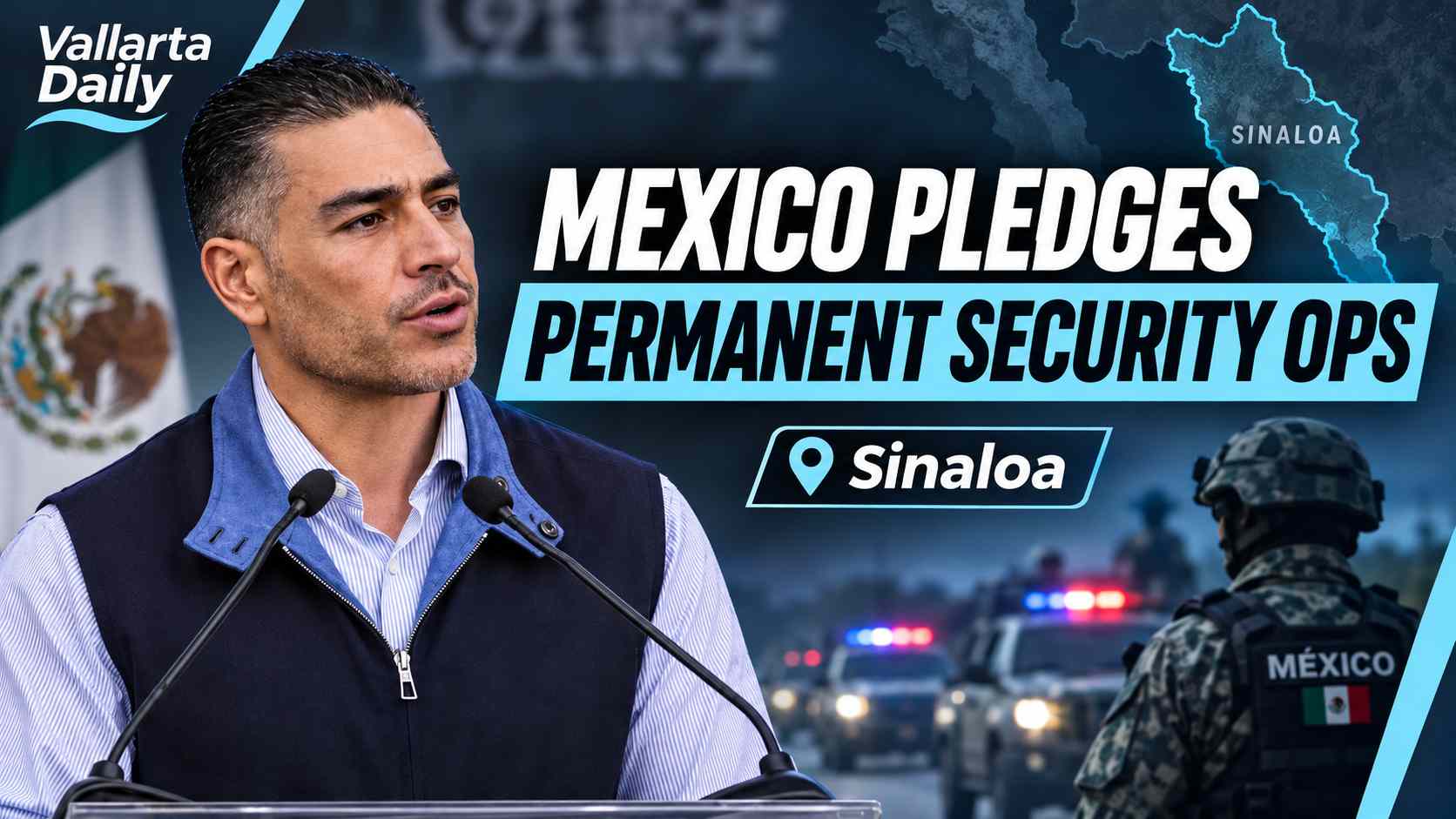
The arrest was followed by an announcement that Mexico would maintain permanent security operations in Sinaloa, reinforcing its commitment to addressing organized crime in the state.
Mexico’s federal security cabinet also continues to publish reports of coordinated security operations in Jalisco, Nayarit and other states.
These developments illustrate that Mexico’s objection to the DEA’s reporting initiative does not necessarily represent opposition to all American involvement in criminal investigations.
The distinction, according to the Mexican government, is whether cooperation takes place through mutually agreed institutional channels.
Could the dispute affect other areas of Mexico-U.S. relations?
Security is only one part of an increasingly complicated relationship between Mexico and the United States.
The two governments are also navigating immigration policy, international trade, tariffs and preparations for the review of their North American trade agreement.
As Vallarta Daily reported earlier this week, Mexico has avoided another round of proposed American tariffs, although significant commercial disagreements remain unresolved.
Sheinbaum indicated Friday that the governments continue communicating across these different areas and did not characterize the DEA dispute as a breakdown in the broader bilateral relationship.
That is an important distinction for Americans and Canadians living in Mexico who may be concerned about deteriorating relations between the two countries.
Friday’s complaint does not announce changes to immigration requirements, travel restrictions or existing bilateral trade arrangements.
What happens next?
For now, the matter rests with the American government.
Ambassador Johnson has reportedly agreed to review Mexico’s complaint, but no decision to suspend, withdraw or modify the DEA initiative has been announced.
The full diplomatic communication and a separate formal response from Washington were not available for independent verification when this article was prepared.
The next significant development will be whether the DEA proceeds with its planned initiative concerning Jalisco and whether Washington agrees to address Mexico’s objections through the existing bilateral security framework.
Both countries have a considerable interest in dismantling criminal organizations. Neither benefits from allowing disputes over jurisdiction to undermine legitimate investigations.
The challenge is finding a way to cooperate that addresses the security concerns of both countries without disregarding the authority of either.