The Atlantic hurricane season began with a quieter forecast than recent years, but Mexican and U.S. agencies are not using the same numbers. Mexico expects as many as 15 named systems in the Atlantic basin, while NOAA’s official outlook is slightly lower. The early message from forecasters is restrained, not reassuring. One storm near land can still change travel, ports, flights, flooding risk, and emergency planning across Mexico’s Caribbean and Gulf coast.
Atlantic season opens under a lower forecast
The 2026 Atlantic hurricane season began Monday, June 1, opening a six-month stretch of storm monitoring for Mexico’s Caribbean and Gulf coast.
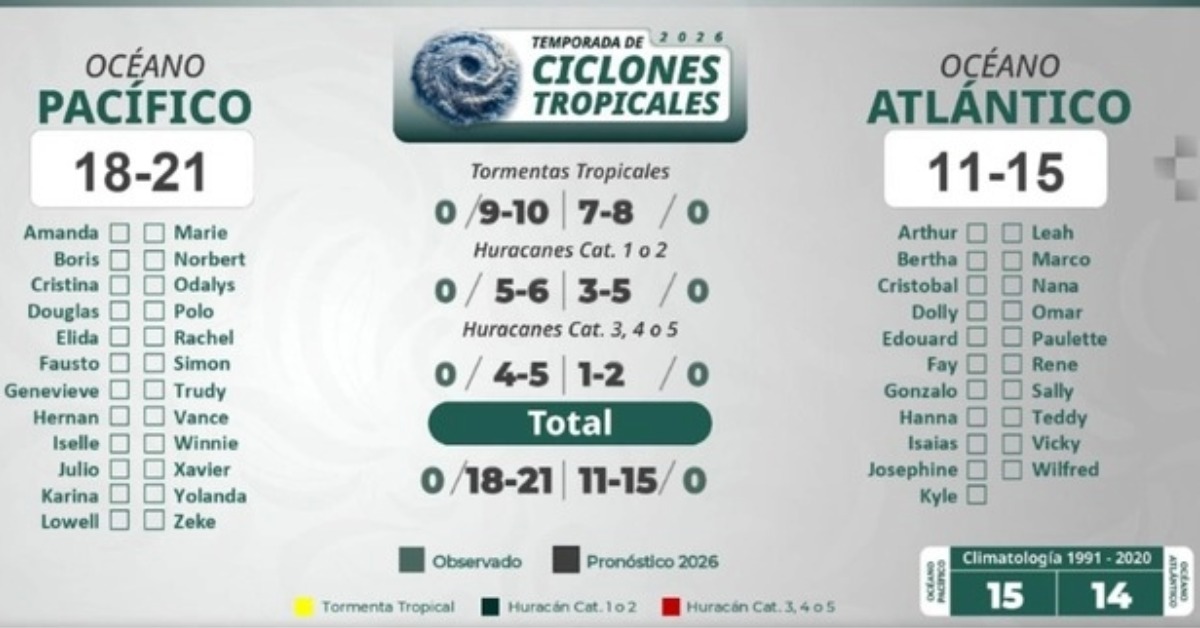
Mexico’s federal meteorological outlook forecasts 11 to 15 named systems in the Atlantic basin this year, according to the government’s seasonal cyclone forecast. The season runs through November 30.
The forecast breaks that total into seven or eight tropical storms, three to five hurricanes in categories 1 or 2, and one or two major hurricanes in categories 3, 4, or 5.
That is not the same as a landfall forecast. It does not say where storms will form, whether they will reach Mexico, or how strong any system would be near land.
NOAA’s official 2026 Atlantic outlook is slightly lower, calling for 8 to 14 named storms, 3 to 6 hurricanes, and 1 to 3 major hurricanes. The agency gives the season a 55 percent chance of finishing below normal.
The difference is useful. Seasonal forecasts describe basin-wide conditions, not local risk. A lower number of storms can still leave one coast dealing with evacuation orders, flooded streets, canceled flights, or damaged power lines.
Quiet opening does not settle the season
At the start of the season, the National Hurricane Center said tropical cyclone formation was not expected in the North Atlantic, Caribbean Sea, or Gulf during the next seven days.
That calm start is limited to the short-range forecast. The Atlantic season usually peaks later, with NOAA saying most activity is likely during August, September, and October.
The National Hurricane Center said the long-term Atlantic averages are 14 named storms, 7 hurricanes, and 3 major hurricanes. The first names on the 2026 Atlantic list are Arthur, Bertha, Cristobal, Dolly, Edouard, and Fay.
Ken Graham, director of the U.S. National Weather Service, warned against reading too much comfort into a below-normal outlook.
“Don’t let words like below-normal change the way you prepare,” Graham said. “It only takes one.”
NOAA forecasters point to expected El Niño conditions as one reason Atlantic activity may be restrained. El Niño can increase wind shear over the Atlantic, making it harder for storms to organize. NOAA also cautions that spring and early-season forecasts carry uncertainty, especially before the peak months.
Mexico’s own 2026 outlook clearly shows the split risk. The Atlantic forecast is more restrained, while the Pacific season has been projected to be busier. Vallarta Daily has been tracking that side of the season in its Mexico hurricane coverage and recent reporting on Pacific storm development near Mexico.
Preparation advice is already active
Mexico’s civil protection guidance treats preparation as a season-long task, not a response once a storm appears. The national civil protection cyclone guide advises people to follow official alerts, identify flood or landslide risk, prepare a family protection plan, define evacuation routes, locate temporary shelters, clean drains and gutters, and keep emergency documents in waterproof bags.
The same guidance warns that cyclones and hurricanes can bring heavy rain, flooding, landslides, and strong winds. It also advises against crossing rivers, streams, or flooded streets during a storm.
The federal Sistema de Alerta Temprana para Ciclones Tropicales, known as SIAT-CT, remains Mexico’s coordinated early-warning system for cyclones. Its alert levels consider storm intensity, movement speed, distance from the coast, and estimated arrival time.
That system matters most once a specific storm threatens land. Until then, the season forecast is a planning signal. It tells emergency agencies, hotels, airports, ports, and coastal municipalities to update their procedures before watches or warnings are issued.
For travelers, the early season usually does not mean canceling plans. It does mean watching official forecasts more closely when visiting the Mexican Caribbean, Veracruz, Tamaulipas, Tabasco, Campeche, or Yucatán during the next six months.