A newly registered Maya settlement in southern Quintana Roo is raising fresh questions about the region’s ancient urban network. Known as El Jefeciño, the site includes about 80 structures spread across at least 100 hectares, with evidence pointing to monumental architecture, vaulted buildings, and possible mural painting. The discovery also shows how much of Mexico’s archaeological record remains hidden in plain sight, often known first by nearby communities before formal study begins.
INAH Registers Ancient Maya Settlement in Quintana Roo
Mexico’s National Institute of Anthropology and History has registered El Jefeciño, a previously undocumented pre-Hispanic settlement in the municipality of Othón P. Blanco, Quintana Roo.
The site contains about 80 structures across an estimated 100 hectares, although specialists say the final area could be larger. Early findings point to a settlement with monumental Maya architecture, likely tied to the Early and Late Classic periods, roughly between 250 and 900 A.D.
The discovery adds another piece to the archaeological map of southern Quintana Roo, an area already known for major Maya sites, including Dzibanché, Kinichná, and Kohunlich. For readers outside Mexico, the story is not just about ruins in the jungle. It is about how archaeologists piece together old settlement networks, regional power, and daily life from architecture, soil, fragments, and unfinished clues.
A Site Reported During Maya Train Archaeology Work
El Jefeciño came to official attention after residents in the region alerted authorities during archaeological work connected to the Maya Train project. The registration was carried out as part of the broader effort to document and protect heritage sites found near the rail corridor.
The INAH work was linked to Section 7 of the train route, under the archaeological salvage project coordinated by Manuel Pérez Rivas. Later registration work at the site was led by specialists connected to nearby archaeological zones, including Dzibanché-Kinichná and Kohunlich.
That detail matters because it shows how archaeological discovery often works in Mexico. Sites are not always “found” in a dramatic moment. In many cases, local residents know about mounds, old stones, or unusual formations long before formal research begins. The formal step is the documentation, mapping, and protection process that brings the site into the national record.
What Archaeologists Found at El Jefeciño
Preliminary observations describe a settlement with about 80 buildings, including a central area with five large structures. These buildings are reported to range from about 11 to 14 meters high and from about 16 to 40 meters long.
The central group appears to be arranged around a plaza in a C-shaped layout. This kind of configuration can help archaeologists understand how people moved through the site, how ceremonies may have been organized, and where elite or public activity may have taken place.
The architecture is believed to exhibit traits of the Petén style, a Maya building tradition characterized by large vaulted structures, rounded and recessed corners, and apron-style moldings. These traits are important because architecture can help specialists place a site within a broader cultural and political landscape.
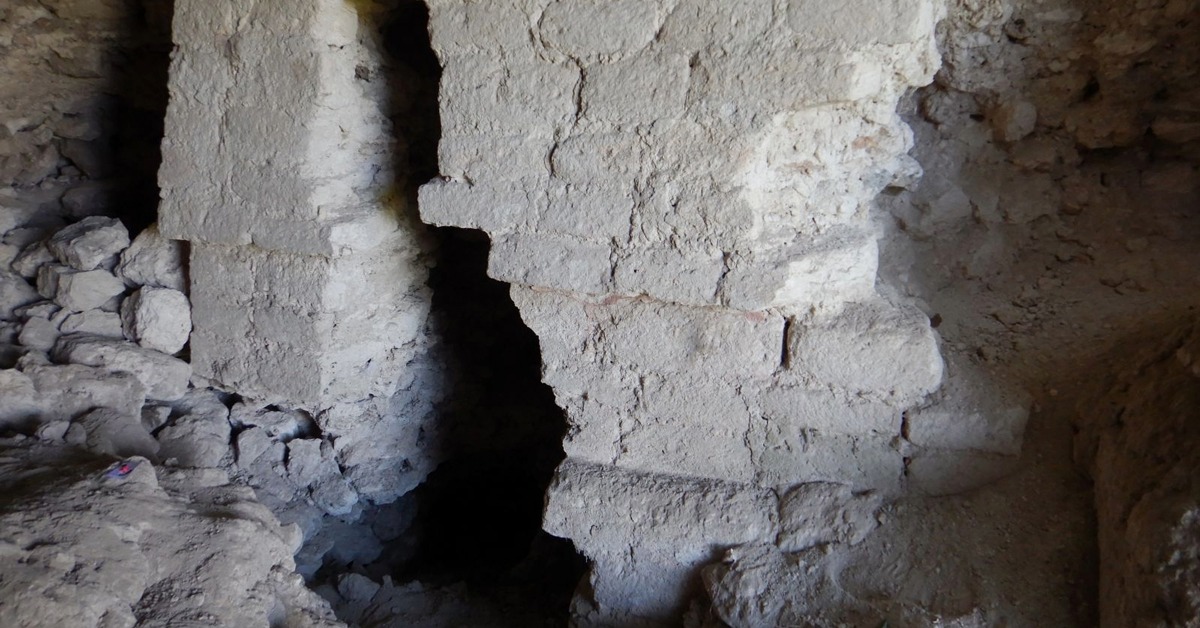
El Jefeciño also contains three Maya vaults in good condition inside some structures. Maya vaults were constructed using a corbel system, in which stones were placed in stepped layers until the space narrowed and could be closed overhead.
Possible Mural Painting and Human Remains
One of the more sensitive findings was reported in a building identified as Structure 53035, in the northeast part of the property. Specialists observed remnants of stucco with possible decorative mural painting, along with fragments of human bone that may belong to a burial context.
The possible painting appears to be decorative rather than narrative. Early descriptions mention white and orange pigments, with red bands. However, INAH specialists have been careful to say that more intensive exploration is needed before firm conclusions can be made.
That caution is important. Archaeology moves slowly because context matters. A pigment fragment, bone fragment, or collapsed staircase can change meaning depending on where it is found, what lies beneath it, and whether it belongs to an earlier or later construction phase.
So far, the evidence has remained in situ, meaning it has stayed in place. Specialists said no full archaeological salvage was carried out at the site, so there has not yet been a deep analysis or recovery of the materials.
Why the Construction Phases Matter
El Jefeciño may contain several construction phases. On the surface, specialists identified at least three. One deeper level includes apron molding. Another is linked to the possible mural painting. A later level shows collapsed areas, with stairway foundations visible.
Researchers believe the largest buildings may contain at least four or five building stages. This would mean the site was not built all at once. Instead, it likely changed over time as leaders, families, or communities modified older structures.
In Maya cities, this pattern is common. Buildings were often expanded, covered, rebuilt, or reoriented. A pyramid or palace might contain earlier versions within it, almost like layers in a stone historical archive.
For archaeologists, these layers can help reconstruct a timeline. They may show when a settlement grew, when it had access to labor, and how its public or ceremonial spaces changed.
Why Southern Quintana Roo Is Important
Southern Quintana Roo sits within a wider Maya region that stretched across the Yucatán Peninsula, Chiapas, Tabasco, Guatemala, Belize, and parts of Honduras and El Salvador.
The area around Othón P. Blanco is especially important because it connects Mexico’s Caribbean side with the older settlement networks of the southern Maya lowlands. Nearby sites such as Kohunlich and Dzibanché already show that this part of Quintana Roo was not marginal. It was part of a dense regional landscape with political, religious, and economic ties.
El Jefeciño may help researchers understand how smaller and medium-sized settlements relate to better-known ceremonial centers. It could also help clarify movement between inland communities, agricultural zones, and broader trade routes.
For expats and international readers living in Mexico, the story is a reminder that many of the country’s most important heritage sites are not tourist destinations. Some are still unexcavated, unmarked, or only partly understood.
What Happens Next
INAH specialists say the site still requires detailed mapping, conservation assessment, and deeper study. A future LiDAR mapping project could help define the settlement pattern without clearing large areas of vegetation.
LiDAR has become one of the most useful tools in Maya archaeology. It can reveal platforms, roads, terraces, and building outlines hidden below tree cover. That kind of mapping could help researchers understand whether El Jefeciño is a compact settlement, a larger urban zone, or part of a wider network.
For now, the official registration gives the site a clearer place in Mexico’s heritage record. It also opens the door to future conservation decisions.
The larger meaning is simple: El Jefeciño is not just another archaeological note from the Maya Train route. It is another sign that southern Quintana Roo still holds major evidence about ancient Maya life, architecture, and regional organization.