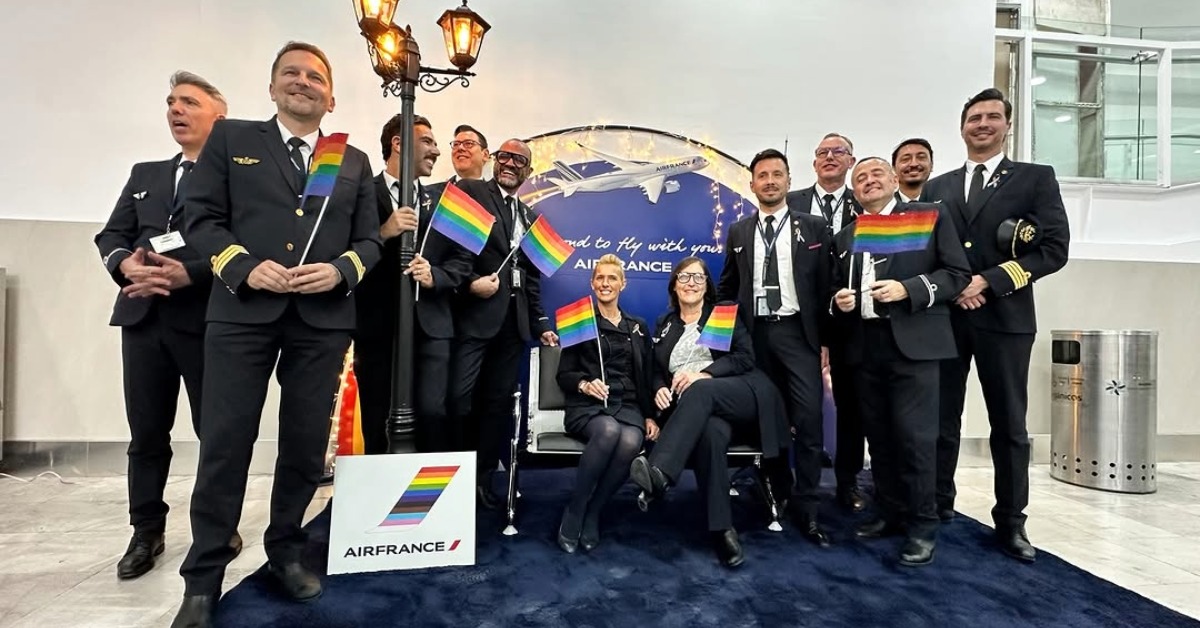
A flight from Paris arrived in Mexico City carrying more than passengers. The “rainbow flight” was part of a broader push tied to the International Day Against Homophobia, Transphobia, and Biphobia. Behind the airport welcome was a larger message about workplace inclusion, corporate policy, and the daily reality of discrimination faced by LGBTQ+ people in Mexico and abroad. The event also connected Mexico’s legal commitments with practical questions for employers, institutions, and public life.
Rainbow flight arrives in Mexico City
A “rainbow flight” from Paris landed at Mexico City International Airport as part of activities tied to the International Day Against Homophobia, Transphobia and Biphobia, marked each year on May 17.
The flight was identified as Air France-KLM flight AF0178. It arrived from Paris with French and airline-sector participants connected to LGBTQ+ inclusion efforts. The group included Éric Martineau, a French lawmaker involved in LGBTQI+ rights work, along with representatives from Air France, Personn’Ailes, L’Autre Cercle, and Transavia.
The arrival was designed as a visible message against LGBTQ+ discrimination. Organizers said the airline group would operate seven “rainbow flights” as part of the campaign.
A workplace message behind the airport event
The airport welcome was only one part of the program. French and Mexican participants also held a binational panel focused on diversity and inclusion in the workplace.
The discussion brought together business and institutional voices on policies to reduce workplace discrimination. A commitment document was also signed to support inclusive workplaces that respect sexual diversity and gender identity.
That focus gives the event a broader meaning. For many LGBTQ+ people, discrimination is not limited to public spaces or social settings. It can affect hiring, promotion, workplace safety, and access to benefits.
L’Autre Cercle, a French organization focused on LGBTQIA+ inclusion in the workplace, promotes a workplace charter for employers. Its model calls on companies to include LGBTQIA+ issues in diversity policies, human resources practices, and anti-discrimination efforts.
Mexico’s legal framework and daily reality
Mexico has formal protections against discrimination, including protections tied to sexual identity and other personal characteristics. Federal anti-discrimination guidance describes discrimination as unequal or restrictive treatment that can block access to rights.
Mexico also recognizes May 17 as the National Day of the Fight Against Homophobia. The date was declared by presidential decree in 2014, aligning with the international day observed by LGBTQ+ rights groups and institutions worldwide.
Those legal steps do not mean discrimination has disappeared. National survey data from ENADIS 2022 found that people from the sexual and gender diversity population reported higher levels of discrimination than the general adult population.
That gap is the context behind events like the rainbow flight. Public gestures can raise awareness, but the test is whether institutions and employers turn those messages into daily practice.
Why the event connects with Mexico’s expat communities
For foreigners living in Mexico, the story is not only about a flight or an airport event. It also reflects how Mexico is handling questions of equality, public policy, and workplace treatment.
Many expats interact with Mexican workplaces as employees, business owners, clients, or volunteers. Others live in cities with visible LGBTQ+ communities, including Puerto Vallarta, Mexico City, Guadalajara, and Cancún.
The event also shows how international companies are increasingly expected to address anti-discrimination policies beyond their home countries. For global brands, inclusion is now tied to hiring, customer relations, and public reputation.
Mexico has made legal gains on LGBTQ+ rights over the years. At the same time, discrimination remains part of daily life for many people. That makes workplace policy, public services, and institutional training central parts of the wider discussion.