Mexico’s territorial security approach can calm hotspots, but cartels adapt fast, shifting violence and extortion into new corridors.
Security forces are trying to hold ground, block by block and highway by highway. On paper, the numbers look better. Yet the pressure doesn’t disappear; it relocates. Across 2025, criminal groups have tested new tools, from drones and signal jammers to roadside explosives, while betting harder on extortion and control of local economies. The result is a country where some cities feel calmer, even as nearby corridors heat up. Here’s what that shift means, and what it says about the next phase of Mexico’s security fight.
The bet behind territorial control
Mexico’s current security bet is simple to explain and hard to execute. If the state can keep a steady presence in the places where criminal groups fight, recruit, hide, and move merchandise, violence should fall. That idea sits behind the push for more patrols, more checkpoints, more bases, and faster deployments when a region flares.
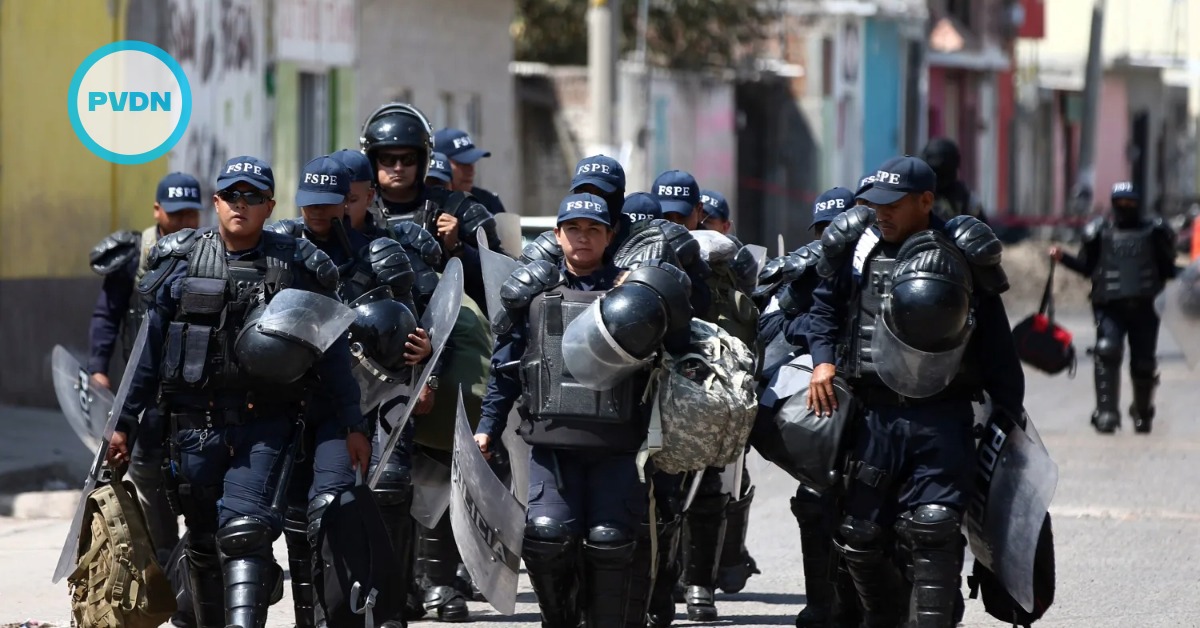
It is not an abstract strategy. In 2025, the federal government described a permanent nationwide deployment of more than 100,000 operational Guard personnel, plus a reorganization into regional territorial commands meant to tighten planning and coordination. The same official reporting frames the work in practical terms: highways, tourist zones, customs, and prisons, along with day-to-day patrols on the ground.
For many residents, including expats, that “territorial work” is what you actually see. A new Guard base on the edge of town. More uniformed patrols on the main road. A stronger presence at the airport approach, the toll booth, the tourist corridor, or the entrance to a hot neighborhood. It feels like the state is showing up.
And sometimes, it does help. Government reporting for late 2024 into mid-2025 highlighted declines in daily averages for homicide and other high-impact crimes. Those numbers matter. They also set a political expectation that the trend should continue.
The problem is what comes next, when the other side adjusts.
The cartel response is not to fight fair
The most important shift to understand is this: organized crime does not need to “win” everywhere to stay profitable. It needs options. When a hotspot becomes expensive, noisy, or heavily patrolled, groups look for the next route, the next municipality, the next market, the next vulnerable industry. That flexibility is the real advantage.
In 2025, that flexibility showed up in tactics that sidestep the strongest parts of a territorial approach.
One is distance. Drones, for example, turn control of a street corner into control of the air above it. They allow surveillance, intimidation, and attacks without needing to move a convoy of gunmen through a checkpoint. Reports tied to Defense Ministry data have described hundreds of explosive drone incidents in recent years, with the curve rising sharply as groups learn what works.
Another is friction. Improvised explosive devices, including roadside mines, change the cost of patrolling. A single hidden device can slow a unit, force a route change, or pin security forces in place while gunmen move elsewhere. In the Michoacán–Jalisco corridor, the use of these devices has grown into a grim routine, with soldiers and civilians among the victims. It is hard to “hold territory” when the territory itself becomes a trap.
A third is denial. Signal jammers and counter-surveillance tools, once associated with state actors, are now part of the criminal toolkit. If the state depends on drones and communications to extend its reach, criminal groups try to blind those systems. The territorial chessboard becomes an electronic one.
None of this replaces the older tactics. It stacks on top of them. Ambushes, roadblocks, forced displacement, and targeted killings still appear when groups want a message to travel faster than a rumor. But the new tools help criminals choose when to be loud and when to be invisible.
Violence that moves instead of vanishing
If you live in Mexico long enough, you notice a strange pattern in the national conversation: “it’s getting better” and “it’s getting worse” can both be true in the same month.
Part of that is math. Violence is not evenly spread. Official briefings in late 2025 described how a small group of states carried roughly half of all homicides nationwide. That means a drop in one high-violence state can improve the national trend even as another region catches fire.
But part of it is strategy. When security forces concentrate on a hotspot, criminal groups often respond by shifting the contest line. They move into rural edges, secondary roads, or smaller municipalities where local police are weaker and where a few assassinations can reshape control. A conflict-tracking project documented this in Sinaloa, where clashes and attacks expanded beyond the capital and into rural areas as factions tried to redraw their zones of influence.
This is where the territorial approach collides with reality. Security deployments are visible and measurable. Criminal adaptation is quieter and faster. A surge of patrols can reduce street-level shootings in one city, while nearby towns absorb the spillover in extortion, disappearances, or targeted attacks that never make national headlines.
The country ends up with “pockets of calm” that coexist with “corridors of heat.” For expats, this matters because daily life is often lived inside those pockets, while risk sometimes sits in the routes between them.
The border is not one story, and neither is the south
Mexico’s violence map in 2025 did not behave like a single national crisis. It behaved like several regional contests happening at once, connected by money, weapons, and movement.
In the north, the security focus has been shaped heavily by fentanyl trafficking, cross-border migration, and weapons flows. A major federal operation launched in February 2025 deployed thousands of Guard personnel along the border, and authorities later reported large totals of detentions, weapons seizures, and drug seizures. That kind of operation can disrupt movement in the short term. It also pushes groups to adapt logistics, move through new crossings, and rely more on technology and corruption than on brute force.
In the south, the story has been about routes and governance. Chiapas, once discussed mainly in terms of migration and poverty, has faced clashes tied to control of border crossings and smuggling corridors. In 2025, state authorities publicly showcased armed drone prototypes as a response to heavily armed groups and to cartel drones that drop explosives. Whatever you think of that response, it underlines the same point: territorial control now includes the air, and local governments are scrambling to keep up.
For expats, the regional nature of the crisis is easy to miss. Many foreigners mostly interact with Mexico through a handful of cities, beach areas, and travel routes. The danger is assuming the country’s “safety level” is one uniform thing. It is not. The better question is always, “Which region, which route, and which kind of crime?”
Extortion is the business model that territory enables
Homicide draws the headlines. Extortion shapes daily life.
This is where the territorial story gets uncomfortable, because extortion thrives in places where a group can enforce rules without constant gunfire. It is easier to charge “protection” to a restaurant, a mechanic, a taxi stand, or a construction site than it is to run an open street war. When a group controls a neighborhood, it can tax normal life.
Official reporting and outside monitoring in 2025 pointed to extortion as one of the few major crimes that has not followed the downward trend claimed for other high-impact offenses. Business groups highlighted record-high official victim counts in the first half of 2025. Other reporting, citing official crime statistics, described extortion complaints running well above 2019 levels.
And even those numbers are only the visible slice. Mexico’s national victimization survey shows that the vast majority of crimes never get reported, and it lists extortion among the most common offenses experienced by victims. That gap between lived experience and official complaints is part of why extortion is so hard to fight. People often think reporting will not help, or they fear retaliation, or they assume the local system is compromised.
From a territorial perspective, extortion is also the “adaptive” crime. A checkpoint can catch a gun. It cannot catch a threat delivered by phone, a demand delivered through a messenger, or a quiet deal made with a local intermediary who looks like a normal businessman.
When security policy celebrates territorial presence without breaking the financial and enforcement systems behind extortion, criminal groups can lose street fights and still win the economy.
What this means for expats living in Mexico
Most expats do not experience Mexico as a battlefield. They experience it as school runs, dog walks, beach days, traffic, and errands. That can make it tempting to tune out the security story as “something that happens elsewhere.”
The territorial-versus-adaptation dynamic is a reason not to tune out, but also not to panic.
It helps explain why a city can feel calmer while risk shifts to the ring roads, the rural outskirts, or the highways you use for weekend trips. It helps explain why “tourist zones” can stay relatively stable while nearby working-class neighborhoods deal with predatory crimes that rarely make international news. It also helps explain why many residents say their biggest security concern is not shootouts, but the quiet crimes that pressure businesses and households.
For foreigners, the practical takeaway is not to treat safety as a single headline about “Mexico.” Treat it as local knowledge: what has changed on your usual routes, what neighborhoods have seen pressure, which industries are being targeted, and how local authorities are responding. The lived reality is granular. Security policy is often national. Organized crime sits in the gap.
A territorial strategy that can keep up
None of this is an argument for abandoning territorial work. Presence matters. Patrols can deter opportunistic violence, and fast deployments can prevent short spirals from becoming long ones. The question is whether territorial work is paired with the parts of state power that criminals fear most.
That means investigations that lead to convictions, not only arrests. It means targeting weapons supply chains and the money networks that pay for drones, explosives, and bribery. It means protecting local officials and honest police, because criminal control often begins with intimidation of the nearest authority. It means making extortion safer to report and harder to monetize, so a group cannot tax everyday life with impunity.
A territorial approach can also be smarter about what “territory” means. Not every square kilometer needs a permanent presence. The priority is the connective tissue: highways, ports, border crossings, industrial corridors, and the municipal seams where one police force ends and another begins. That is where violence and illicit commerce move when they are squeezed.
At year’s end, the clearest lesson is that organized crime has stopped behaving like a set of static cartels. It behaves like a set of adaptive networks, able to shift tactics, geography, and business lines with speed. Territorial work can slow that. On its own, it rarely breaks it.