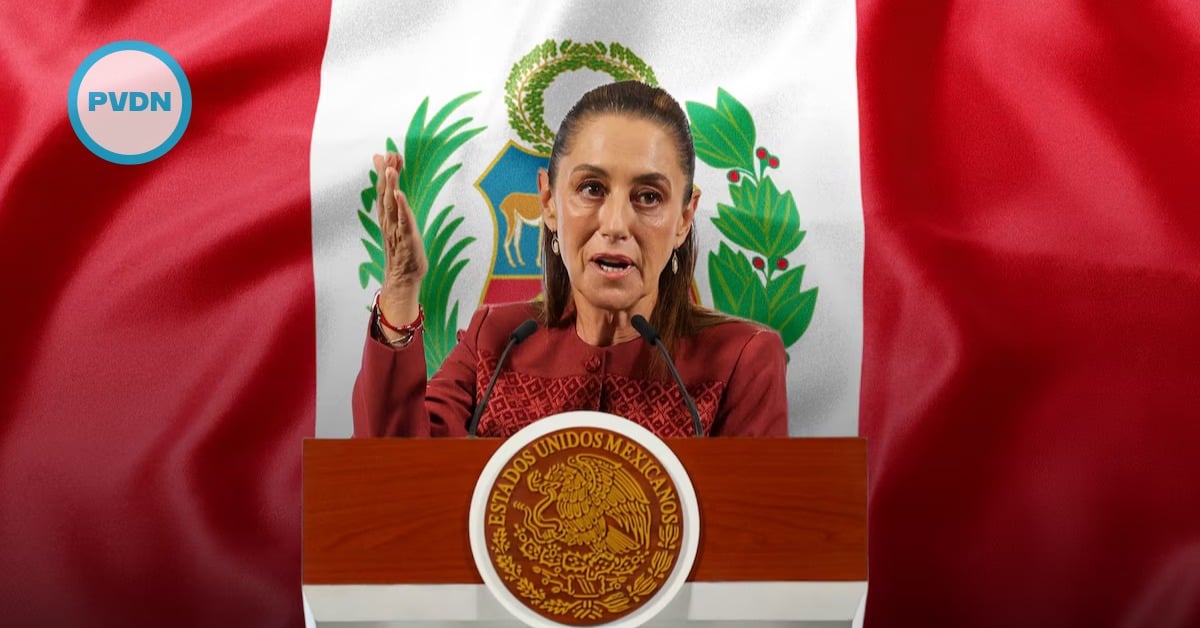
Sheinbaum warns Peru that storming Mexico’s embassy in Lima to arrest Betssy Chávez would breach international law and Mexican sovereignty.
At her morning press conference, President Claudia Sheinbaum drew a clear red line for Peru. Any move to send security forces into Mexico’s embassy in Lima to arrest former Peruvian prime minister Betssy Chávez, she said, would violate international law and Mexico’s sovereignty.
Her comments came after Peru’s interim president, José Jerí, said in a weekend interview that he was prepared to order an operation inside the embassy to enforce an arrest warrant against Chávez. The former prime minister is accused of helping then-president Pedro Castillo in his failed 2022 attempt to dissolve Congress and remains the target of a criminal case that could bring a decades-long prison sentence.
Sheinbaum stressed that international rules protect Mexico’s decision to grant Chávez asylum. She described any forced entry into the embassy as an “irregular” act that would “violate all international laws”. She framed the dispute as a test of whether both countries can manage deep differences without crossing legal lines. She also repeated a message that has become a constant in her foreign policy: disagreements, she said, must be settled through dialogue, not threats.
For Mexico, the warning is not only about Chávez. It also speaks to a wider concern about the safety of its embassies, after a year in which one of its diplomatic missions was already stormed abroad.
Mexico’s Peru embassy standoff
Mexico’s Peru embassy standoff began earlier this month, when Chávez entered the Mexican embassy in Lima and requested protection. Days later, Peru’s government announced it was cutting diplomatic relations with Mexico, calling the asylum decision an “unfriendly act” and citing what it saw as repeated interference in its internal affairs. Peruvian police have since guarded the streets around the embassy, while formal communication between the two governments has been reduced to a minimum.
Chávez, who briefly served as prime minister under Castillo, is accused of conspiracy against the state and of taking part in his attempt to shut down Congress in December 2022. She spent more than a year in jail before being released in 2023 to prepare her defense. Prosecutors are seeking a 25-year sentence and a judge has now ordered five months of preventive detention, along with an international arrest warrant.
Since she took refuge in the embassy, Peruvian authorities have insisted they must execute the court order. In his interview, Jerí said bluntly that “if it is necessary to enter the Mexican embassy, it will be done,” language that quickly set off alarm bells in Mexico and across the region. In a separate comment, he said his “hand does not tremble” when it comes to enforcing the law, signaling a hard-line stance even as his own diplomats called for caution.
At the same time, Peru’s foreign ministry has tried to cool the rhetoric. After criticism from legal experts and opposition figures at home, Jerí later said he would act in consultation with his chancellery, and senior officials have since stressed that Peru will respect its international obligations. That has not erased the impact of his original threat, which Sheinbaum called out directly from Mexico City.
The standoff comes on top of an already fractured relationship. Tensions between Mexico and Peru have been high since the removal and arrest of Castillo in 2022, when Mexico granted asylum to his family and questioned Peru’s handling of the crisis. This month, Peru’s Congress went further, voting to declare Sheinbaum persona non grata after her government confirmed asylum for Chávez.
Embassy law and regional precedent
Behind the political statements lies a firm legal framework. The Vienna Convention on Diplomatic Relations, which both Mexico and Peru have signed, states that the premises of a diplomatic mission are inviolable and that agents of the receiving state may not enter them without the consent of the head of mission. The rule is considered one of the foundations of modern diplomatic practice, precisely because it protects embassies even in moments of deep political tension.
Mexico also argues that Chávez’s situation falls under regional agreements on diplomatic asylum, including the Caracas Convention, signed by several Latin American states during the Cold War. Those instruments were designed with the region’s history of coups and political persecution in mind, and Mexico has often presented itself as a defender of asylum in Latin America.
A recent trauma colors Sheinbaum’s warning to Peru. In April 2024, Ecuadorian police and soldiers forced their way into Mexico’s embassy in Quito to arrest former vice president Jorge Glas, who had been granted asylum while facing corruption charges. The raid was widely condemned as a violation of the same Vienna rules that now govern the dispute with Peru, and Mexico broke diplomatic ties with Ecuador and took the case to the International Court of Justice.
That experience helps explain the sharp tone of Mexico’s reaction in the current crisis. Mexican diplomats argue that allowing one embassy raid to go unanswered has already set a dangerous precedent. A second forced entry against a Mexican mission, they say, would send the message that international rules are optional when political stakes are high.
Peru’s government, for its part, insists that Chávez must face trial for her alleged part in the 2022 power struggle. Courts there have framed her case as one of defending democratic order against an attempted self-coup. Officials argue that asylum cannot be used to shield someone from accountability for serious domestic crimes, a position also raised by Ecuador during the dispute over Glas.
For now, the former prime minister remains inside the Mexican ambassador’s residence in Lima, under the protection of a government that has doubled down on its commitment to asylum. Outside, Peruvian police continue to guard the streets, while both capitals trade statements about law, sovereignty and the limits of state power.
What happens next will depend less on public threats and more on quiet diplomacy. Mexico has signaled it wants a negotiated solution that respects its right to grant asylum and Peru’s need to enforce court orders. Peru’s leaders say they will act within international law, even as some voices at home urge a tougher line. Between those positions sits a fragile balance: an embassy that must remain off-limits to force, and a high-profile defendant whose fate has become a symbol of where that line is drawn.