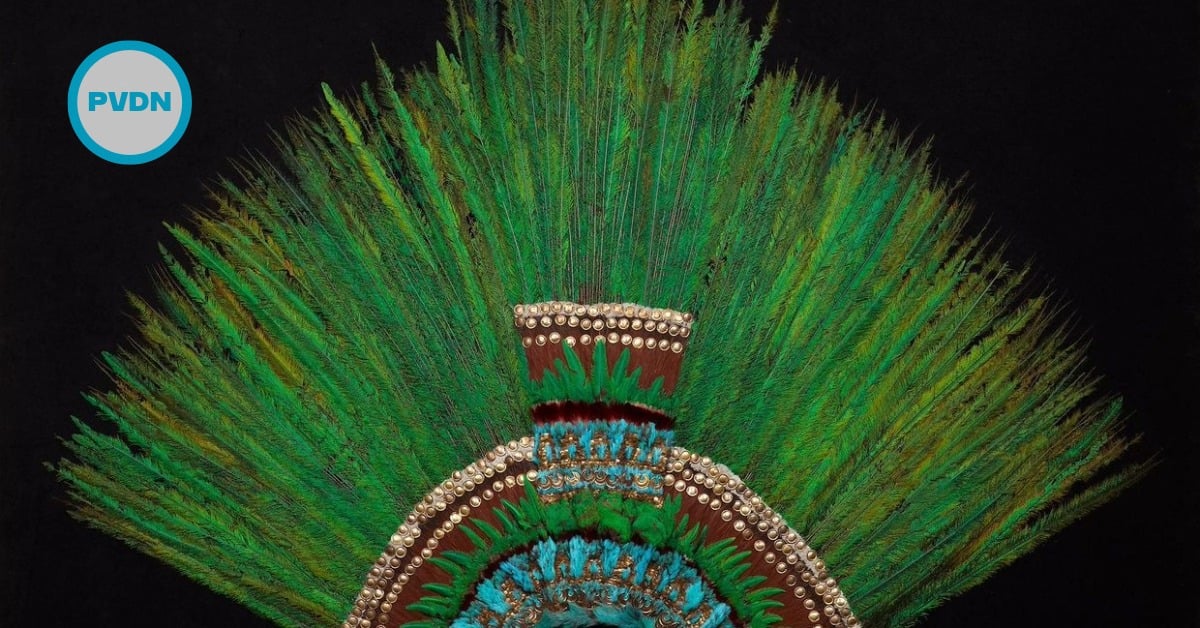
The fight over Mexico’s most famous plume of quetzal feathers is no longer just diplomatic small talk. A descendant of the Aztec ruler says her family will take the case to court—backed by a U.S. firm known for landmark art-restitution wins—if Mexico’s government signs on. Vienna insists the 500-year-old piece can’t travel without falling apart; activists argue that claim is convenient. What would a courtroom ask—and answer—about ownership, provenance, and fragility? Here’s what’s real, what’s rhetoric, and what happens next.
The family of historian Blanca Barragán Moctezuma, who identifies as a 16th-generation descendant of the Mexica tlatoani, says they are preparing a legal push to reclaim the Penacho de Moctezuma—the feathered headdress in Vienna—if Mexico’s federal government formally backs them. They’ve been in talks with Los Angeles firm Burris, Schoenberg & Walden (BSW), which the family credits with advising a path after political and diplomatic avenues stalled, according to a new report in El Universal published early Tuesday, October 14, 2025.
BSW is best known for lawyer E. Randol Schoenberg’s role in the Altmann litigation that pried Gustav Klimt’s “Portrait of Adele Bloch-Bauer I” from Austria and returned it to the heirs, a work widely cited in art-law circles and reflected in the firm’s own materials. That case reshaped expectations around suing foreign states and museums in U.S. courts under the Foreign Sovereign Immunities Act (FSIA).
Today, the original headdress sits in Vienna’s Weltmuseum Wien, which describes the piece as singular and of uncertain route out of Mexico—“how and when it left” remains unclear. The museum frames it as world cultural heritage and underscores its exceptional significance.
For years, Austria has rejected loan or transfer requests, citing a binational conservation assessment (2010–2012) that concluded the featherwork is too fragile to move by land, sea, or air without “massive” damage. Reuters reported that position again in 2020, and Mexico’s Foreign Ministry reiterated the joint experts’ conclusion in 2017, noting both sides agreed it cannot travel until technology eliminates harmful vibration.
Inside Mexico, President Claudia Sheinbaum’s administration has recently acknowledged the continuing aspiration to repatriate pre-Hispanic pieces while avoiding diplomatic rupture—language repeated in a May 30, 2025, presidential press-conference transcript. This month, lawmakers again urged the federal government to press Austria.
Moctezuma headdress lawsuit
Here is where the litigation talk gets complicated. International cultural-property law lacks a one-size-fits-all lever for objects that left their homelands centuries ago. The 1970 UNESCO Convention—a touchstone for today’s returns—is not retroactive; it generally applies only to illicit transfers after both countries implemented it, not to 16th-century departures. Any case would turn on national laws, the object’s path into Austria, and whether a court accepts a theft theory or an argument of gift or lawful transfer.
Provenance remains contested. Vienna’s museum emphasizes lingering uncertainty about the piece’s exact journey, while Mexican sources and activists lean toward dispossession narratives. Scholars and journalists have long debated whether the artifact was a royal headdress or an insignia, and whether it ever personally belonged to Moctezuma II. The lack of airtight documentation is likely to matter in court.
BSW’s involvement hints at one possible route: a strategy informed by Altmann, the 2004 U.S. Supreme Court decision that allowed Maria Altmann to sue Austria in U.S. court under FSIA exceptions. But Altmann dealt with Nazi-era takings and U.S. jurisdiction links; the penacho sits in Austria, with a provenance centuries earlier. Even if heirs allege wrongful taking, counsel would need a jurisdictional hook—and a forum—willing to hear it. The precedent shows it can be done in some contexts, but not necessarily in this case.
There’s also the fragility wall. Austria’s position is that transport would endanger the work; conservators from both countries signed onto that conclusion. Whether that’s a legal defense or a practical brick in the road depends on the forum, but it’s undeniably a public-opinion factor. Mexican officials and advocates have challenged the absoluteness of the claim, arguing for new risk assessments or creative solutions; the museum says it is “keeping up with the latest technological developments.”
What about political pressure? In August 2023, members of the U.S. Congressional Hispanic Caucus urged Austria to return the headdress, a symbolic vote of solidarity that underscores how the penacho has become a cultural flashpoint well beyond Mexico and Austria. Diplomatic statements raise the stakes; they don’t substitute for a legal footing.
What the court could actually decide
If a case is filed, the early questions are technical: Which court has jurisdiction? What law governs the claim? What’s the standard of proof for ownership after five centuries? A court might first test standing and sovereign-immunity defenses; then wade into provenance, chain of custody, and whether the object was taken unlawfully or transferred as a gift. The UNESCO framework will inform the rhetoric, but it is unlikely to control the outcome due to its non-retroactive scope.
Even if heirs or the Mexican state won a ruling, remedy is its own puzzle. Austria’s museum asserts the piece cannot travel safely; Mexico’s conservation officials once acknowledged the same, pending technological breakthroughs. A judgment could, in theory, order restitution, set terms for shared stewardship, or nudge the parties into a negotiated solution—for example, intensified collaboration, scholarship, high-fidelity replicas in Mexico, or time-bound in-situ exhibitions designed for Mexican audiences in Vienna. Those ideas have been floated in policy debates for years, even as both sides keep the original in its vibration-controlled vitrine.
For now, the legal move by Barragán Moctezuma’s family is real, the government’s stance is pivotal, and the science around transport remains a roadblock. That combination—law, politics, and conservation—will decide whether the Moctezuma headdress lawsuit becomes a landmark case or another chapter in a 500-year argument about who owns the past.