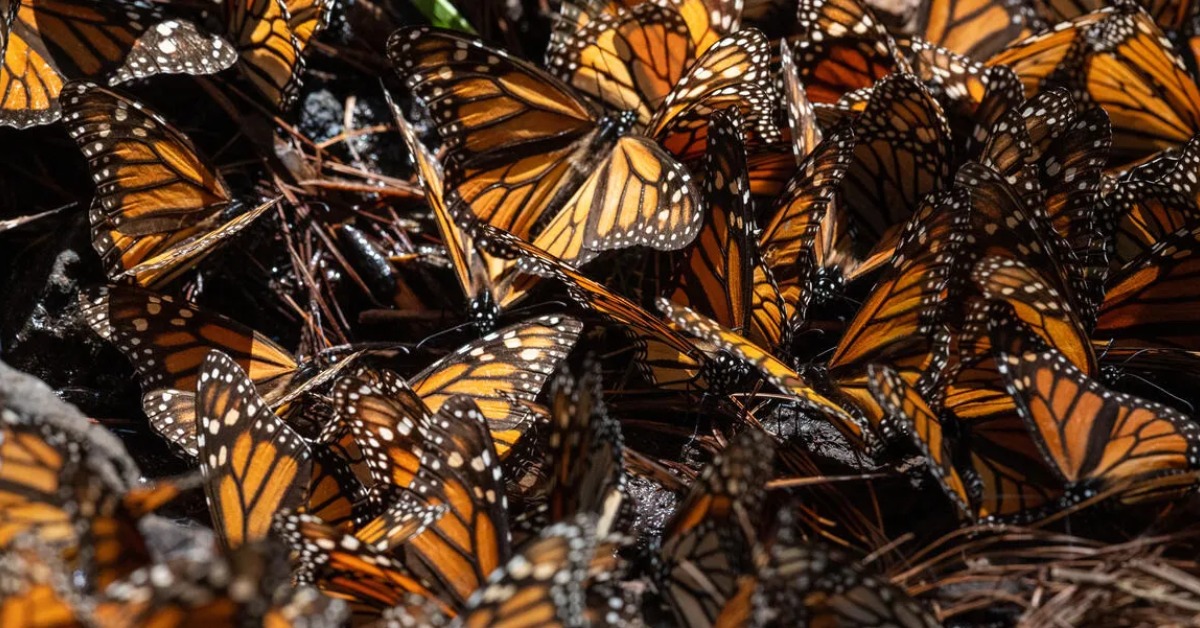
Mexico’s monarch butterfly colonies posted a sharp increase this winter, a welcome shift after several difficult seasons. But the headline number only tells part of the story. The annual count measures how much forest the butterflies occupied, not how secure the migration has become. Behind the rebound is a longer fight over habitat, illegal logging, pesticide use, and climate pressure across North America. The result is encouraging, but it does not mean the species is out of danger.
A better season, but not a full recovery
Mexico reported a 64% increase in wintering monarch butterfly colonies during the 2025-2026 season, with the insects occupying 2.93 hectares of forest, up from 1.79 hectares a year earlier. The result marks a notable improvement after several weak years and offers a more hopeful snapshot for one of North America’s best-known migrations.
Even so, the increase should be read with caution. The latest result is stronger than last year’s count, but it remains far below the levels recorded in the 1990s, when monarch colonies covered much larger areas of forest in central Mexico. In other words, this winter’s growth points to a better year, not a return to historic strength.
That distinction matters because monarch numbers often rise and fall sharply from one season to the next. Weather conditions, food sources, habitat quality, and migration survival all play a role. One positive season does not erase the pressures that have weakened the population over time.
What the annual monarch count actually measures
The monarch survey in Mexico is based on forest area occupied by colonies, not a direct count of individual butterflies. Researchers locate the clusters after the monarchs settle in the high-elevation forests of Michoacán and the State of Mexico, then calculate how much land the colonies cover.
That method has become the standard way to track the eastern monarch population, which breeds across large parts of the United States and southern Canada before flying south to spend the winter in Mexico. The butterflies gather in dense groups on trees in mountain forests, making the occupied area a practical way to compare one year with another.
This season, officials reported a total of nine colonies. Most of the occupied forest was inside the Monarch Butterfly Biosphere Reserve, though some colonies were found outside the protected core area. That detail is important because it shows the migration depends on a broader landscape, not only on the best-known sanctuaries visited by tourists.
Why the numbers improved this year
Officials and conservation groups linked the stronger season in part to better environmental conditions in breeding and migration zones north of Mexico. Wetter conditions in some parts of the United States helped support the growth of milkweed and nectar plants that monarchs rely on during their life cycle. Lower drought stress also likely improved survival during migration.
That context helps explain why the population can shift so much from year to year. Monarchs are affected by conditions across an enormous geographic range. A difficult spring in the U.S. Midwest, a dry migration corridor, or extreme winter weather in Mexico can all affect the final number measured in the sanctuaries.
So while the increase is real and meaningful, it may reflect a season of improved conditions as much as a deeper structural recovery. That is why conservation groups continue to treat annual gains carefully. The trend matters, but so does the reason behind it.
The threats have not gone away
The challenges facing monarch butterflies remain across North America. In the United States and Canada, monarchs depend on milkweed for reproduction. Loss of that habitat through land-use change and herbicide use has been one of the main long-term threats to the species. Nectar plants used during migration have also declined in many areas.
In Mexico, the winter forests remain vulnerable to illegal logging, fire, drought, and changing climate patterns. Forest damage in the monarch reserve’s core zone declined compared with the previous year, but it did not disappear. That means the quality of the winter refuge still depends on continued protection and monitoring.
Climate pressure is another major concern because monarchs rely on a highly specific natural rhythm. Their migration spans thousands of kilometers and depends on seasonal conditions spanning three countries. When those patterns shift, the effects can ripple through the entire cycle.
Why this story matters in Mexico
For many readers in Mexico, the monarch butterfly is not only a conservation issue. It is also tied to forests, water systems, tourism, and local economies in the central highlands. The reserve that shelters the butterflies is part of a broader environmental system that supports communities far beyond the immediate sanctuary.
That is one reason the monarch’s winter count receives so much attention each year. The butterflies are easy to recognize, but the story behind them is about the condition of an interconnected landscape. A stronger season can signal that some pieces of that system held together better this year.
Still, the latest count is best understood as encouraging progress, not a final turnaround. The migration remains fragile, and its future depends on long-term habitat protection in Mexico, the United States, and Canada. The 64% increase is real. So is the uncertainty that still surrounds it.
With information from WWF México, Mexico Daily News