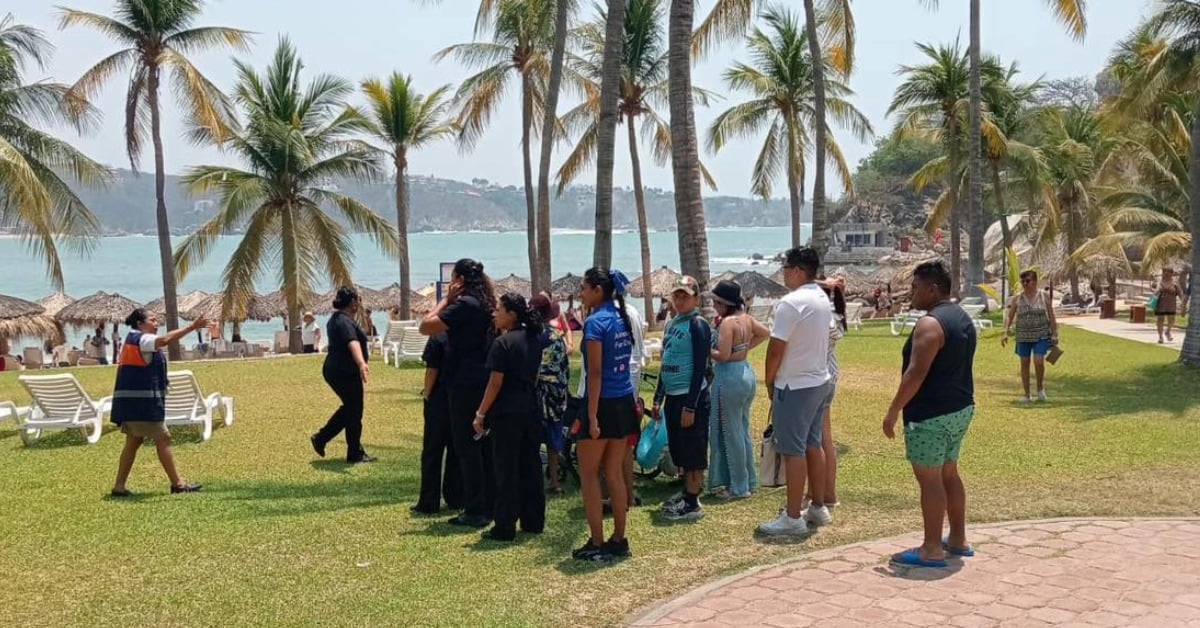
Civil Protection officials on Oaxaca’s coast convened in Santiago Pinotepa Nacional to coordinate the September 19 national earthquake drill, aligning playbooks for government offices, schools, businesses, and the hotel sector from Pinotepa to Huatulco. The planning meeting emphasized a noon start and uniform procedures for evacuations and reunification points across coastal towns.
The state’s communiqué confirms that the drill will run at noon (Central Time) under a scenario simulating an 8.1-magnitude earthquake with an epicenter near Lázaro Cárdenas, Michoacán. That scenario mirrors the federal hypothesis set for this year’s exercise, anchoring training to a realistic coastal subduction event felt firmly along Oaxaca’s shore.
What will actually happen on Sept. 19 at noon
The federal portal for the Segundo Simulacro Nacional 2025 lists the official time and provides registration for workplaces—including hotels—so local units can receive guidance, drill materials, and certificates of participation. Oaxaca’s government has also flagged a first-ever nationwide test message to cell phones during the drill, part of a push to layer mobile alerts onto existing systems.
That national plan sits alongside the SASMEX early warning network, which for years has provided alerts across Oaxaca and the Pacific corridor through radio, EAS/SAME receivers, and public loudspeakers. CIRES, the nonprofit operating SASMEX, documents long-standing coverage in Oaxaca and the system’s role in alerting to major coastal events. The coastal municipalities expect to coordinate their drill cues with both the federal guidance and local alerting infrastructure.
September 19 is not a random date. Mexico’s most devastating modern quake struck on September 19, 1985, when an ~M8 offshore Michoacán event hammered Mexico City; another destructive earthquake hit on September 19, 2017, with a different mechanism yet painful resonance. Annual drills aim to make muscle memory from lessons that were once learned in rubble.
The 2025 hypothesis mirrors coastal reality. Oaxaca straddles one of the country’s most active subduction zones; the state’s guidance stresses frequent drills and robust “unidades internas” inside workplaces. The federal labor ministry’s practical guide for evacuation drills recommends at least two exercises per year per facility, coordinated with local Civil Protection.
What it means for Huatulco’s hotels and public spaces
Huatulco’s municipal channels have signaled participation, and coastal coverage this week underscores that hotel corridors and public venues will follow unified instructions. For hotels, the state’s program templates translate into familiar steps: pre-drill guest briefings at check-in, visible signage to safe points, elevator lockouts during the alarm, and bilingual floor-warden assignments that move people safely to muster areas.
The meeting in Pinotepa knitted those details town by town. Local reports note participation from dozens of municipal authorities across the Costa, reflecting the region’s decision to rehearse together rather than piecemeal. That consensus helps hotels that operate across multiple properties standardize their actions and messaging.
Visitors along Oaxaca’s coast may hear sirens, loudspeakers, or tones from EAS/SAME receivers; in parallel, phones should display the federal test message if carriers and devices are configured for cell-broadcast reception. SASMEX’s long record in Oaxaca—documented by CIRES and state materials—explains why coastal towns train to act quickly even with short lead times. The drill harmonizes these layers so that on a real day, people follow the nearest instruction rather than hunting for perfect information.
This year’s drill is about consistency. A fixed time, a clear scenario, and synchronized municipal plans let schools, markets, and hotels rehearse the same choreography. That’s good news for a coast that lives with seismic risk and depends on tourism. If you are staying in Huatulco or traveling the Costa on September 19, expect a midday pause and an orderly walk to a safe point. It’s practice worth taking seriously.