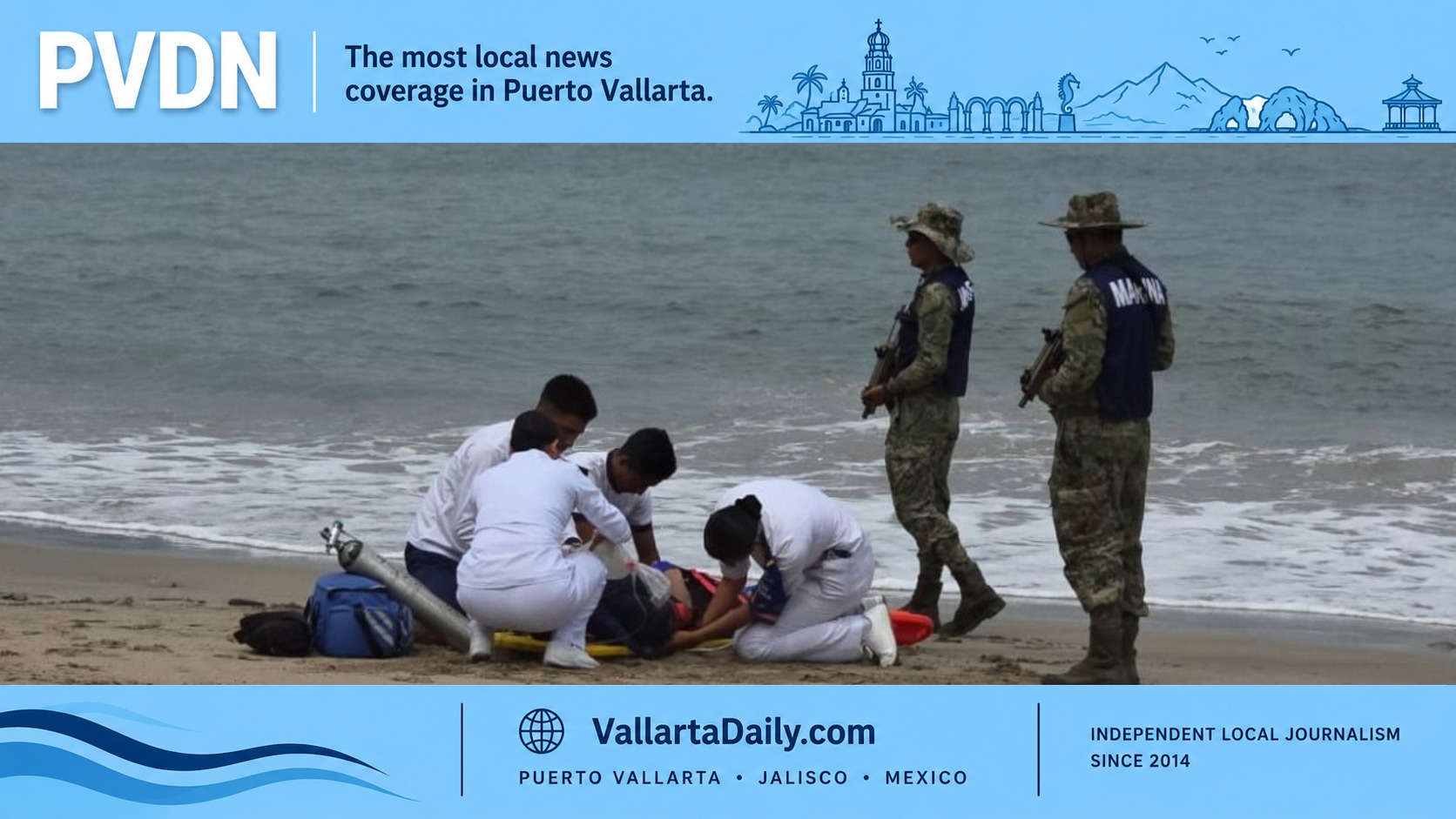
Puerto Vallarta, Jalisco, July 9, 2026 — A capsized boat, one person stranded on its overturned hull and another being carried toward shore by the current formed the emergency scenario tested Thursday by Mexican Navy rescue crews off Olas Altas.
The exercise did not involve an actual accident. It was staged to test how quickly separate teams could respond to victims in deeper water and closer to the beach during Puerto Vallarta’s summer vacation season.
After receiving a simulated emergency call, the Navy dispatched a Defender-class response boat to the area off Olas Altas. Two rescue swimmers entered the water to reach the person positioned on the overturned vessel, while shore-based lifeguards moved to recover the second participant as the current carried that person toward the beach.
The divided response was the central part of the drill. One rescue required a boat and trained swimmers offshore, and a second unfolded within reach of beach personnel.
Gonzalo Fernando Flores Quiroz, commander of Puerto Vallarta’s Naval Search, Rescue and Maritime Surveillance Station, said the exercise tested the training and emergency-response capabilities of personnel assigned to the summer operation.
The drill was conducted by the Mexican Navy through the Twelfth Naval Zone and formed part of Operation Lifeguard Summer 2026, which began June 30 and is scheduled to continue through August 30.
Puerto Vallarta entered the vacation period with Navy rescue personnel, patrol vessels and first-aid support assigned to the coastline. PVDN previously reported on the start of the city’s expanded summer beach patrol operation, which places specialized personnel near heavily used beaches during the seasonal increase in swimmers and recreational boats.
Thursday’s drill provided a public demonstration of how those resources are expected to work together when an emergency moves between open water and the shoreline.
The choice of Olas Altas also placed the exercise beside one of the city’s most active waterfront areas, close to Los Muertos Beach and the dense hotel, restaurant and condominium zone south of the Cuale River. An emergency there could require rescuers to operate around swimmers, small boats and other coastal activity rather than in an isolated section of the bay.
The Navy did not report the precise response time recorded during the exercise, the number of personnel involved or whether municipal Civil Protection crews participated. It also did not announce any changes to beach staffing after the drill.
The scenario began with a call reporting an overturned vessel near Olas Altas, followed by the rapid deployment of the Defender boat and simultaneous shore rescue.
The exercise tested a response structure that has been used during real emergencies in the bay. In 2023, personnel from the same naval search-and-rescue system brought nine people back to Puerto Vallarta after their yacht became stranded roughly 15 kilometers offshore.
For beachgoers, the drill does not change access to Olas Altas or Los Muertos Beach. No closure or swimming restriction was announced in connection with the exercise.
Water conditions can still change quickly during the rainy season, particularly when storms generate stronger surf, currents, or runoff near river mouths. Swimmers should follow the flag posted at each beach and the instructions of lifeguards, even when conditions appear manageable from shore.