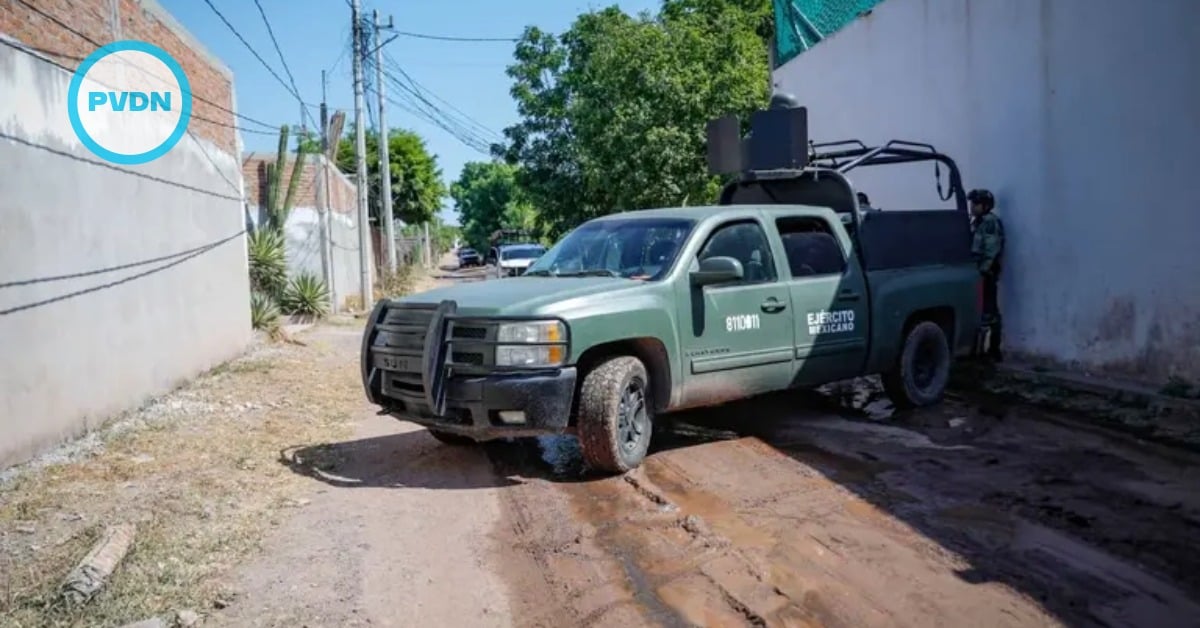
The federal government launched Operación Frontera Norte on 5 February, sending roughly ten thousand soldiers and National Guard members to key points along the border with the United States. The mission is to hit organized crime on several fronts at once: synthetic drugs, fuel theft, arms trafficking, and human smuggling, while tightening control over crossings, ports, and highways.
Nine months later, security officials say the operation has led to 9,128 detentions. They report the seizure of 6,921 firearms and almost 1.2 million rounds of ammunition. The same brief lists 31,808 magazines, more than 109,000 kilograms of drugs, and 494 kilograms of fentanyl. Authorities also count 5,622 vehicles and 1,096 properties taken from criminal groups since the deployment began.
The latest update focuses on Sinaloa, where military and federal agents moved into rural zones of Culiacán and Cosalá. According to the government’s tally, teams located and disabled 13 sites used to store materials for synthetic drugs. They report seizing 16,665 liters of chemical substances and a reactor for organic synthesis, equipment typically associated with large-scale methamphetamine production.
Officials estimate the financial blow at 337 million pesos for the group that controlled those supplies. The figure is based on the cost of the precursors and the potential market value of the drugs they could produce. While those calculations are always an estimate, the number underlines the scale of industrial drug production now operating in the Sierra and along key transport corridors in Sinaloa.
The same briefing notes, smaller but telling actions in other states. In Playas de Rosarito, Baja California, troops report seizing a kilogram of heroin and a vehicle. In Badiraguato, Sinaloa, they say they secured a long gun, five magazines, more than a thousand cartridges, and four improvised explosive devices. In Cajeme and Hermosillo, Sonora, police and federal forces detained four people with packages of methamphetamine and marijuana. And in Abasolo, Tamaulipas, an operation ended with four detainees and the seizure of four rifles, 17 magazines, 75 cartridges, a monitoring center, a motorcycle, and two vehicles.
These numbers come after weeks of similar weekend bulletins, where authorities have documented raids on safe houses, rural drug sites, and urban properties used to move cash and chemicals. Together, they paint a picture of an operation that moves city by city, rather than a single spectacular blow.
Beyond one raid in Sinaloa
The Sinaloa seizures fit a broader pattern that has been taking shape since February. Early in the deployment, federal reports highlighted large drug shipments intercepted on highways and border crossings. One of the first big cases involved a trailer loaded with hundreds of kilos of methamphetamine and cocaine, stopped before it could reach the United States. That seizure set the tone for a campaign that mixes highway checks, targeted warrants, and joint operations with state police.
In Baja California, the same operation has been linked to the discovery of a 600-meter clandestine tunnel between Tijuana and San Diego. Investigators found the tunnel entrance in a house near the Otay border crossing, with rails, pipes, and a pulley system inside. The tunnel, one of dozens documented along the frontier in recent decades, showed how deep-rooted smuggling networks are adapting to tighter controls at official crossings.
Farther east, the border state of Tamaulipas has become a key test for the strategy. Since February, authorities there have reported at least 15 million liters of illegal fuel seized and close to 20 people detained in actions tied to fuel theft. Intelligence reports cited by Mexican officials describe how criminal groups have turned stolen crude and refined fuel into a major income stream, helped by corrupt links inside ports and pipelines. The same reports note more than 1,100 illegal taps on pipelines in Tamaulipas in 2024, up sharply from just over 200 in 2021.
Operación Frontera Norte is also unfolding alongside a renewed push with the United States to cut both fentanyl and weapons flows. Mexican authorities point to recent joint operations that stopped shipments of rifles and ammunition headed south at international bridges. Those cases highlight how assault weapons purchased in U.S. states still supply many of the groups now targeted in Sinaloa, Sonora, and Baja California.
For border communities, the operation is another chapter in a long cycle of deployments and raids. Cities like Tijuana, Reynosa, and Matamoros have lived with overlapping patrols by municipal police, state forces, the National Guard, and the army for years. Residents see roadblocks, convoys, and occasional firefights, while migrants and deportees move through the same corridors. The government argues that this sustained presence is needed to keep pressure on criminal groups and to protect people moving through the region.
At the same time, researchers and local advocates warn that success cannot be measured only in kilograms, liters, or arrest counts. They point out that high numbers can hide patterns of repeat arrests, or shifts in routes that push violence into more rural areas. Official data from the first months of the Sheinbaum administration show large increases in drug seizures compared with the end of the previous government, yet homicide and extortion figures remain stubborn in many municipalities.
Still, the 337 million peso hit reported in Sinaloa stands out even against that backdrop. Disabling chemical stockpiles and specialized equipment is harder to replace than street-level dealers or small arms. For synthetic drug production, reactors, precursor chains, and secure storage sites are the backbone of the business. Removing them forces groups to move, rebuild, and take risks that can expose other parts of their structure.
What remains less clear is how long the current tempo of operations can be sustained, and whether the same level of coordination will reach lesser-known corridors beyond the headlines. The government insists the campaign will continue, and new weekend summaries will almost certainly bring fresh numbers of detainees, seized weapons, and destroyed drug sites. For now, the Sinaloa blow has given officials a clear talking point: months into Operación Frontera Norte, the operation is still uncovering industrial-scale drug infrastructure that had been hidden in plain sight.