Every December 12, Our Lady of Guadalupe Day turns Mexico City’s basilica and hometown parishes into a massive thank-you pilgrimage.
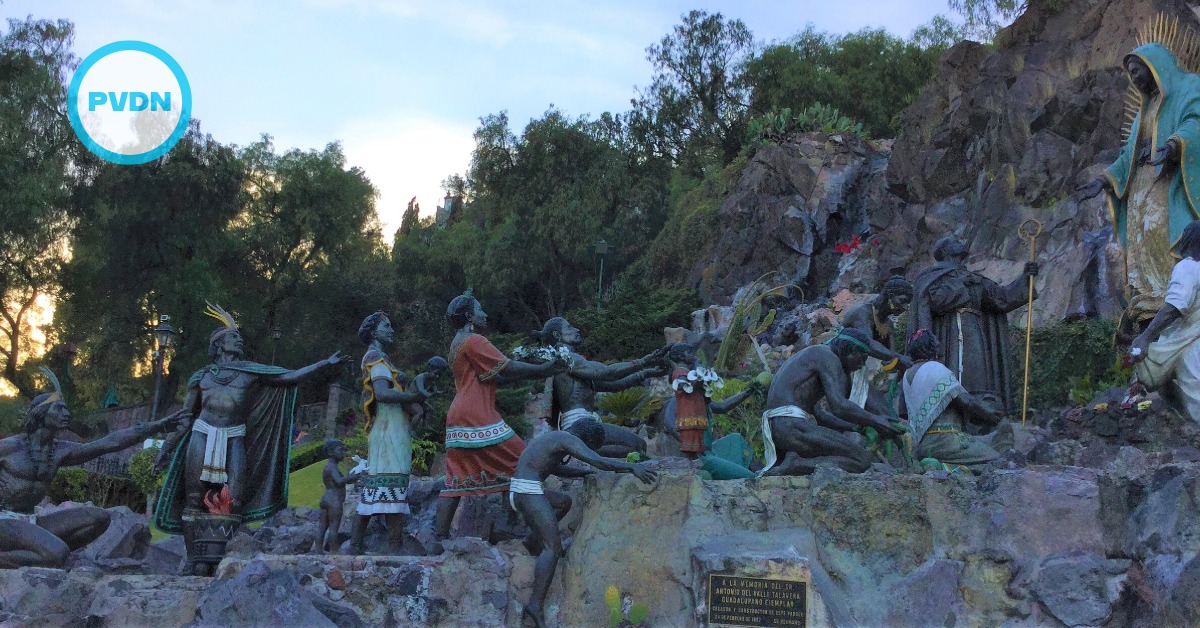
Just after the Spanish conquest, the Valley of Mexico was a place of grief and upheaval. According to Catholic tradition, it was there, on a small hill called Tepeyac, that an Indigenous convert named Juan Diego said he heard birdsong and a woman’s voice at dawn on December 9, 1531.
The woman identified herself as Mary, the mother of Jesus, and asked for a church to be built on that hill. Juan Diego carried the message to the first bishop of Mexico City, Juan de Zumárraga. The bishop listened, but he did not agree. He wanted proof.
Over the next days, tradition says, the apparitions continued. The young Church in New Spain was still fragile. Many Indigenous people were wary of the new faith. The idea that Mary spoke in Nahuatl to a poor widower, on his way to catechism, carried a powerful message about who mattered in this new world.
The date at the center of today’s feast comes with the fourth apparition. At dawn on Tuesday, December 12, 1531, Juan Diego set out to find a priest for his dying uncle. He tried to avoid the hill, worried the Lady would delay him. She intercepted him anyway, reassured him that his uncle was already healed, and repeated her request for a shrine.
She then told him to climb Tepeyac and gather flowers. It was winter, yet he found roses in bloom. He wrapped them in his maguey-fiber cloak, or tilma, and walked back to the bishop’s residence. When he opened the cloak, the story goes, the roses fell to the floor and an image of the Virgin appeared on the fabric. That moment, tied to that specific Tuesday, is why the Church later fixed Our Lady of Guadalupe Day on December 12.
In the years that followed, the tale was written down in Nahuatl in a text known as the Nican Mopohua. Church investigations in the seventeenth and eighteenth centuries examined the devotion, the story and the image. In 1754, Rome granted a proper Mass and feast in honor of Our Lady of Guadalupe, set for December 12, the date associated with the final apparition and the unveiling of the tilma.
Pilgrims on December 12
The little chapel that went up on Tepeyac after the apparitions has long since grown into the vast Basilica of Our Lady of Guadalupe. It is now one of the most visited Catholic shrines in the world. In a typical year, tens of millions of pilgrims pass through the complex, and around nine to twelve million arrive in the days surrounding December 12 alone.
The journeys begin weeks before the feast. Pilgrims approach the basilica on foot, by bike and in caravans of buses and pickup trucks. Many carry large framed images of the Virgin. Others bring small home altars, photographs of family members or handwritten notes of thanks. Some arrive barefoot or on their knees, offering the pain as a sign of gratitude for a favor they believe they received.
Inside, an electric walkway passes beneath the tilma, now protected behind glass. People crane their necks for a few seconds of eye contact with the image. Outside, dancers in feathered headdresses keep up a constant beat. Mariachi groups and parish choirs take turns singing “Las mañanitas” to the Virgin at midnight, a birthday song that, on this night, doubles as a national lullaby.
The feast is not limited to Mexico City. Every parish in the country marks December 12 with Masses, processions and neighborhood altars. Many Mexican and Mexican-American communities abroad follow the same pattern, starting with novenas and ending with a late-night serenade. Children often dress as Juan Diego or in regional Indigenous clothing, stand for a photograph next to a small shrine, and receive a blessing from the priest.
Behind all these customs lies something deeper than a single miracle story. For many Catholics, the image on the tilma shows a brown-skinned young woman who stands between worlds: clothed like a Spanish Madonna, yet surrounded by symbols that Indigenous viewers recognize. That mix has helped make the Virgin of Guadalupe a national symbol as much as a religious one. She appears on protest banners, murals, taxi dashboards and market stalls.
On Our Lady of Guadalupe Day, that symbolism comes into sharp focus. For some, December 12 is a day to ask for work, health or protection on a dangerous migration route. For others, it is a way to stay connected to parents and grandparents who taught them to pray in front of a modest home altar. The basilica and thousands of local churches become spaces where faith, history and everyday worries meet.
The official calendar has shifted around her over the centuries. A papal decision in the eighteenth century fixed the feast on December 12. A nineteenth-century Mexican Congress declared the date a national holiday, even though it is not currently a paid federal day off. Yet the country has never needed a law to fill the roads to Tepeyac. The promise attached to that Tuesday in 1531, that a mother would listen to the cries of her children in this land, is enough to keep people walking.