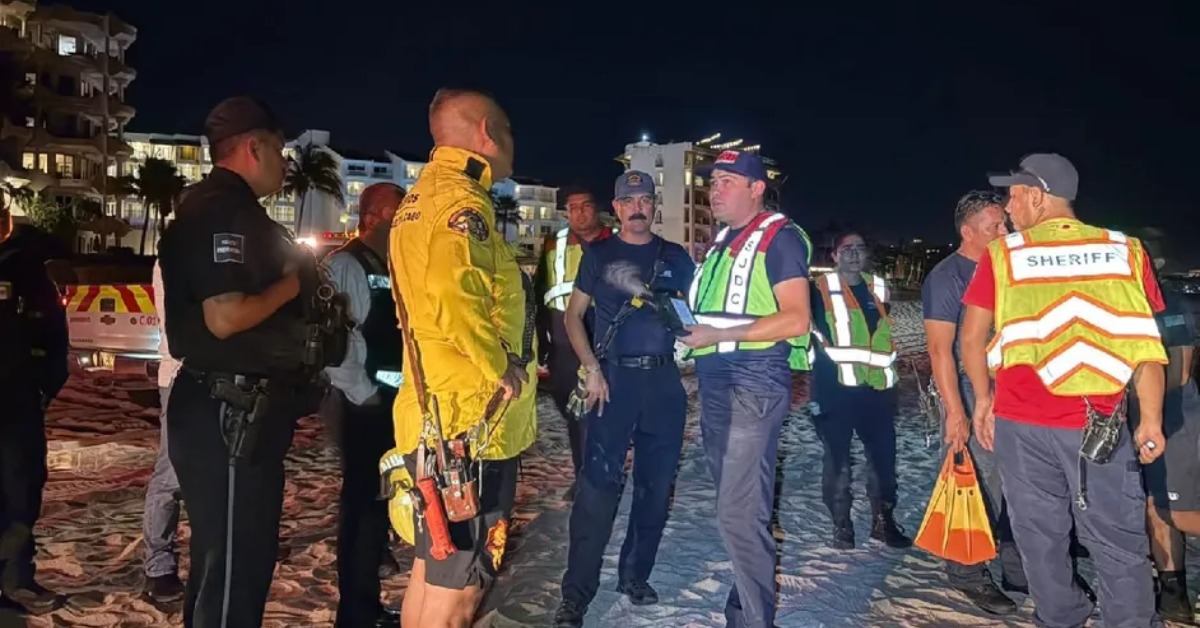
A small boat overturned off Costa Azul on Monday evening near the Kristal Grand area in San José del Cabo, prompting a broad emergency response along the coast. Authorities received the call for help at 7:47 p.m. Rescue crews responded after reports that two people were in the water when the vessel went over.
One of those occupants, identified only as a foreign national, was rescued alive at the scene. Emergency personnel treated the person on site, and Cruz Roja later transferred the patient for medical evaluation. Authorities did not release further details about nationality, age, or condition. In the first hours after the accident, responders also worked under the assumption that a second person was missing, which expanded the operation on land and at sea.
The search widened before authorities got better news
For a time, the case looked more serious. Authorities searched coastal waters and nearby shoreline areas while asking the public to report any floating debris, life jackets, or signs of distress. The response brought together Bomberos de San José del Cabo, Protección Civil, Seguridad Pública, ZOFEMAT, and the Secretaría de Marina, showing how quickly a local marine emergency can turn into a multi-agency effort.
Later, officials confirmed that the second occupant had left the water without rescue and was already at home. That update changed the incident’s final outcome, but it did not eliminate the risks involved. For several hours, the possibility of a missing person kept rescue teams on alert and added urgency to a situation that began with a capsized boat close to shore.
Why this story matters beyond one isolated incident
For readers new to Los Cabos, this was not just a one-off mishap. The case fits into a broader safety picture that local authorities have been emphasizing for weeks. Earlier this month, municipal officials warned of mar de fondo conditions, with waves expected to reach 2 to 2.5 meters and with strong pull in the water. Those warnings were directed mainly at beach users, but the same sea state can also create dangerous conditions near the coast for smaller craft and anyone entering the water.
Officials have also said recent rescue calls in the area have often been tied to people underestimating the ocean. That matters in Costa Azul, Palmilla, El Tule, and other exposed stretches of the Tourist Corridor, where conditions can change quickly. Water that looks manageable from the beach can become difficult in minutes once waves, wind, and current begin working together.
A tourist destination with real coastal risk
That tension is one of the defining facts of Los Cabos. The coastline is central to the local economy, daily life, and visitor experience. It is also a place where rescue crews are regularly called out for incidents involving swimmers, divers, and now small vessels. For foreign residents and travelers, that can be easy to miss. Many people arrive with the idea of calm vacation water, then encounter surf, undertow, and changing coastal conditions that demand more caution than expected.
This latest case also shows how quickly an emergency can develop, even when the final outcome is not fatal. A boat overturns. One person is rescued. Another is unaccounted for. Multiple agencies respond. Public calls go out for help. Even when everyone is eventually located, the margin between a rescue and a tragedy can be narrow. That is why local authorities continue to stress flag warnings, official instructions, and attention to sea conditions rather than relying on appearances.
What authorities have not yet said
At this stage, officials have not publicly explained why the boat capsized. There has been no detailed statement on the weather at the exact moment of the accident, the condition of the vessel, whether life jackets were being used, or whether the boat was operating recreationally or for another purpose. Those unanswered questions matter because they determine whether this was mainly a sea-condition incident, an equipment problem, or a mix of factors.
Until more details are released, the most solid facts remain limited but important. The capsize happened off Costa Azul on Monday night. One foreign national was rescued and taken for medical attention. A second occupant was initially treated as missing, then later confirmed safe after reaching land without rescue. The event is now part of a broader pattern of coastal safety pressure in Los Cabos, where authorities have already been warning residents and visitors to exercise greater caution in the sea.
The takeaway for residents and visitors
The strongest lesson from this case is not dramatic but practical. In Los Cabos, the sea can become hazardous even during routine leisure activities. A warning flag on the beach is not background scenery. A rough-water advisory is not just a notice for surfers. And a short outing near shore can still become an emergency if conditions shift or a vessel loses stability.
This incident ended far better than it first appeared. No deaths were confirmed. The missing-person phase of the search was closed. But the fact that it happened at all, and that it required such a large response, is enough to keep coastal safety in focus. In a destination built around the water, rescue stories like this are not only local incidents. They are reminders of how quickly the ocean can take control.