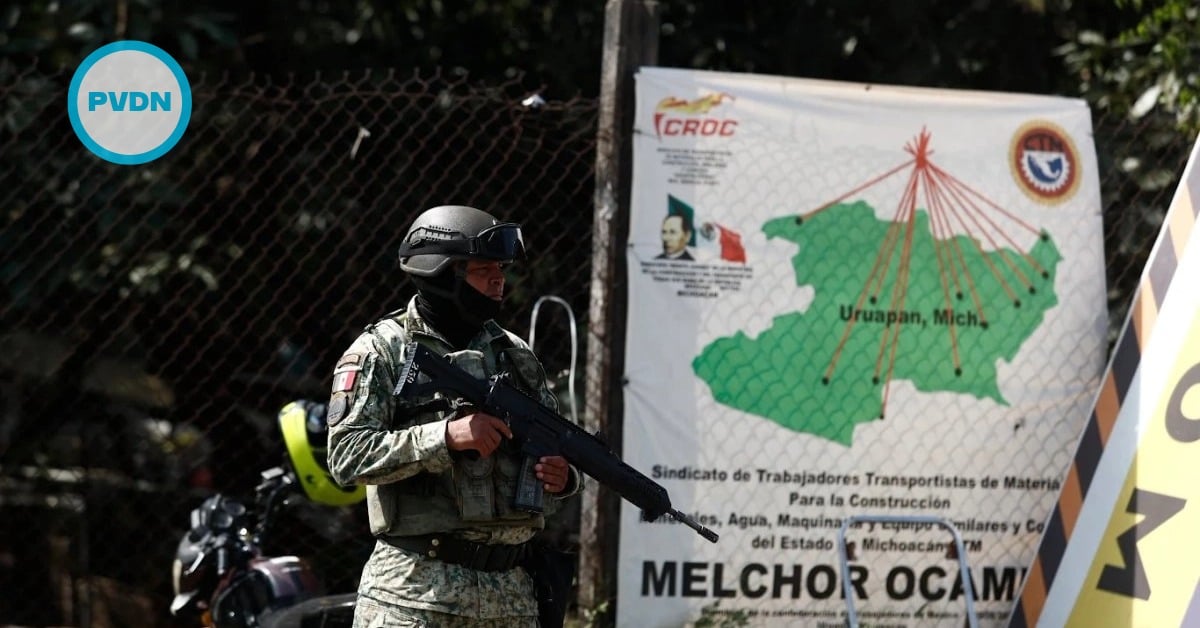
The latest deployment under the Plan Michoacan por la Paz y la Justicia brought together the Army, National Guard, Navy, federal prosecutors, and state police in coordinated raids across the state. According to federal security reports, the most significant find came in Playa La Soledad, in the coastal municipality of Lázaro Cárdenas, where soldiers located a concentration site for methamphetamine precursors. There, they seized nine 200-liter containers and more than two metric tons of chemical substances, along with ammunition and a vehicle. Authorities estimate the blow to cartel production capacity at more than 232 million pesos.
Beyond the chemical warehouse, security forces detained seven people and confiscated weapons, drugs, vehicles, and improvised explosive devices in several municipalities. In Pátzcuaro, troops dismantled two camps believed to be used by armed groups and secured multiple vehicles, long guns, dozens of magazines, hundreds of cartridges, and tactical gear. Additional patrols in towns such as Jiquilpan led to the seizure of more explosive devices and doses of crystal meth. At the same time, federal and state units reinforced highway checkpoints and carried out so-called “proximity” patrols meant to keep daily life running despite the tension.
These operations are part of a broader federal push launched this month after a string of high-impact crimes. The Plan Michoacan por la Paz y la Justicia was announced by President Claudia Sheinbaum as a long-term strategy that combines security deployment with promised social spending and infrastructure investment. Federal authorities have spoken of more than ten thousand security personnel assigned to the plan and tens of billions of pesos earmarked for the state, arguing that the mix of force and development is needed in a region where criminal groups have long profited from extortion, drug production, and control of local economies.
The recent actions also overlap with an earlier phase of the plan, when federal security officials reported 12 arrests between 14 and 16 November and the seizure of weapons, explosives, vehicles, and properties in at least ten municipalities. Together, these operations sketch a picture of sustained pressure on armed groups, not only on their gunmen but on the logistics that support them, from safe houses and storage sites to the vehicles and explosives used to control territory.
At the center of this week’s flare-up is Ángel Chávez Ponce, known as “El Camaleón,” identified by authorities as a regional leader of the Cártel Jalisco Nueva Generación. Security forces were attempting to capture him when they came under fire near the community of La Cantera, in the municipality of Salvador Escalante. President Sheinbaum confirmed that Army personnel were attacked during that operation and described the incident as a direct assault on federal troops. The clash left two presumed assailants dead, while the target, a priority for federal and state authorities, remains at large.
Highway blockades and daily life
The attack on the military convoy triggered a rapid and coordinated reaction by the criminal group. Armed cells hijacked and burned vehicles on federal and state roads, throwing the region into chaos. State authorities documented at least 15 vehicles — including cargo trucks, buses, and private cars — set on fire and used as barricades in more than a dozen municipalities. Among the affected areas were Pátzcuaro, Zamora, La Piedad, Morelia, Tzintzuntzan, Quiroga, Huaniqueo, Ecuandureo, Vista Hermosa, Ixtlán, Sahuayo, Chavinda, Chilchota, and Tangamandapio, as well as neighboring zones near the border with Guanajuato.
For several hours, key corridors that link Michoacan with other parts of the country were partially paralyzed. Images shared by authorities and local residents showed long lines of stranded motorists, burned-out shells of trucks across the asphalt, and armored vehicles moving in to secure the area. The blockades were not only a show of force but a tactical move: security officials say the intention was to slow down or divert reinforcements while the group tried to secure the escape of its regional leader.
Security forces eventually moved in to clear the roads. Federal and state authorities reported that all blockades had been removed and traffic restored, while patrols by the Army, National Guard and state police continued along the affected stretches. Aerial support and anti-drone equipment were deployed as part of the ongoing operation in Salvador Escalante and surrounding municipalities, reflecting the level of concern about the group’s capacity to respond to government actions.
The unrest comes on the heels of other crimes that shook the state and prompted the federal plan. On 1 November, Uruapan mayor Carlos Manzo was assassinated during a public event, a killing that underscored the dangers faced by local officials in regions where criminal groups seek influence over municipal governments. In Apatzingán, the murder of citrus growers’ leader Bernardo Bravo earlier this year highlighted how extortion and violence reach deep into legal agricultural industries that depend on exports and domestic markets alike.
Together, these cases explain why Michoacan remains a central focus of national security policy. The seizure of chemicals worth hundreds of millions of pesos, along with weapons, explosives, and vehicles, strikes at the financial and operational base of one of the country’s most aggressive cartels. Yet the swift wave of blockades and arson in response shows that the group retains the ability to disrupt daily life across an entire region with little warning.
For now, the Plan Michoacan por la Paz y la Justicia is still in its early weeks. Officials point to the latest raids, arrests, and seizures as proof that the strategy is producing results and insist that the state will not cede territory back to organized crime. Residents, meanwhile, are watching whether this combination of large-scale operations and promised investment can translate into fewer shootings on their roads, less extortion in their towns, and a sense that the violence will not simply return once the convoys move on. The 232-million-peso blow is real and measurable; whether it marks a turning point for Michoacan will only become clear with time and sustained attention.