A beachfront closure in Playa del Carmen has drawn new attention to a problem that has been building for years. Authorities restricted access in front of the It Beach Combo building after erosion left the sea reaching the base of the structure. The building itself remains open, but officials say the beachfront area needs a safety review. The case raises a larger question for coastal communities across Quintana Roo: what happens when the beach disappears faster than the city can respond?
Beach access restricted after erosion reaches building base
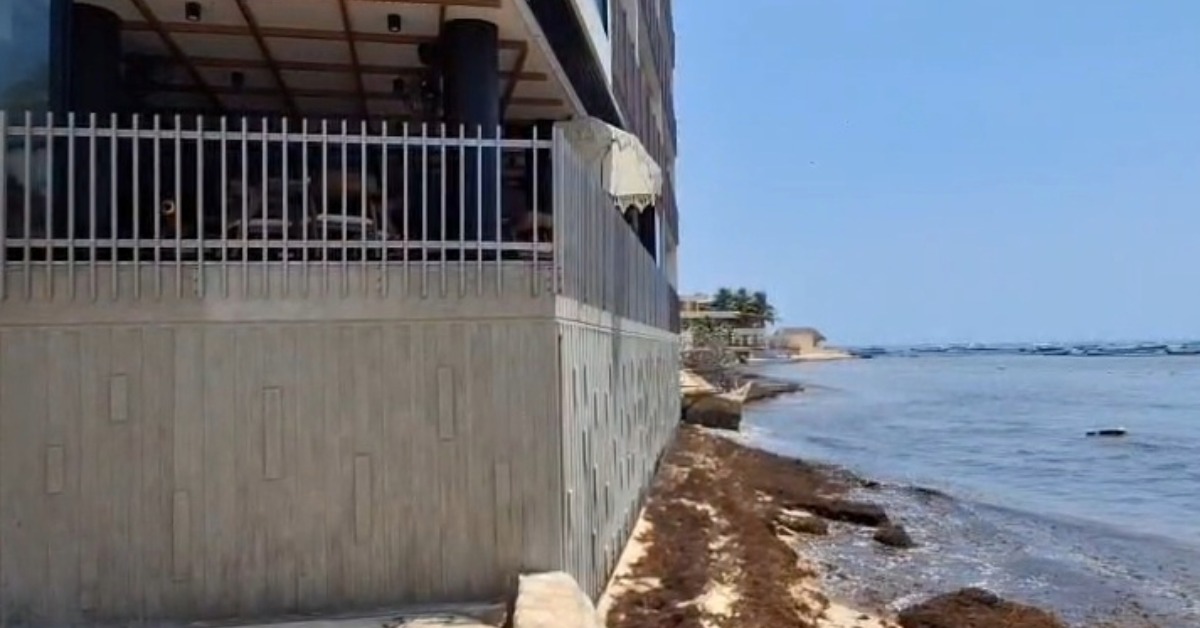
Civil Protection in Playa del Carmen restricted access to the beach area in front of the It Beach Combo building after erosion left waves hitting the base of the structure.
The building is located near Avenida Albatros and CTM, in a coastal area where the strip of sand has narrowed sharply. Authorities said the closure applies only to the beachfront area, not to the building itself.
The restriction followed a small collapse in the front beach zone. Pieces of the block were visible in the closed-off area, but officials did not report a full structural failure of the building.
The immediate concern is public safety. When waves begin reaching the base of a structure, the risk is no longer only about beach loss. The question becomes whether the land and foundation area can continue to support the structure over time.
Officials say the building was not closed
Darwin Covarrubias Góngora, secretary of Civil Protection, Risk Prevention, and Firefighters for Playa del Carmen, said the building itself was not shut down. The action taken by authorities was limited to the beach area in front of the property.
That distinction matters for residents, visitors, and nearby businesses. A beachfront closure does not always mean a building has been declared unsafe. It means authorities are restricting public access while they review the risk.
Covarrubias said the city will seek support from specialists and professional associations to conduct a structural assessment. The goal is not only to assess the current condition but also to understand how the situation could develop if erosion continues.
He also said the question of demolition is not for Civil Protection to decide at this stage. That decision would depend on technical findings, permits, legal authority, and the condition of the property.
A local closure tied to a larger coastal problem
The case is not isolated. Beach erosion has become one of the most visible coastal problems in Playa del Carmen and other parts of Quintana Roo.
In simple terms, erosion happens when the sea removes more sand than natural systems can replace. Beaches are not fixed surfaces. They move with waves, wind, tides, storms, and seasonal changes. The problem becomes serious when that movement reaches buildings, walkways, roads, or public access areas.
In Playa del Carmen, erosion is often driven by multiple pressures at once. Strong currents and storms can quickly remove sand. Reef damage can reduce the natural protection that softens wave energy. Coastal construction can disrupt how sand moves along the shore.
Development on or near the coastal dune can also make the beach more vulnerable. Dunes work as natural buffers. They store sand and help protect the land behind them. When dunes are removed, flattened, or built over, the shoreline has less room to adjust.
That is why erosion can appear as a sudden emergency, even when the underlying problem has developed over the years.
Public beaches can become harder to use
Mexico’s beaches are public, but public use depends on safe and passable access.
The Zona Federal Marítimo Terrestre, often called Zofemat, is generally understood as a 20-meter strip of firm, passable land next to the beach. In practice, erosion can make that strip difficult or impossible to use in some areas.
When the sand narrows to less than a meter in front of a building, beachgoers may be forced closer to waves, walls, or private structures. That creates safety concerns even before a building is formally declared at risk.
For people who live in Playa del Carmen, this is not only an environmental issue. It affects daily access to the beach, tourism activity, local businesses, and the destination’s appearance.
For visitors and foreign residents, the closure is also a reminder that not every beachfront area is safe just because it is open or reachable. Yellow tape, warning signs, and Civil Protection instructions should be treated seriously.
Recovery projects are complex and slow
Beach restoration is not as simple as bringing in more sand.
A serious recovery project usually requires technical studies, environmental review, and federal authorization. These studies can examine currents, underwater conditions, sand sources, dunes, reefs, public access, and potential effects on neighboring beaches.
In Mexico, major coastal work may require a Manifestación de Impacto Ambiental (MIA). This environmental impact process can take months, and sometimes longer, depending on the scope of the project and the information requested by federal authorities.
Quintana Roo has been preparing broader beach recovery plans for several coastal municipalities, including Playa del Carmen. State-level proposals have included work in Cancún, Puerto Morelos, Playa del Carmen, and Cozumel.
The challenge is that erosion does not wait for paperwork. A beach can continue shrinking while studies, permits, and budgets are still being prepared.
That gap between urgent local damage and slow technical review is one reason coastal erosion remains difficult to manage.
Reefs and dunes are part of the safety picture
The condition of reefs and dunes matters because they help reduce the force of the sea before it reaches the shore.
The Mesoamerican Reef runs along the Mexican Caribbean and helps reduce coastal flooding and wave impact in Quintana Roo. Healthy reefs can act as a natural barrier. When reefs weaken, more wave energy can reach the beach.
Dunes provide another layer of protection. They help absorb storm surge and store sand that can feed the beach after heavy wave action. When dunes are damaged or removed, the coast becomes more exposed.
This is why coastal protection cannot rely only on emergency closures or beach fill. Long-term safety depends on how the shoreline is managed, how close buildings are allowed to stand, and whether natural defenses are protected.
What comes next near It Beach Combo
The next step is the technical review.
Authorities are expected to assess whether the erosion has affected the safety of the beachfront area and whether the structure faces future risk if the sea continues reaching its base.
Until that review is completed, the restricted beach area should be treated as a safety zone. The closure may be temporary, but the conditions that caused it are part of a broader pattern along the coast.
For Playa del Carmen, the case adds another warning sign to a growing list. The city’s beaches remain central to its economy and identity, but several stretches are under pressure from erosion, development, and changing coastal conditions.
The immediate issue is a closed strip of beach in front of one building. The larger question is how much time Playa del Carmen has to protect the shoreline before more beachfront areas face the same problem.