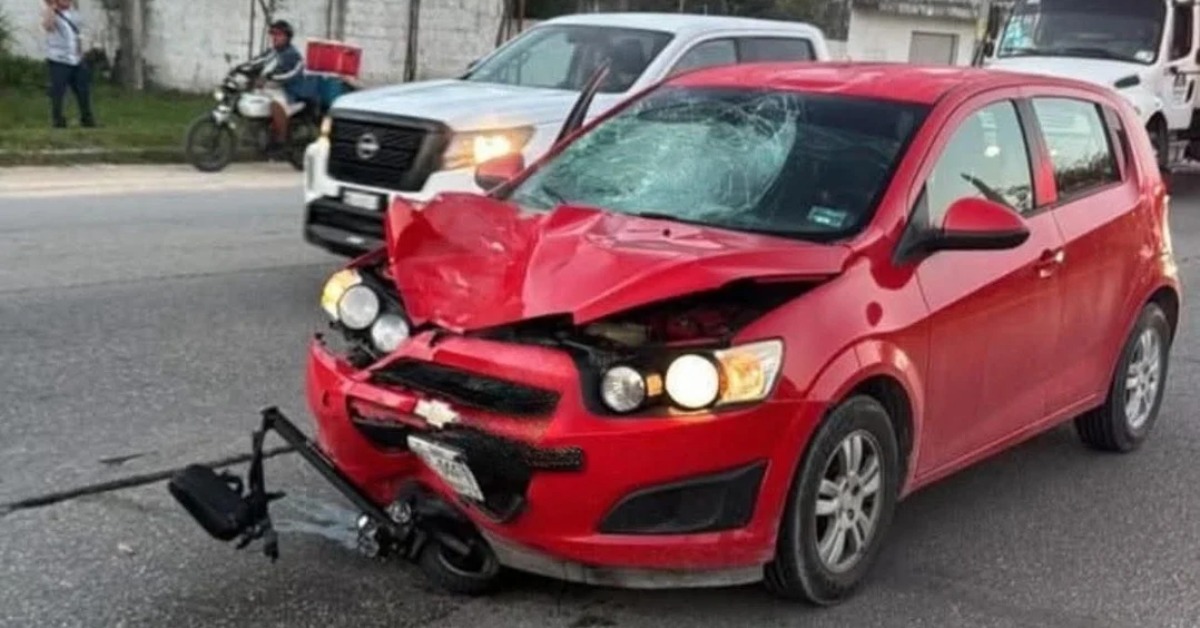
The death of a woman riding a scooter in Playa del Carmen on April 8 has reignited a debate that had been growing quietly for some time. According to reports from that day, the crash happened at Boulevard Playa del Carmen and Avenida Chemuyil, when the woman was struck by a Chevrolet Sonic while attempting to cross a fast-moving corridor. The immediate cause of the collision will remain a matter for authorities, but the public response has quickly moved beyond one case.
What followed was a sharper conversation about whether Playa del Carmen has kept pace with a form of transport that is already common in many urban areas. For some residents, scooters are not a novelty. They are part of the daily trip to work, school, shops, or the beach. That is why this story has resonated. It is about one death, but it also touches a bigger question about how a city handles a growing class of vulnerable road users.
Why riders say the rules still feel unclear
The complaint from scooter operators and users is not simply that riding can be dangerous. Their argument is that the rules feel incomplete at street level, especially when riders move between bike lanes, side streets, and large vehicle corridors. That matters in a city where rapid growth has increased pressure on roads, intersections, and mixed-use travel routes.
This is where the legal picture becomes more complicated than it first appears. At the state level, Quintana Roo already recognizes micromobility in its mobility law. The law defines micromobility vehicles as light personal vehicles, including electric options. State law also provides a framework for public micromobility rental services and requires permits for such operations. The state regulation goes even further by setting conditions for micromobility service vehicles, including lighting, braking requirements, and a system to prevent speeds above 30 kilometers per hour.
But that does not automatically answer the questions ordinary riders face every day in Playa del Carmen. Where should a privately used scooter travel when a bike lane ends? What is allowed on a fast corridor? What protective equipment should be required? What sanctions apply when rules are broken? In Mexico, those practical answers often lie at the intersection of state mobility law and municipal traffic enforcement, and that overlap is exactly where this case has exposed confusion.
The gap between state policy and municipal reality
The state’s mobility law requires municipalities to align their local rules with the broader legal framework and to issue their own Municipal Mobility Programs. In other words, the state has already laid down the principle that cities should update their rules to reflect newer forms of transport and safer street design.
A review of Playa del Carmen’s own online regulatory registry shows why some users say the local framework still feels outdated. The city’s registry points to a traffic regulation first published in 2006. The registry entry itself was updated in 2023, but the downloadable full text was unavailable during a review on Friday. That does not prove there are no local rules in force. It does show, however, that the public-facing rulebook is not easy to find or evaluate at a time when the city is dealing with new mobility patterns.
For foreign residents, this can be especially confusing. In many places outside Mexico, scooters are regulated through a clearly posted local code that spells out where they can travel, parking rules, helmet requirements, speed limits, and penalties. In Playa del Carmen, the law is easier to understand in theory than in everyday practice. That gap can leave both riders and drivers making assumptions on the road.
Infrastructure is part of the story too
The debate is not only about regulation. It is also about street design. Riders have argued that even where bike lanes exist, they do not always form a continuous and protected network. When lanes disappear, become obstructed, or fail to connect safely across major roads, users are pushed into riskier decisions.
That concern is not entirely abstract. Playa del Carmen has invested in cycling infrastructure in recent years. In 2023, city officials said they had built 3,350 meters of bike lanes on major avenues. In 2024, the city also reported work on a longer corridor project with lighting and lane continuity tied to the federal road area. Those projects show that active mobility is already part of local planning.
Still, isolated stretches of infrastructure do not solve the hardest problem. Safety depends on what happens between protected segments, at crossings, and on high-speed roads where a scooter rider has little margin for error. A city can build lanes and still leave users exposed if those lanes do not connect into a system that is easy to read and safe to use.
What this means for a fast-growing city
Playa del Carmen is not dealing with a niche issue. It deals with the consequences of growth, mixed transport, and uneven street design. Workers use low-cost transport because it is practical. Some residents use scooters to avoid congestion or reduce transport costs. Visitors and foreign residents also tend to adopt lightweight mobility faster when the city feels compact and short trips are common.
That makes this case larger than one operator’s complaint. The real issue is whether the city wants scooters to remain a loosely tolerated reality or become a mode of transport governed by clear public rules. If officials decide to act, the discussion will likely move toward lane access, speed controls, visible enforcement, rider obligations, crossing design, and how to separate small electric vehicles from roads built for much faster traffic.
The fatal crash on April 8 did not create Playa del Carmen’s scooter problem. It exposed it. The next step will determine whether the city treats that death as an isolated event or as a warning that mobility policy, enforcement, and infrastructure are no longer moving at the same speed.