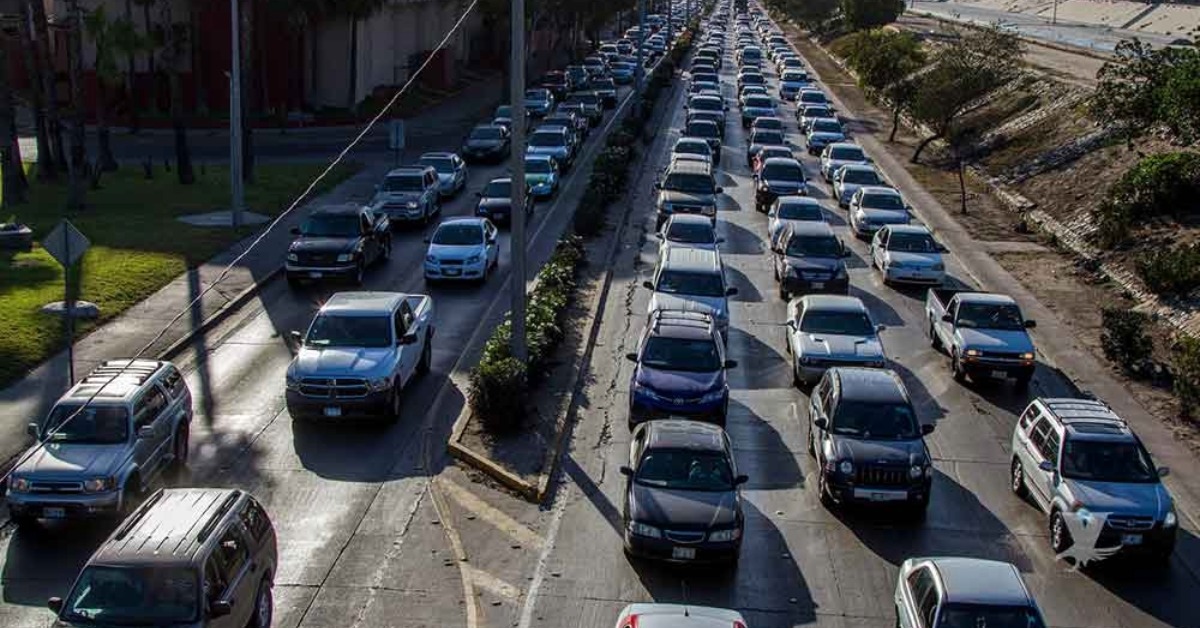
For years, Mexico City was treated as Mexico’s clearest example of urban congestion gone too far. That framing is getting harder to defend. In the 2025 TomTom Traffic Index, Mexico City remained the country’s worst case, with 75.9% congestion and 184 hours lost during rush hour over the year. But the national ranking also showed that the problem is spreading well beyond the capital. Tijuana ranked fourth in Mexico, León fifth, and Puebla seventh. These are not fringe cases. They are growing urban centers that increasingly look like earlier versions of the capital’s mobility problem.
That matters because these cities have often been seen as easier places to live, work, and invest than Mexico City. They are still smaller and less dense than the capital. Yet their daily travel patterns are starting to show the same structural weaknesses. Long commutes, overloaded corridors, and peripheral growth are putting more pressure on roads that were not built for this level of demand. The issue is visible in traffic, but the roots go deeper. What looks like a driving problem is often a planning problem that has been building for years.
Why León, Puebla and Tijuana are getting stuck
The common thread is not simply that these cities added more residents. It is that they expanded in ways that separated housing, jobs, and services. New industrial investment and residential construction arrived faster than public transport systems could adapt. As cities spread outward, many residents ended up living farther from work, school, and shopping. That makes the car, taxi, or motorcycle feel less optional and more necessary.
This is why the congestion story in these cities is not identical, but still related. Tijuana combines border-region growth, industrial activity, and long daily movement across a wide urban footprint. León has grown as a major economic center in the Bajío while continuing to stretch outward. Puebla faces pressure from metropolitan expansion and increasingly long urban trips. In each case, growth created opportunities, but it also increased the distance between daily needs. Once that pattern takes hold, road space fills quickly. Even when governments widen avenues or add overpasses, the relief is often temporary because the underlying travel demand remains.
Housing pressure helps explain the traffic
The traffic story is also a housing story. In fast-growing cities, rising demand for homes often pushes people toward the urban edge, where land is cheaper but commutes are longer. That tradeoff can look manageable at first. Over time, it becomes part of the congestion cycle. The farther a household is from work and services, the more likely daily life depends on private transport or long, multi-leg trips.
That pattern is visible in recent housing data. The Sociedad Hipotecaria Federal reported that in 2025, home prices in Tijuana rose 10.6% and in León 10.1%, both above the national average of 8.7%. Puebla-Tlaxcala matched that national pace at 8.7%. Those numbers do not prove that higher prices alone cause traffic. They do show that these metros are under the same market pressure that often pushes growth outward. When the city expands faster than coordinated transport planning, new housing can add distance before it adds connectivity. Residents then absorb the cost in time, fuel, stress, and lost flexibility.
More lanes do not solve a city built around distance
A familiar official response is to build more road capacity. That can ease a choke point for a while, but it rarely changes the broader pattern. Mobility specialists often describe this as induced demand. When authorities make driving easier in the short term, more people drive, more trips shift to cars, and the new capacity fills up. The city ends up back where it started, only larger.
Mexico already has examples that point in another direction. León has long had a bus rapid transit model. Ecatepec connects to a larger regional transit network through Mexibús. Mexico City, despite remaining deeply congested, has spent years building a more integrated system of metro, bus, and other modes. The lesson is not that transit alone fixes everything. It is that road building without land-use discipline usually fails. A city cannot solve long distances with asphalt alone. It has to shorten, connect, or better serve those trips.
Why this matters beyond commuters
This story is bigger than an inconvenience. Congestion affects air quality, household budgets, and access to opportunity. It can also reshape how cities function. Workers spend more time getting to jobs. Families pay more to move across town. Emergency response can slow. Businesses face less predictable logistics. Secondary cities that market themselves as efficient alternatives can lose part of that advantage if their mobility systems do not keep pace with growth.
There is also a public health angle. The World Health Organization says the combined effects of outdoor and household air pollution are linked to 6.7 million premature deaths worldwide each year. At the same time, road safety remains a major problem in Mexico. International road safety data cited by UN agencies continues to put annual road deaths in Mexico in the 15,000 to 16,000 range. Heavy congestion does not automatically mean more deaths, but car-dependent growth increases exposure to polluted air, risky crossings, and longer time on the road. That raises the stakes well beyond the daily complaint about traffic.
The bigger test is whether cities plan before they build
Mexico is not starting from zero. The country’s General Law on Mobility and Road Safety, enacted in 2022, establishes a national framework defining mobility as a matter of safety, accessibility, efficiency, sustainability, and inclusion. The harder part is putting those principles into local decisions about permits, housing, industrial expansion, and transit funding. That is where many cities still fall short.
The real test for León, Puebla, Tijuana, and other fast-growing cities is whether mobility planning happens before the next wave of development, not after roads are already overloaded. Readers should watch for three things. First, where new housing is approved. Second, whether large industrial or commercial projects come with serious transport access plans. Third, whether local governments invest in systems that move more people, not just more vehicles. Mexico City’s traffic crisis did not develop in a year. The warning from these rising cities is that the same pattern can be repeated much faster now.
Deep Dive:
Mexico City traffic congestion now worst in the world
Monterrey experts say reversible lanes won’t solve long-term traffic
Cancun urban plan shakeup finally aims to rein in sprawl