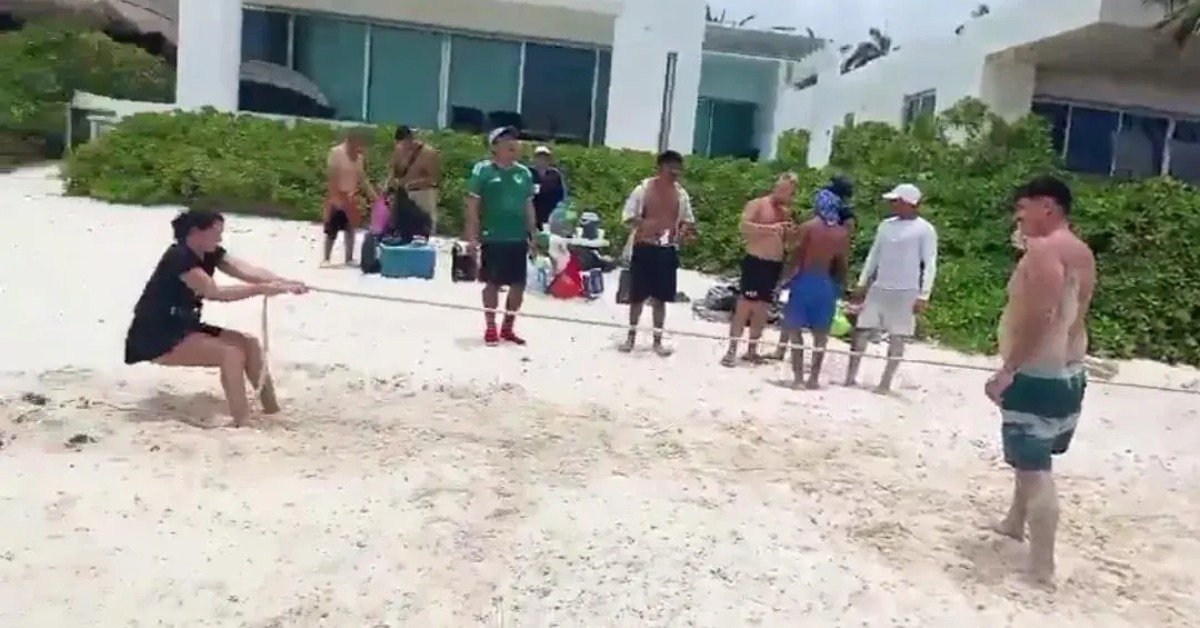
A viral confrontation in Playacar turned into something quieter but more pointed on Sunday. People brought food and games to a stretch of coast after a foreign woman allegedly tried to remove Mexican beachgoers from sand near a beachfront home. The episode now sits at the center of two tensions in Playa del Carmen. One is legal, because Mexico’s beaches are public. The other is local, because public access can still become contested where private property reaches the shore.
A picnic on the sand and a legal line
A beach-access dispute in Playacar drew a peaceful picnic-style protest, a municipal police presence, and renewed attention to the hard line Mexican law draws between private property and the shore.
The gathering followed the circulation of a video in which a foreign woman allegedly tried to remove Mexican beachgoers from the sand in front of a coastal property. Images and local accounts from Sunday showed people arriving with food, drinks, and games near the property, with police present nearby and no intervention reported.
The scene was small, informal, and loaded. Playacar is one of Playa del Carmen’s best-known gated coastal areas, where homes and hotels sit close to a narrowing shoreline. The dispute did not begin as a court filing or a municipal enforcement action. It began as a viral confrontation over who could stand on the beach.
Mayor Estefanía Mercado responded by saying the city’s beaches are public. In remarks quoted by local media, she said, “The beaches belong to the people.” She also urged people not to turn the dispute into street justice and said authorities need a formal complaint to pursue a legal investigation.
The woman seen in the video has not been publicly identified by municipal authorities. There was no official report of an arrest or sanction tied to the confrontation by Sunday night.
What Mexican beach law says
Under Mexico’s 2020 beach-access reform, access to maritime beaches and the adjacent federal maritime terrestrial zone cannot be blocked, restricted, obstructed, or conditioned except in cases allowed by regulation. The same reform says owners of land beside the federal coastal zone must allow access when no public road or public entry point exists, through routes agreed with federal environmental authorities.
The federal coastal strip is known as ZOFEMAT. Profepa’s ZOFEMAT glossary describes it as a public-domain asset that forms part of Mexico’s national patrimony. The exact boundary is technical, but the principle behind the Playacar argument is simpler. A beachfront address does not make the beach private.
The law also includes penalties. Owners, concession holders, or permit holders who block or condition access to beaches or ZOFEMAT can face fines. Concession holders can lose their concession for repeat violations, according to the 2020 reform.
Access on paper and access on the coast
The Playacar case sits in a longer-running coastal argument in Quintana Roo. Public beach access can exist on paper, while gates, hotels, erosion, security guards, and narrow strips of sand make the beach harder to reach or use.
Playa del Carmen has been dealing with that second pressure as well. Vallarta Daily recently reported that beach erosion forced authorities to restrict shore access near the It Beach Combo building after waves reached the structure’s base. That case involved safety, not a private-property claim, but it showed how quickly public beach use can become fragile when the coast narrows.
Municipal beach rules also place obligations on beach users. Playa del Carmen’s beach regulations prohibit littering, bonfires, smoking or nicotine use, Styrofoam, disturbing wildlife, and entering restricted areas. Those rules do not privatize the shore. They set conditions for public use.
That distinction is now central to the Playacar dispute. The picnic-style protest was framed by participants as a defense of public beach access. The mayor’s response put a second limit on the same conflict. Beach access is protected by law, but enforcement still runs through complaints, authorities, and due process.
Local accounts differed on the size and timing of Sunday’s turnout. Some described dozens of people gathering with food and games, while another account said the planned 9 a.m. callout had not drawn a crowd at the house and noted police presence in the area. What was clear by the end of the day was that the video had pushed another beach-access fight into public view in Playa del Carmen.