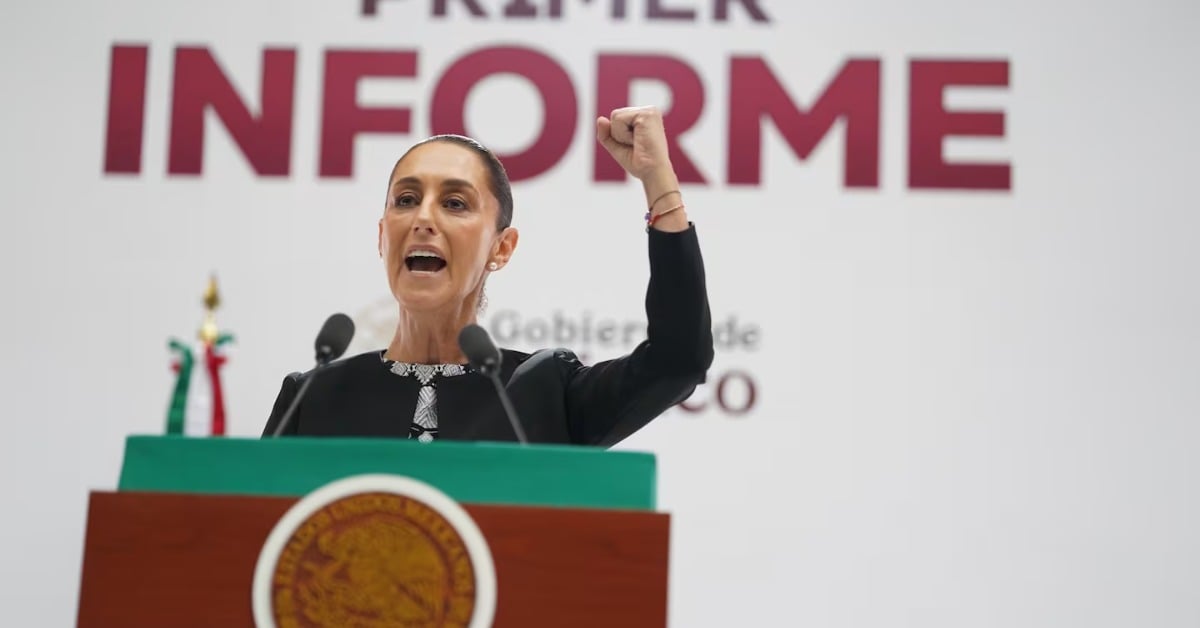
President Sheinbaum delivered her first state-of-government address from the National Palace with a simple message: “We’re doing well, and we’ll do better.” This President Sheinbaum report highlighted a decline in homicides, inflation back near target, and a sharp fall in poverty since 2018. She also touted a new judiciary elected by popular vote and urged business to back “Plan México.” We verified the most critical claims—from crime and jobs to inflation and foreign investment—and outlined what holds up, what needs context, and what to watch next in 2025.
Claudia Sheinbaum report
President Claudia Sheinbaum used her first Informe to argue that the country is on a firmer footing, citing progress in poverty reduction, public safety, and economic growth. The speech, delivered at the National Palace, lasted approximately an hour and drew frequent applause from a guest list that was heavily weighted with cabinet officials, governors, diplomats, and business leaders. This Claudia Sheinbaum report underscores her vision for Mexico’s future. The President Sheinbaum report is essential reading to understand her approach.
She framed her government as the continuation of the “Fourth Transformation,” stressing social programs, public investment, and macro stability. The message also carried a political edge: she said recent constitutional changes mark a new phase for Mexico’s institutions and vowed to press ahead.
Security claims under scrutiny
Sheinbaum said intentional homicides fell 25% over 11 months, with significant drops in Zacatecas, Guanajuato, the State of Mexico, Nuevo León, Baja California, Tabasco, and Colima. National government data do show a sustained decline in monthly homicide victims through mid-2025 versus late 2024, though the size of any reduction depends on the baseline and whether you use rolling averages. Year-to-date comparisons compiled from federal figures indicate improvement, but not uniformly across states. Treat the 25% figure as a political claim pending final 2025 totals. This data is an essential part of any Claudia Sheinbaum report, as well as the broader President Sheinbaum report.
Judicial overhaul takes effect
A sweeping judicial reform, approved earlier this year, began today. The judiciary is now elected by popular vote, a first in modern Mexico, with the new system rolling out nationwide. Legal scholars and rights groups warn about risks to independence, while the government argues it restores public trust. Separately, 881 new judges took office to help shrink case backlogs. This is one of the most consequential changes of Sheinbaum’s term so far.
Economy by the numbers
On prices, INEGI’s latest reading puts annual inflation at about 3.5% in July, within Banxico’s target range. The jobless rate hovered near 2.7–2.8% in July’s labor survey. Both are consistent with the president’s remarks in her Claudia Sheinbaum report, firmly encapsulated in the President Sheinbaum report narrative.
The peso started September below 19 per dollar; Banxico’s FIX for today closed around 18.64, in line with market prints. That supports her “sub-19” framing.
Regarding investment, Sheinbaum noted that the first-half foreign direct investment reached a record of over $ 36 billion. The Economy Ministry’s preliminary figure published in August was 34.3 billion; the difference likely reflects subsequent updates or rounding in the president’s figure, but the direction—strong FDI—checks out.
Growth remains modest. Banxico last week nudged its 2025 GDP outlook higher but still around one percent, underscoring a softer macro backdrop than in 2023–24.
Poverty drop and an inequality claim
Sheinbaum attributed much of the social progress to a decline in poverty since 2018. The 2024 poverty measure, now published by INEGI, shows that 29.6% of people are in poverty, compared to 41.9% in 2018—approximately 13.4 million fewer people, which aligns with what she cited. That’s a significant change and consistent with recent independent summaries.
She also stated that Mexico now has the second-lowest inequality in the Americas, after Canada. Cross-country inequality rankings vary by method and year; World Bank profiles show countries like Uruguay typically report lower inequality than Mexico. The bottom line: Mexico’s inequality has eased, but the “second-lowest” superlative needs careful methodological caveats included in any Claudia Sheinbaum report, and the President Sheinbaum report.
Plan México and U.S. ties
On industrial policy, Sheinbaum urged businesses to join Plan México—a long-horizon effort centered around development “poles,” the Interoceanic Corridor, and new industrial parks to capitalize on nearshoring. Government materials and same-day coverage confirm that five of 15 poles are active, eight sites along the corridor, and 18 of 100 planned parks are moving forward.
She also said she will meet U.S. Secretary of State Marco Rubio this week to frame security cooperation. Rubio is indeed serving as Secretary of State in the current U.S. administration, and the State Department listed Mexico City travel for early September. The encounter will test the government’s mantra of “cooperation without subordination,” especially amid debates on fentanyl and border enforcement.
Why it matters
Today’s address sets the political tone for Sheinbaum’s second year: a claim of momentum on security and social indicators, coupled with a bet that nearshoring and public works can sustain growth—the data on inflation, jobs, and the peso line up. The homicide claim looks directionally right but deserves end-of-year confirmation to complete the Claudia Sheinbaum report. The judicial remake will shape Mexico’s rule-of-law climate for years, and how it is applied will matter as much as the text of the reform within the President Sheinbaum report.